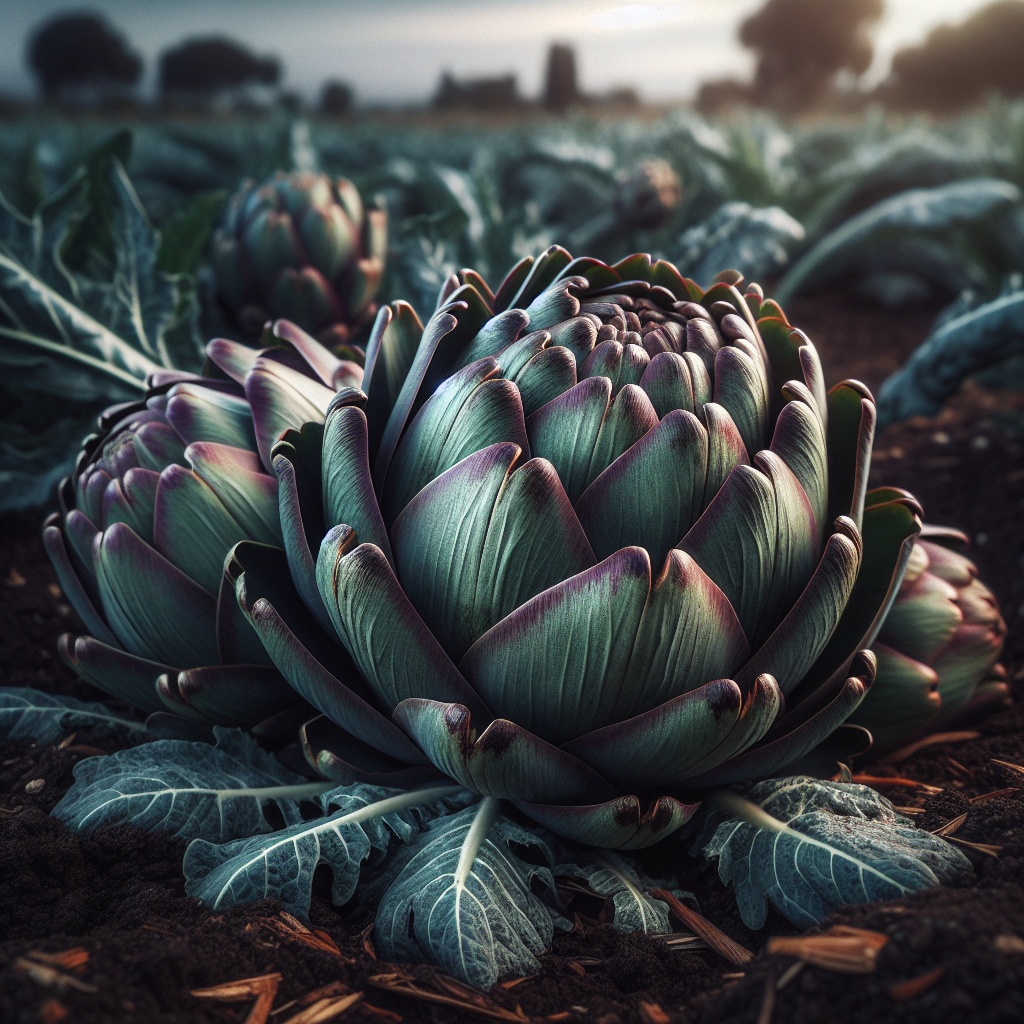
Introduction to Artichoke (Violetta)
Violetta is one of the distinguished purple artichoke types associated with Italian and Mediterranean horticulture, where artichokes have been selected for centuries for tenderness, color, earliness, and culinary quality. It belongs to the cultivated artichoke group derived from Cynara cardunculus, the same species complex that also includes cardoon. In the field, Violetta is recognized by its ornamental architecture: a bold rosette of deeply lobed, silver-green leaves and upright flower stalks carrying elongated to rounded purple-flushed buds.
What makes this type especially appealing to growers is the balance between market appeal and eating quality. The buds are often slightly smaller and more pointed than standard green globe types, with attractive violet bracts and a delicate, nutty flavor. For fresh market growers, chefs, and home gardeners, that color alone can command attention. If you are comparing production habits with larger green cultivars, a general Artichoke guide can help frame the species-level basics, but Violetta should be managed with an eye toward premium bud quality rather than sheer bud size.
Historically, purple artichokes were favored in regions with mild winters and long, cool springs, where plants could establish strong crowns and produce multiple flushes. In those conditions, Violetta can behave as a short-lived perennial, yielding for several seasons if crowns are protected and divided correctly. In colder regions, it is often grown as an annual from seed or as a vernalized transplant, though success depends heavily on matching planting time to temperature patterns.
This is not a crop for neglect. Violetta rewards growers who invest in deep fertility, precise irrigation, and careful timing. The difference between average and exceptional production is often invisible early on but dramatic at harvest: evenly sized purple buds with tight bracts, thick fleshy scales, and dense hearts come only from steady growth without drought shock or nitrogen starvation.
Botanical Profile of Artichoke (Violetta)
This cultivar is a thistle-forming perennial in the Asteraceae family. Like all globe artichokes, it is grown for immature flower buds harvested before the inflorescence opens. If left uncut, buds expand into large, striking purple-blue composite flowers that are highly attractive to pollinators but no longer suitable for culinary use.
Plants typically form a broad basal rosette before sending up stout flowering stems. Mature plants commonly reach 3 to 5 feet (0.9 to 1.5 m) tall and 4 to 6 feet (1.2 to 1.8 m) wide under fertile conditions. Leaves are long, arching, and deeply divided, often gray-green from a waxy surface that helps moderate water loss. Root systems are substantial and favor deeply loosened soil; the crop performs poorly in compacted ground because oxygen deprivation around the crown reduces vigor and increases rot risk.
Violetta-type buds are typically medium-sized, with noticeable purple coloration on the outer bracts, especially under cool nights and bright light. The edible portion includes the fleshy lower bracts and the receptacle, commonly called the heart. The choke, a mass of immature floral tissue in more developed buds, becomes more pronounced as buds age; harvesting at the correct stage is therefore central to quality.
Physiologically, artichoke productivity is strongly influenced by vernalization and photoperiod. Many cultivars require or respond strongly to a period of cool temperatures to initiate flower stalks. Violetta often performs best where plants receive enough cool weather to trigger bud formation but not so much hard freezing that the crown is injured. Excessive summer heat can cause buds to open prematurely, become fibrous, or lose tenderness.
From a crop-longevity standpoint, crowns can remain productive for 3 to 5 years in favorable climates, though commercial yields often decline after the second or third year unless fields are aggressively managed. Rejuvenation by division is common in traditional artichoke districts.
Soil, pH, and Climate Requirements for Artichoke (Violetta)
This crop demands deep, fertile, well-drained soil with high organic matter and consistent moisture-holding capacity. The ideal texture is a friable loam or sandy clay loam that drains freely after rain but does not dry excessively fast between irrigations. Avoid shallow soils, hardpans, or sites where water stands around the crown for more than 24 hours after heavy precipitation.
Optimal pH is 6.5 to 7.5. It will tolerate slightly alkaline soils better than many vegetables, but performance declines in strongly acidic ground below about pH 6.0, where nutrient availability and root growth become less favorable. Before planting, incorporate a large volume of finished compost or well-rotted manure into the top 12 to 18 inches (30 to 45 cm) of soil. Artichokes are gross feeders, and Violetta in particular produces best when the rooting zone is both nutrient-rich and physically loose.
A productive baseline soil target is:
- Organic matter above 4%
- Good calcium availability
- Moderate to high potassium
- Steady nitrogen release rather than one heavy dose
- Excellent drainage with no compaction at crown depth
Climate-wise, Violetta is best suited to Mediterranean and cool-temperate regions. Ideal daytime temperatures for vegetative growth are 60 to 75°F (16 to 24°C), with cooler nights around 45 to 55°F (7 to 13°C). Bud quality is best when the crop matures in cool to mild weather. Temperatures above 85°F (29°C) during bud development reduce tenderness and can trigger loose, opening buds. Hard freezes below about 20°F (-6°C) may damage crowns, especially in wet soil.
In humid climates, spacing, airflow, and irrigation discipline become more important because dense foliage traps moisture and encourages fungal problems. In arid climates, mulching and consistent drip irrigation are essential to prevent drought stress. Drought at any stage reduces bud size, but the most damaging window is during stem elongation and bud swelling, when moisture deficits cause small, tough, or misshapen heads.
For growers working to build that kind of deep, biologically active soil, see soil health strategies.
Step-by-Step Planting & Propagation
Start with the right propagation method for your climate. In mild winter regions, crown divisions or rooted offshoots are often the most reliable way to maintain true-to-type Violetta plants. In colder regions or where divisions are unavailable, seeds can be used, but seed-grown plants may show some variation and often require careful temperature management to induce budding in the first season.
For seed production, sow indoors 8 to 12 weeks before the last expected frost. Use deep cell trays or pots because seedlings produce a pronounced taproot-like central root system early. Maintain germination temperatures at 70 to 75°F (21 to 24°C). Seeds usually emerge in 10 to 21 days. Once seedlings develop 2 to 3 true leaves, grow them on in bright light at cooler temperatures around 60 to 65°F (16 to 18°C) to prevent weak, stretched growth.
To encourage first-year bud formation in annual culture, many growers expose established seedlings to cool conditions around 45 to 50°F (7 to 10°C) for 10 to 14 days after they are sturdy but before transplanting. This vernalization step can improve bud initiation, though results vary with seed strain and local weather.
For crown division, select healthy mother plants during dormancy or just before spring regrowth. Use a sharp spade or knife to separate offshoots with at least one strong bud and a good portion of roots attached. Discard soft, dark, or diseased crown tissue. Replant divisions immediately at the same depth they were previously growing.
Planting steps:
- Choose a full-sun site with at least 8 hours of direct light.
- Double-dig or loosen soil to 12 to 18 inches deep.
- Incorporate 2 to 4 inches of compost and, if needed, balanced organic fertilizer.
- Form raised rows or broad mounded beds where drainage is imperfect.
- Transplant after danger of severe frost has passed, while weather is still cool.
- Space plants 3 to 4 feet apart in rows 4 to 6 feet apart.
- Water deeply after planting to settle soil around roots.
- Mulch with straw, leaf mold, or composted bark once the soil warms slightly.
Do not bury the crown deeply. The transition zone where leaves emerge should sit at or just above finished soil grade. Planting too deep increases Crown rot risk; planting too shallow exposes roots and destabilizes the plant.
In containers, only very large vessels are suitable: a minimum of 20 to 25 gallons per plant, with excellent drainage and frequent feeding. Field production is far more forgiving.
Care & Maintenance regimes for Artichoke (Violetta)
Irrigation must be steady, deep, and oxygen-conscious. Violetta performs best when soil remains evenly moist in the active root zone, roughly the top 8 to 12 inches, without becoming saturated. As a working target, soil should feel cool and lightly damp at 2 to 3 inches below the surface; it should hold together when squeezed but not release water. In loam soils, this often means 1 to 2 deep irrigations weekly depending on weather, delivering about 1.5 to 2 inches of total water per week during active growth, and up to 2.5 inches during hot, windy conditions.
Signs of underwatering include bluish-gray foliage, loss of leaf turgor during the morning, reduced bud size, tough outer bracts, and premature bud opening. Signs of overwatering include persistently yellow lower leaves, limp foliage despite wet soil, sour-smelling ground, blackening near the crown, and slow, stagnant growth. Overwatered artichokes often look drought-stressed because damaged roots can no longer take up oxygen or nutrients.
Fertility should be staged. At establishment, prioritize phosphorus, potassium, calcium, and moderate nitrogen. Once strong vegetative growth begins, side-dress with nitrogen-rich amendments every 3 to 4 weeks in annual culture, or after each major harvest flush in perennial plantings. Good options include composted poultry manure, feather meal, fish-based fertilizer, or well-balanced pelleted organic blends. Excess nitrogen late in the season can produce lush leaves at the expense of buds, so taper feeding as the main harvest approaches.
Mulch is highly beneficial. A 2 to 4 inch layer suppresses weeds, stabilizes moisture, and buffers crown temperatures. Keep mulch a few inches away from the actual crown to avoid trapping moisture directly against the stem base.
Weed control is critical in the first 8 to 10 weeks after planting. Young artichokes dislike root competition. Hand weeding, shallow cultivation, and organic mulches are preferable because deep hoeing can damage feeder roots.
Perennial management involves cutting back spent stalks after harvest and maintaining crown health through seasonal feeding and sanitation. In regions with freezing winters, cut plants back after frost, mulch heavily with straw or leaves, and protect crowns from winter wet. In climates with mild winters, plants may continue low growth year-round and need only periodic cleanup.
For maximum bud quality, remove very small secondary shoots if the goal is larger market heads. If total bud count is more important than size, allow more side shoots to develop. Commercial growers often compromise by preserving a moderate number of side stems for a prolonged harvest window.
Pests, Diseases & Organic Management
Aphids are among the most common pests, clustering deep in leaf folds and around developing buds. They distort tender growth, excrete honeydew, and encourage sooty mold. Strong water sprays, conservation of beneficial insects, and insecticidal soap applied thoroughly into bud crevices are effective early strategies.
Artichoke plume moth and related caterpillar pests can bore into buds and stems in some production areas. Watch for frass, chewed bracts, or pinhole feeding. Bacillus thuringiensis works best on very young larvae and should be timed early.
Slugs and Snails attack young transplants and low foliage, especially in damp mulched systems. Use iron phosphate baits, nighttime scouting, and habitat reduction around bed edges.
Spider mites can appear in hot, dusty conditions, causing stippling and bronzing. Maintaining adequate moisture and reducing dust often prevents serious outbreaks.
Diseases are usually linked to excess moisture, poor airflow, or infected planting material. Crown rot and Root rot are the most serious, commonly associated with waterlogging or soilborne pathogens. Prevent them by planting in well-drained soil, avoiding deep burial, and never allowing irrigation to keep the crown continuously wet.
Botrytis and other foliar rots can affect older leaves and buds in humid weather. Remove senescent leaves, maintain wide spacing, and water early in the day so foliage dries quickly. Powdery mildew may occur late in dry-warm conditions with cool nights; sulfur-based organic controls can help if applied before severe coverage.
Verticillium wilt is a major concern in some soils. Symptoms include one-sided yellowing, vascular browning, wilting despite adequate moisture, and progressive decline. Because there is no curative treatment, prevention is the only reliable strategy: use clean divisions, rotate away from susceptible crops, and avoid fields with a history of wilt. Be careful following Tomato, potato, eggplant, or other hosts in short rotations.
General organic prevention priorities:
- Use disease-free starting material
- Keep crowns dry at the surface while maintaining deep root moisture
- Remove damaged or decaying leaves promptly
- Rotate planting areas when possible
- Encourage beneficial insects with flowering border plants
- Avoid overfeeding with soluble nitrogen, which attracts soft-bodied pests
Harvesting, Curing & Optimal Storage
Harvest when buds are full-sized for the cultivar but still tight, with bracts closed and compact. For Violetta, market quality is often highest slightly before full expansion, when the purple coloring is vivid and the scales are still fleshy and tender. If bracts begin to spread outward, quality declines quickly and the choke enlarges.
Use a sharp knife or pruners to cut the stem 2 to 4 inches below the bud for fresh market presentation, or longer if stems are being sold as edible. Main central buds mature first and are usually the largest. Once the central bud is removed, secondary buds along lateral stems enlarge and can significantly extend the harvest period.
Harvest frequency is important. In cool weather, inspect every 2 to 3 days; in warming spring weather, daily checks may be necessary. Buds can pass peak maturity surprisingly fast, especially after a warm spell.
Unlike garlic or onions, artichokes are not cured in the dry-storage sense. They are a high-moisture vegetable and should be cooled promptly after harvest. Field heat removal is crucial for preserving texture and color. Move harvested buds into shade immediately, then hydro-cool or refrigerate as soon as possible.
Optimal storage conditions are 32 to 36°F (0 to 2°C) with 90 to 95% relative humidity. Under these conditions, buds may keep 1 to 2 weeks, though premium eating quality is best within 5 to 7 days. Lower humidity causes shriveling and bract desiccation; warmer storage accelerates opening and quality loss.
Do not wash heavily unless necessary, and avoid storing buds wet in closed packaging, which can encourage decay. For best market appearance, trim stems cleanly, remove damaged outer bracts, and pack in ventilated crates or perforated liners.
If growing as a perennial, post-harvest care determines the next season's performance. Remove spent flowering stalks, feed the crown lightly, maintain moderate moisture, and allow the plant to rebuild leaf reserves before winter dormancy or summer rest.
Companion Planting for Artichoke (Violetta)
Because this crop occupies substantial space and casts broad shade, companion planting should focus on shallow-rooted, fast, or insectary species that do not compete aggressively with the crown. The best companions either repel pests, attract beneficial insects, or make use of edge space around the plant's large footprint.
Thyme works well along bed margins because it stays low, attracts pollinators, and does not strongly compete for vertical light. Yarrow is valuable nearby as an insectary plant that supports parasitic wasps and predatory insects useful against Aphids. Nasturtium can function as a trap crop for Aphids and also draws pollinators, though it should be placed where its trailing habit does not smother young artichoke transplants. Lettuce can be interplanted early in the season as a short-term filler before artichokes reach full canopy size.
Avoid placing artichokes next to equally massive, heavy-feeding perennials in small beds, and avoid dense plantings that restrict airflow around the crown. The goal is not crowding but ecological support. In market gardens, a practical pattern is a single artichoke row with insectary strips on one side and low salad crops on the other during establishment. Once Violetta reaches mature width, reduce understory competition and keep the root zone well mulched and open.
Done well, companion planting around Violetta improves pollinator presence, moderates weed pressure, and reduces pest flare-ups without compromising the plant's need for light, airflow, and deep soil resources.