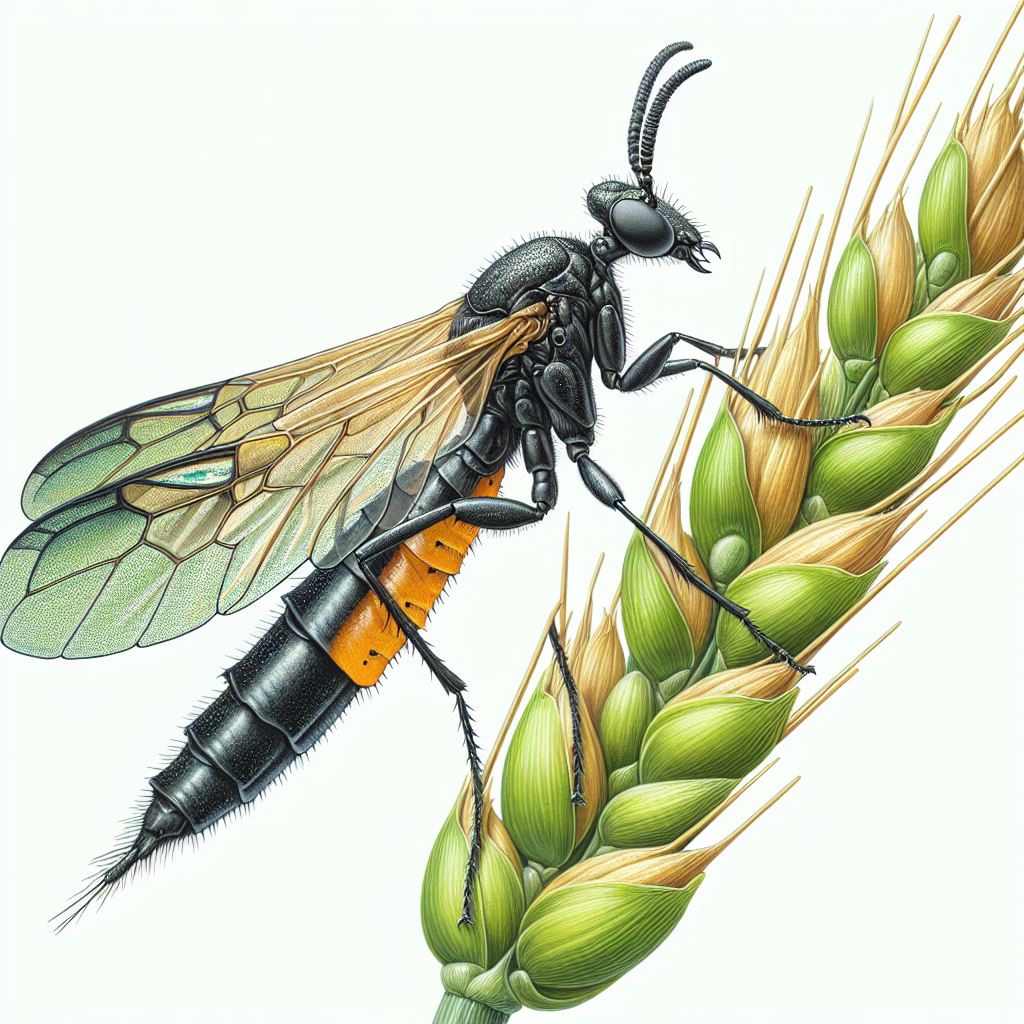
Introduction to Wheat stem sawfly
The wheat stem sawfly, scientifically known as Cephus cinctus, represents one of the most challenging pests for wheat growers, particularly in the northern Great Plains of the United States and the Prairie provinces of Canada. Native to Eurasia, this insect was accidentally introduced to North America in the early 1900s and has since become a persistent threat to wheat production. Adult sawflies are slender, wasp-like insects measuring about 10-15 mm in length, with shiny black bodies, a distinctive orange band around the abdomen, and a prominent saw-like ovipositor used by females to deposit eggs into plant stems.
Larvae are the primary damaging stage, creamy-white, legless, and up to 12 mm long, feeding internally within wheat stems. This hidden feeding disrupts nutrient and water transport, weakening culms and causing plants to lodge—fall over at maturity—resulting in unharvestable heads and yield reductions of 20-50% in severe infestations. Economic impacts are staggering; in peak years, losses exceed millions of bushels annually. Unlike many pests, chemical controls are often ineffective due to the protected larval stage, making cultural and biological strategies essential. This definitive guide equips farmers with diagnostic tools, lifecycle insights, organic treatments, and long-term prevention to safeguard Hard Red Winter Wheat and other varieties. Early scouting and integrated management are key to minimizing damage from this stealthy stem borer.
Identifying Symptoms & Damage
Diagnosing wheat stem sawfly infestations requires keen observation during key growth stages. The most telltale sign is lodging: stems bending or breaking at or just above the second node from the base, creating a 'swan neck' appearance in fields. Affected culms fail to stand upright at harvest, with heads lying flat on the ground, leading to shattered grain and combine losses.
Internally, scout for the characteristic 'sawfly cut'—a neat, horizontal girdle near the base of the stem created by mature larvae before pupation. This girdle weakens the stem, promoting lodging. Dissect infested stems to find the legless, C-shaped larva or frass-packed tunnels. Pupal cases, ribbon-like and parchment-colored, often protrude from stem nodes post-harvest.
Early symptoms include stunted plants with yellowing lower leaves, though these mimic nutrient deficiencies or stem rust. Differentiate by splitting stems: sawfly tunnels are clean and linear, unlike fungal discoloration. Yield impacts vary by infestation level—10% infested stems may cut yields 10%, while 50% infestation halves production. Monitor edges of fields first, as sawflies prefer field margins. Use sweep nets for adults in late spring or sticky traps for monitoring. Accurate ID prevents misdiagnosis with Hessian fly or sawflies, ensuring targeted management. Regular field walks from tillering (Feekes 3-5) through soft dough (Feekes 11.2) are crucial.
Lifecycle and Progression of Wheat stem sawfly
Understanding the univoltine (one generation per year) lifecycle of Cephus cinctus is pivotal for timing interventions. Adults emerge from overwintered pupae in late spring to early summer (late May to July), coinciding with wheat jointing to flag leaf stages. Females select stems 5-8 mm in diameter, inserting 1-2 eggs per stem via ovipositor slashes. Eggs hatch in 7-10 days into tiny larvae that burrow upward, feeding on parenchyma tissues.
Larvae overwinter as mature instars within the basal stem, constructing a protective frass tube sealed with a silk plug. Pupation occurs in spring inside this hibernaculum, with adults chewing out after 2-3 weeks. Peak flight aligns with temperatures above 15°C (59°F) and low wind. Fecundity averages 40-70 eggs per female, with survival rates up to 80% in susceptible varieties. Development thresholds: egg hatch at 10°C base, full cycle requires 800-1000 growing degree days (GDD).
Progression varies by region—earlier in southern prairies, later north. Overwinter survival exceeds 90% in residue, fueling annual outbreaks. Track using degree-day models from first adult catch. This biology explains resistance of solid-stemmed cultivars, as larvae starve in dense pith.
Environmental Triggers & Risk Factors
Wheat stem sawfly thrives in dry, continental climates with mild winters and hot summers, optimal at 20-25°C (68-77°F). Low humidity (<60%) favors adult activity, while excessive rainfall disrupts egg-laying. Soil temperatures above 10°C trigger pupation. Risk spikes in continuous wheat monocultures, especially after drought-stressed crops, as weakened stems are preferred oviposition sites.
Field margins adjacent to last year's infested fields serve as epicenters, with adults dispersing <200m but wind aiding longer flights. No-till and heavy residue retention boost overwinter survival by 20-30%. Susceptible spring wheats face higher pressure than winter types. Compaction and poor drainage exacerbate lodging. Regional outbreaks correlate with Barley yellow dwarf virus-stressed plants or low natural enemy populations. Monitor GDD from April 1; >500 GDD by mid-June signals high risk. Crop rotation disrupts cycles, reducing populations 50-70% after two non-host years like corn or soybeans.
Organic Control & Treatment Plans
Organic management emphasizes cultural, biological, and varietal tactics over sprays, as larvae are shielded. Plant resistant solid-stemmed varieties like 'Sawfly' or 'Solid Stem 677'—these reduce infestation 70-90% by impeding larval tunneling. Time planting to avoid peak oviposition: delay spring wheat 10-14 days post-optimum.
Destroy residue post-harvest via deep tillage (8-10 inches) to expose pupae to predators and desiccation, cutting next-year emergence 60%. For Spring Pest Patrol: Organic AI Strategies to Shield Your Crops from Common Invaders, scout margins weekly from jointing, hand-crushing egg clusters (white, rice-like on stems). Introduce parasites like Bracon cephi (native, 20-40% parasitism) via field releases or habitat strips with yarrow.
Border sprays of BT (Bacillus thuringiensis) or spinosad target young larvae if detected early (pre-tunneling), applied at egg hatch with >80% coverage. Neem oil disrupts adult feeding. Trap crops like susceptible wheat borders lure females away from mains. Biologicals: encourage ground beetles and birds via hedgerows. Integrate with clover underseeding for suppression. Threshold: treat if >5% stems with eggs. Monitor efficacy via stem dissections.
Preventing Wheat stem sawfly in the Future
Long-term prevention builds resilient systems. Rotate with non-hosts (peas, barley) for 2-3 years, slashing populations >80%. Adopt solid-stem varieties field-wide; blend 20% resistant into susceptible for hybrid resistance. Burn or bale residue in high-risk fields, followed by tillage.
Enhance biodiversity: plant trap strips of wheat, mow unharvested borders. Scout annually using 100-stem samples per 10 acres. Use degree-day models for predictions. Foster natural enemies via reduced tillage in low-pressure areas and floral borders attracting parasitoids. For detailed wheat cultivation, see the wheat wiki. Future-proof with certified clean seed and volunteer control. IPM plans reduce incidence below 2%, sustaining yields.
Crops Most Affected by Wheat stem sawfly
Primarily attacks wheat species, with spring wheats most vulnerable due to synchrony with adult emergence. Durum Wheat suffers 30-50% losses; Hard Red Winter Wheat less so if solid-stemmed. Infests Triticale, rye, and barley at lower rates (10-20% infestation). Oats rarely affected due to tough stems. Prefers grassy hosts; no economic impact on broadleaves. In mixed rotations, wheat edges amplify spread to adjacent corn or sorghum, though non-preferred.