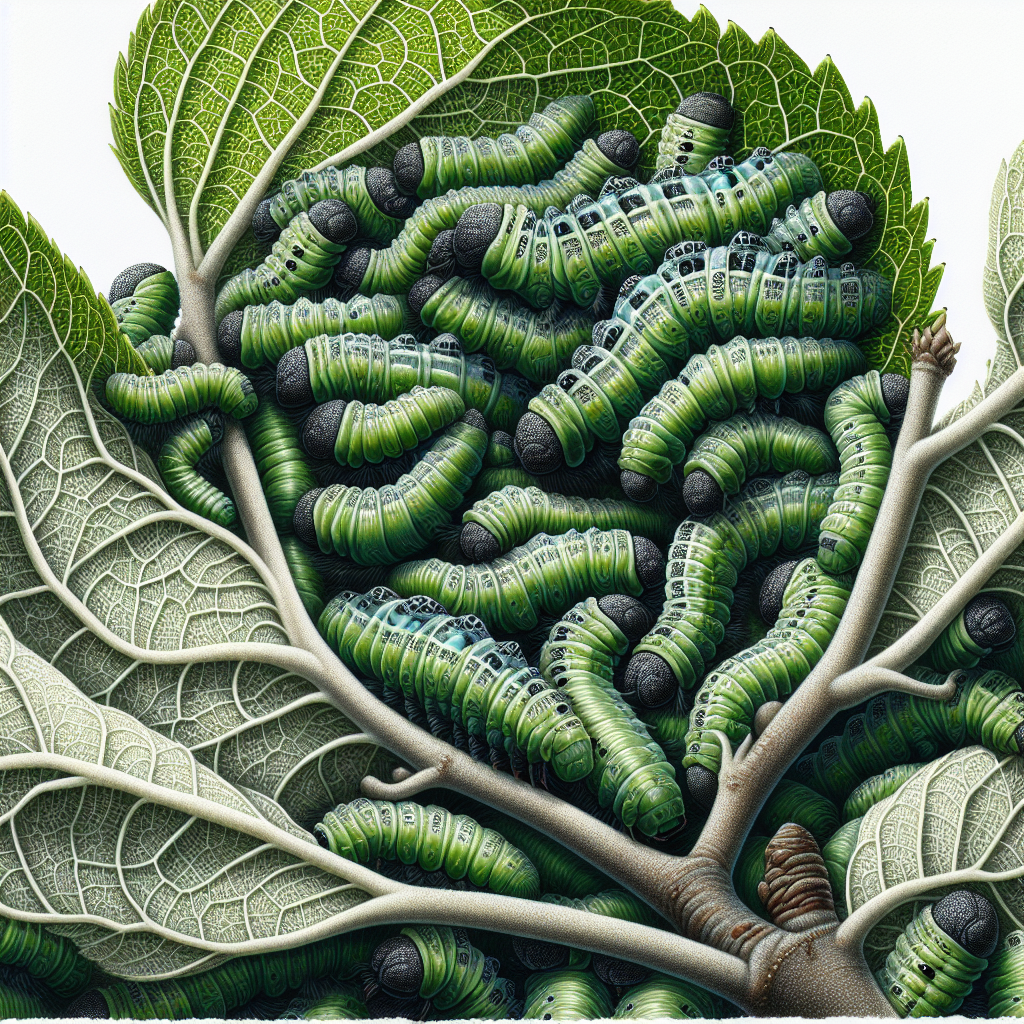
Introduction to sawflies
Sawflies represent a significant threat to agricultural and horticultural systems worldwide, belonging to the suborder Symphyta within the order Hymenoptera. Unlike their stinging relatives like bees and wasps, sawflies are generally stingless, named for the saw-like ovipositor females use to slice into plant tissues for egg-laying. Over 8,000 species exist globally, with many acting as pests on apple, pear, pines, roses, and various berries. Their larvae, often mistaken for caterpillars or slugs due to their plump, legless appearance, can defoliate entire plants in a short time, leading to stunted growth, reduced yields, and plant death in severe infestations.
In agricultural contexts, sawfly outbreaks can devastate orchards and forests, costing millions annually in lost timber and fruit production. Common genera include Tenthredo, Athalia, Arge, and Monophadnoides, each targeting specific hosts. For instance, the introduced pine sawfly (Diprion pini) ravages conifers, while the rose sawfly (Arge ochropus) targets ornamentals. Early detection is crucial, as larvae feed voraciously in groups, stripping leaves down to veins. This guide provides farmers, orchardists, and gardeners with professional-grade diagnostics, lifecycle insights, and organic management strategies to combat sawflies effectively. Understanding their biology empowers proactive defense, minimizing chemical reliance and preserving ecosystem balance. Check out this Spring Pest Patrol: Organic AI Strategies to Shield Your Crops from Common Invaders for timely tips.
Identifying Symptoms & Damage
Sawfly damage is distinctive and often confused with caterpillar or beetle feeding. Primary symptoms include skeletonized leaves, where larvae consume the soft mesophyll tissue between veins, leaving a lacy network. Look for clusters of pale green to grayish, slug-like larvae on leaf undersides, often dropping silk threads when disturbed—a classic escape behavior. Severe infestations cause complete defoliation, with branches appearing bare by midsummer.
On trees like cherry or peach, you'll notice rolled or webbed leaves protecting larvae. Needle-feeding species on pines clip entire needles at the base, creating sparse canopies. Secondary signs include frass (droppings), honeydew from adults, and sooty mold on lower leaves. Differentiate from caterpillars by the lack of prolegs (sawfly larvae have fewer than five pairs) and from slugs by their six true legs and thoracic prolegs.
Diagnostic tips: Shake branches over white paper; larvae will parachute down on threads. Use a 10x hand lens to spot the ovipositor scars—neat slits along leaf veins or edges. On berries like strawberry or raspberry, notched leaf margins signal egg-laying sites. Early scouting in spring, when adults emerge, prevents explosive larval populations. Economic thresholds vary: 10-20% defoliation on ornamentals warrants action; fruit trees tolerate up to 50% before yield loss.
Lifecycle and Progression of sawflies
Sawflies complete 1-3 generations per year, depending on species and climate, with lifecycles spanning 2-8 weeks. Adults, resembling thick-waisted wasps (1/4-1 inch long), emerge from overwintering cocoons in soil or plant debris in early spring. Females insert 20-50 eggs via ovipositor into leaf tissues, hatching in 5-14 days into tiny larvae.
Larvae progress through 5-7 instars over 3-6 weeks, feeding nocturnally or concealed. Upon maturity, they drop to soil, spin silken cocoons, and pupate. Diapause occurs in summer or fall, with adults emerging next season. univoltine species (one generation) dominate temperate regions; bivoltine in warmer climates.
Key progression stages: Egg (slit in leaf, 1-2mm); Young larva (transparent, skeletonizing); Mature larva (robust, defoliating); Pupa (soil, 1-3cm cocoon); Adult (nectar-feeding, egg-laying). Timing aligns with host budbreak: monitor 10-14 days post-adult sighting. Parasitic wasps and birds target larvae, but outbreaks follow mild winters reducing natural mortality.
Environmental Triggers & Risk Factors
Sawfly populations explode under specific conditions. Mild winters (>32°F minimums) boost overwintering survival, while wet springs favor egg hatching and larval establishment. Monocultures, like vast wheat fields or pine plantations, amplify outbreaks by concentrating hosts. Stressed plants—drought, nutrient deficiency, or prior aphids damage—emit volatiles attracting females.
Soil tillage disrupts cocoons, but no-till systems increase risk. Proximity to wild hosts (roses, willows) seeds infestations. Climate change extends generations northward. High nitrogen fertilizers promote lush foliage, ideal larval food. Risk mapping: Scout field edges first, as adults migrate short distances. Companion planting with thyme or marigold repels via volatiles.
Organic Control & Treatment Plans
Integrated Pest Management (IPM) prioritizes organics. Cultural: Handpick larvae into soapy water; prune and destroy egg-laying sites. Tillage buries cocoons. Biological: Encourage predators like paper wasps, tachinid flies, and ground beetles. Release Cotesia parasitoids (species-specific). Bacillus thuringiensis (Bt) var. kurstaki targets young larvae effectively, applied evenings (rates: 0.5-1 lb/acre).
Botanicals: Neem oil (0.5-2% azadirachtin) disrupts molting; spinosad (0.2-0.4 oz/gal) for heavy infestations, OMRI-listed. Pyrethrum as last resort. Physical: Sticky traps for adults; burlap wraps on trunks intercept dropping larvae. Treatment timeline: Scout weekly; treat at 10 larvae/10 leaves. Rotate modes to prevent resistance. For wheat stem sawflies, solid-stem varieties resist boring.
Sample plan: Week 1 scout; Week 2 Bt/neem; Week 4 release predators. Monitor 7 days post-treatment. Success metrics: <5% defoliation. Avoid broad-spectrum sprays killing beneficials.
Preventing sawflies in the Future
Prevention hinges on habitat manipulation and monitoring. Plant resistant varieties: e.g., columnar aspens resist leafminers, indirectly sawflies. Diversify with non-hosts like garlic borders. Mulch lightly to deter soil pupation; encourage birds with nest boxes.
Fall cleanup removes 80% cocoons. Use row covers during egg-lay (April-May). Pheromone traps disrupt mating. Soil solarization kills pupae. Long-term: Build soil health via cover crops like clover, fostering natural enemies. Annual phenology models predict flights—track degree-days (base 50°F). IPM audits reduce outbreaks 70%.
Crops Most Affected by sawflies
Sawflies target woody ornamentals, fruits, berries, and grains. Top victims: Pines (red-headed pine sawfly), roses (rose slug), apple/pear (pearslug), cherry (cherry sawfly), strawberry (strawberry crown borer), raspberry (raspberry sawfly). Grains like wheat suffer wheat stem sawfly (Cephus cinctus), boring stems causing lodging. Willows, birches, oaks host dozens. Tropicals like mango face litchi leafminer relatives. Economic hits: $50M/year in U.S. forestry alone.