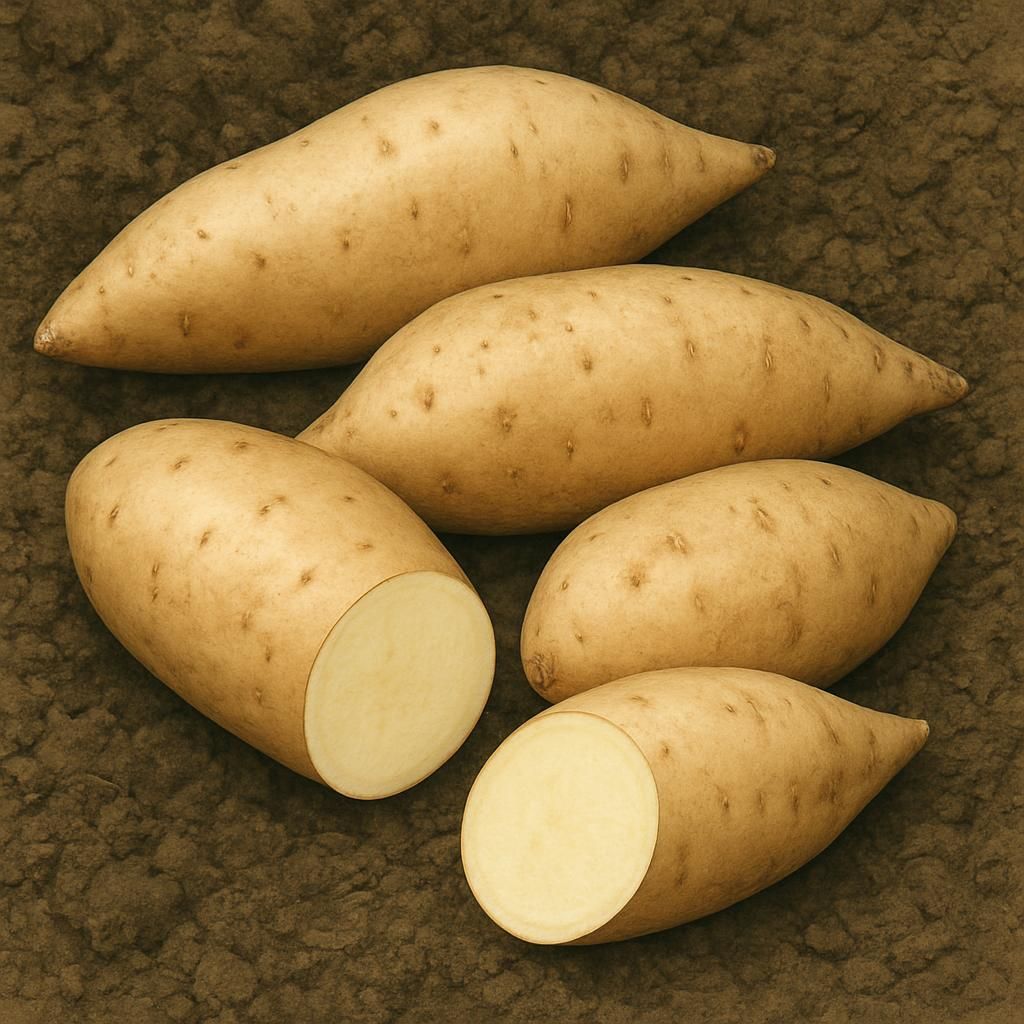
Introduction to Sweet Potato (O'Henry White)
Sweet Potato (O'Henry White) is a vigorous, warm-season perennial vine grown as an annual for its large, creamy-white storage roots. Developed for superior appearance and reliable productivity, this cultivar produces smooth, light-tan skins over pale, moist flesh that retains excellent baking and frying qualities. With strong resistance to common soil-borne issues and consistent performance across USDA zones 7–11, it has become a favorite among market growers seeking a white-fleshed alternative to orange varieties such as Beauregard Sweet Potato.
The plant’s trailing habit makes it suitable for both raised beds and conventional rows, while its moderate drought tolerance once established reduces irrigation demands during late-season growth. Because slips (rooted cuttings) are the primary propagation method, growers can rapidly scale plantings without seed-saving logistics. In addition to fresh-market sales, the roots store well after proper curing and can be processed into flour, chips, or baby-food purees.
Botanical Profile of Sweet Potato (O'Henry White)
Ipomoea batatas belongs to the Convolvulaceae family and exhibits a prostrate, vining growth habit reaching 3–6 m in length. The cultivar O’Henry produces heart-shaped to triangular leaves that are medium green with prominent veins. Although the plant rarely flowers under commercial conditions, occasional lavender blooms appear in long-day environments.
Adventitious roots form at each node along the stem; those that penetrate the soil swell into storage roots within 60–90 days. O’Henry roots are typically cylindrical to slightly tapered, 15–25 cm long, and weigh 200–500 g at maturity. The white flesh is low in carotenoids yet rich in complex carbohydrates and vitamin C, offering a subtle sweetness that intensifies after curing.
Soil, pH, and Climate Requirements for Sweet Potato (O'Henry White) (MUST INCLUDE A MARKDOWN TABLE OF IDEAL CONDITIONS)
Successful cultivation begins with well-drained, sandy-loam soils that warm quickly in spring. Heavy clays restrict root expansion and increase the risk of rot; raised beds or ridges 20–30 cm high are recommended where drainage is marginal. The crop tolerates a broad pH range but performs best in slightly acidic conditions that optimize nutrient uptake, particularly phosphorus and micronutrients.
| Parameter | Ideal Range | Notes |
|---|---|---|
| Soil Type | Sandy loam to loam | Avoid compacted or waterlogged soils |
| Soil pH | 5.8–6.5 | Liming may be required below 5.5 |
| Organic Matter | 2–4 % | Incorporate well-rotted compost pre-plant |
| Daytime Temperature | 24–32 °C | Growth stalls below 18 °C |
| Night Temperature | 15–21 °C | Frost will kill vines |
| Soil Temperature (10 cm depth) | 21–29 °C | Minimum for slip planting |
| Annual Rainfall | 750–1 250 mm | Supplemental irrigation improves uniformity |
Step-by-Step Planting & Propagation
- Produce or purchase certified disease-free slips 4–6 weeks before the last frost. Each slip should be 15–20 cm long with 4–6 leaves.
- Harden slips outdoors for 3–5 days, gradually increasing sun exposure.
- Prepare raised beds or ridges 1.0–1.2 m apart; incorporate 5–8 cm of compost and a balanced organic fertilizer (N-P-K 4-6-8) at 40–60 g m⁻².
- Plant slips 10–15 cm deep on 30 cm centers within the row, leaving 2–3 leaves above soil level. Water immediately to settle soil around roots.
- Maintain consistent moisture for the first 10–14 days until new growth appears; thereafter reduce frequency to encourage deep rooting.
Care & Maintenance regimes for Sweet Potato (O'Henry White) (MUST INCLUDE A MARKDOWN TABLE OF WATER, FERTILIZER, AND PRUNING SCHEDULES)
After establishment, the crop requires minimal intervention beyond weed suppression and moisture management. Mulching with 5–8 cm of straw or pine needles suppresses weeds and moderates soil temperature. Vines may be redirected inward to keep rows tidy, but tip pruning is seldom necessary unless excessive vegetative growth delays bulking.
| Growth Stage | Irrigation Frequency | Fertilizer Application | Pruning / Canopy Management |
|---|---|---|---|
| Weeks 0–3 | 2–3 times per week | Starter: 4-6-8 at planting | None |
| Weeks 4–8 | 25–30 mm per week | Side-dress 2-4-6 at 30–40 g m⁻¹ row | Remove yellow basal leaves |
| Weeks 9–14 | 20–25 mm per week | None unless deficiency symptoms appear | Redirect vines into row if spreading |
| Weeks 15–Harvest | Reduce to 15 mm per week | None | None |
Pests, Diseases & Organic Management
Major insect pressures include wireworms, cutworms, and flea beetles. Wireworm larvae create shallow tunnels in roots; rotation with non-host crops and the use of bait traps reduce populations. Cutworm damage is mitigated by collars around slips and evening applications of Bacillus thuringiensis.
Fungal diseases such as southern blight and root rot are managed through well-drained beds, crop rotation with corn or sorghum, and avoidance of fresh manure. Root-knot nematodes are suppressed by planting resistant cover crops such as marigold or sunn hemp the preceding season. Regular scouting and removal of infected plants remain the cornerstone of organic control.
Harvesting, Curing & Optimal Storage
Harvest begins 100–120 days after planting when foliage begins to yellow. Use a garden fork inserted 30 cm from the row to lift roots gently, avoiding skinning or bruising. Cure freshly dug roots at 29–32 °C and 85–90 % relative humidity for 7–10 days to heal wounds and convert starches to sugars. After curing, store at 13–15 °C with 85 % humidity; properly cured roots remain marketable for 4–6 months.
Companion Planting for Sweet Potato (O'Henry White)
O’Henry pairs well with low-growing legumes such as bush beans that fix nitrogen without competing for light. Aromatic herbs including thyme and rosemary deter foliage-feeding insects. Avoid planting near potato or tomato to reduce shared nematode and disease pressure. Tall companions such as sunflower provide light afternoon shade in hot climates while attracting beneficial insects.
For deeper insight into soil-health strategies that complement root-crop rotations, see The Forgotten Art of Fall Soil Revival: 8 Organic Strategies for Small Farm Resilience.