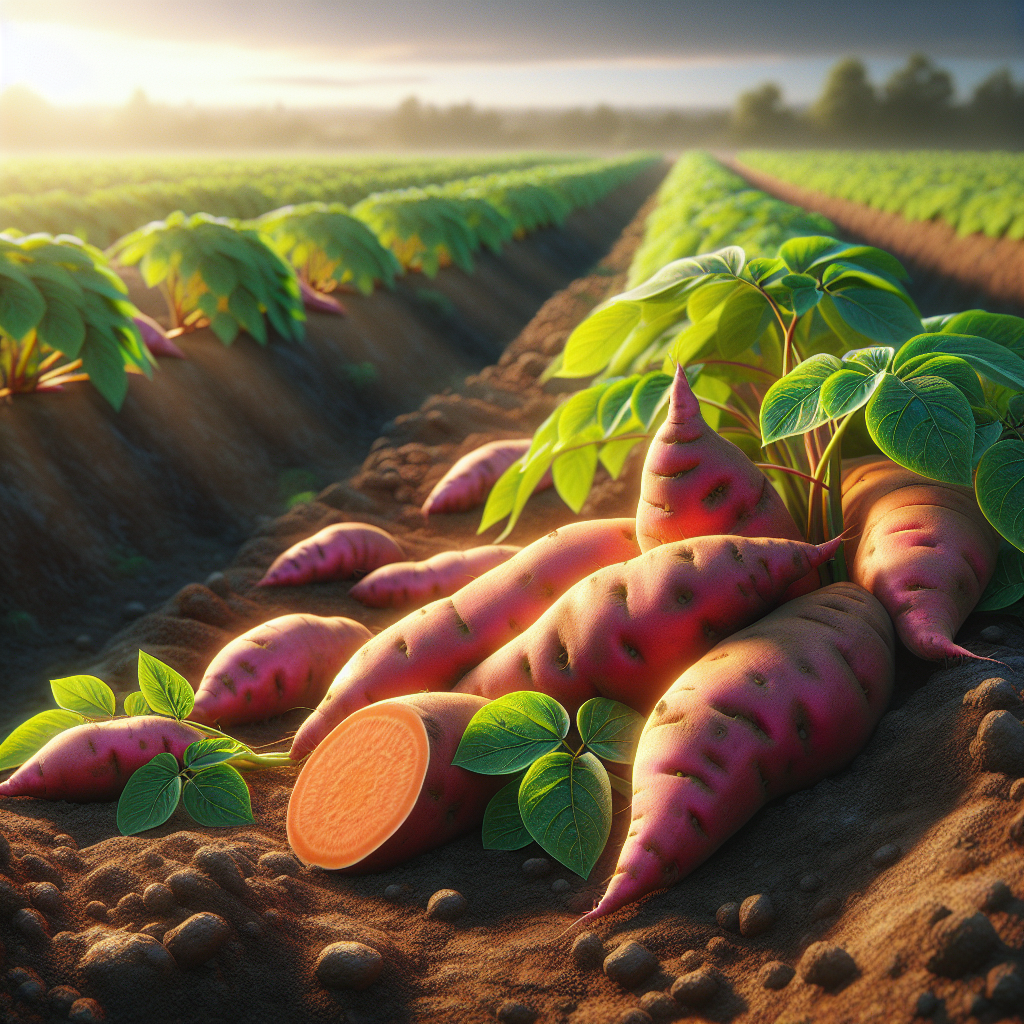
Introduction to Beauregard Sweet Potato
Released in Louisiana in 1987, this cultivar quickly became a standard for orange-fleshed sweet potato production because it combines strong vigor, broad adaptation, and marketable root shape. It was bred to improve yield consistency and storage-root uniformity, and it remains one of the benchmark varieties against which newer sweet potatoes are compared. The plants produce vigorous vines and typically mature in about 90 to 110 frost-free days, though actual timing varies with heat accumulation, soil type, and plant spacing.
What makes this cultivar distinctive is the balance between agronomic reliability and culinary quality. The storage roots usually have smooth, reddish-copper skin and moist, sweet, deep orange flesh rich in beta-carotene. Under good management, roots size up evenly rather than producing an erratic mix of oversized jumbos and pencil-thin roots. That said, Beauregard can still become misshapen or cracked if grown in compacted soil, subjected to alternating drought and saturation, or overfed with nitrogen.
Sweet potatoes are botanically and agronomically different from true potatoes. They are tropical perennial vines grown as annuals in most food gardens and farms. If you want a broader background on the crop type itself, see the Sweet Potato guide. Beauregard performs best where summer heat is reliable, soils are loose and well drained, and the crop can remain frost-free from transplanting through harvest.
Botanical Profile of Beauregard Sweet Potato
This cultivar belongs to the morning glory family, Convolvulaceae, not the Solanaceae family of Irish potatoes. The species, Ipomoea batatas, forms trailing vines with heart-shaped to lobed leaves depending on growing conditions and plant age. Adventitious roots emerge readily from nodes along the vine, but the economically valuable portion is the enlarged storage root formed from selected adventitious roots under favorable environmental and nutritional conditions.
Beauregard is an orange-fleshed table cultivar developed for high yield and good processing and fresh-market performance. Its canopy is moderately aggressive, which helps suppress weeds once established, but also means it needs adequate spacing and airflow in humid climates. The storage roots are typically elongated but not excessively long, with fairly uniform shoulders if soil is friable. Skin color tends toward rose-copper, while flesh is deep orange due to carotenoid accumulation.
Root initiation in sweet potato is sensitive to environmental conditions. Warm soils encourage rapid establishment, but excessive nitrogen or prolonged waterlogging shifts the plant toward vine growth rather than storage-root bulking. During the first few weeks after transplanting, the plant focuses on establishing fibrous roots and recovering from transplant stress. Once daylength, temperature, and nutrition align, select roots begin to thicken and become storage roots. This is why early-season soil conditions matter so much more than many growers realize.
Flowering is variable and often sparse in this cultivar under many field conditions. Seeds are not used for practical production; growers propagate it vegetatively using slips, which are rooted shoots taken from sprouted mother roots or from foundation stock. Because propagation is clonal, disease-free planting material is critically important. Viral buildup over seasons can reduce vigor, yield, and root quality even when obvious symptoms are absent.
Soil, pH, and Climate Requirements for Beauregard Sweet Potato
This crop performs best in sandy loam or loamy soils with excellent drainage, high biological activity, and minimal compaction in the top 8 to 12 inches. The ideal texture allows rapid root penetration and uniform swelling of storage roots. Heavy clay is not automatically disqualifying, but in clay soils yields are often lower and roots become rough, forked, or cracked unless the ground is deeply loosened and planted on ridges or raised beds.
An ideal pH range is about 5.8 to 6.5. The plants tolerate slightly more acidity than many vegetables, but below about 5.5 nutrient imbalances can reduce vigor, while above 6.8 certain micronutrients become less available and scab pressure may increase in some fields. If liming is needed, apply it well ahead of planting so the soil has time to equilibrate; avoid last-minute, heavy lime applications just before setting slips.
Warmth is non-negotiable. Soil temperature should be at least 65°F (18°C) at planting, and 70 to 85°F (21 to 29°C) is better for rapid establishment. Air temperatures below 55°F (13°C) slow growth substantially, and even a light frost can injure foliage or ruin the crop outright. In cool climates, use black plastic, low tunnels, or raised beds to warm the soil, but remove or vent protection once excessive heat and humidity build up.
Beauregard thrives in long, warm summers with full sun, ideally 8 or more hours of direct light daily. A long frost-free period is essential. In marginal temperate zones, choose the warmest site available: south-facing slope, wind-sheltered field, or heat-retentive bed. In tropical or subtropical areas with intense rainfall, the priority shifts from warming soil to ensuring drainage and preventing waterlogging.
Moisture management should be steady but never swampy. Aim for consistently moist soil in the root zone, roughly equivalent to about 60 to 80% of field capacity during establishment and early bulking. In practical terms, soil at 3 to 4 inches deep should feel cool and slightly damp, forming a weak ball in the hand but not releasing free water when squeezed. If the soil becomes powdery and vines flag by midday then remain limp into evening, drought stress is occurring. If the bed smells sour, stays sticky, and leaves yellow from the base while vines look lush but brittle, overwatering is likely suppressing root quality.
Nutritionally, this is not a heavy nitrogen feeder compared with many fruiting vegetables. Excess nitrogen leads to rampant vines, delayed bulking, and poor skin set. A soil test should guide amendments, but in general sweet potatoes prefer moderate fertility with good potassium availability. Potassium is especially important for root sizing, carbohydrate movement, and storage quality.
Step-by-Step Planting & Propagation
Start with certified disease-free slips whenever possible. This is the single best insurance against yield loss from viruses, Black rot, and other systemic problems. If producing your own slips, choose only healthy, true-to-type mother roots from a vigorous crop that stored well and showed no signs of rot, cracking, or off-shape.
To produce slips, place mother roots in warm conditions 6 to 8 weeks before your outdoor planting date. Commercially, roots are often bedded in moist sand or light substrate at 75 to 85°F (24 to 29°C). Keep humidity moderate and provide light once shoots emerge. Slips are usually removed when they reach 8 to 12 inches long. They may be pulled with a small heel attached or cut cleanly, then either transplanted directly or pre-rooted in water or a sterile propagation medium for several days.
Prepare beds 2 to 3 weeks before planting. Loosen soil deeply, remove stones and clods, and shape raised rows 8 to 12 inches high if drainage is less than ideal. Avoid fresh manure, which can cause forked roots and excessive vine growth. If compost is used, it should be well matured and applied modestly. A pre-plant fertilizer with lower nitrogen and adequate potassium is usually preferable to a rich, fresh organic amendment.
Wait until all danger of frost has passed and soil is reliably warm. Transplant slips 3 to 4 inches deep, burying several nodes if possible while keeping the top leaves above soil level. Standard spacing is 12 to 18 inches between plants in rows 36 to 48 inches apart. Closer spacing tends to produce more medium-sized roots; wider spacing often produces fewer but larger roots. For Beauregard, 12 inches in-row is common for home gardens seeking a generous yield of kitchen-sized roots.
Water slips immediately after planting to settle soil around the stems. The first 7 to 10 days are the most critical. Slips initially lack a developed root system and can wilt dramatically under sun and wind. Temporary afternoon wilting is normal during establishment, but plants should recover by evening. If wilting persists overnight, provide water and consider temporary shade cloth in very hot, dry weather.
For growers interested in whole-field planning and bed efficiency, the principles in The 1-Acre Blueprint are useful for organizing long-season crops like sweet potatoes within a mixed production system.
Care & Maintenance regimes for Beauregard Sweet Potato
During the first two weeks after transplanting, irrigate lightly and frequently enough to keep the slip rooting zone evenly moist. This often means watering every 1 to 3 days in sandy soil, less often in loam. Once plants are established, shift to deeper, less frequent irrigation. A common target is about 1 inch of water per week from rain or irrigation, increasing slightly during intense heat on sandy ground, but always adjusted for soil type and plant stage.
The key is not just total water but consistency. Alternating drought and heavy irrigation is one of the main causes of growth cracks and irregular root development. During root bulking, moisture should remain moderate and stable. Soil should not cycle from hard-dry to saturated. If using drip irrigation, run long enough to wet the top 8 to 10 inches of soil, then allow the upper surface to dry slightly before the next irrigation. Overhead irrigation is workable but increases leaf wetness and may worsen foliar disease pressure in humid areas.
Fertilization after planting should be restrained. If growth is pale and slow due to documented nutrient deficiency, side-dress lightly rather than applying heavy nitrogen. Too much soluble nitrogen after establishment can create dense vine growth at the expense of storage roots. If potassium is low based on a soil test, supplementing can improve root fill and storage performance. Calcium and boron deficiencies, though less common, may contribute to root disorders in depleted or highly leached soils.
Weed control matters most early. The crop is a poor competitor until vines begin to run. Keep beds clean for the first 4 to 6 weeks through shallow hoeing, mulching, stale seedbed technique, or biodegradable mulch films. Once vines cover the row middles, they suppress many later weeds. Do not cultivate deeply after roots begin enlarging, as mechanical injury can reduce yield and create infection sites.
Avoid repeatedly lifting or moving vines once they have rooted at nodes, unless your goal is specifically to prevent excessive rooting in very fertile soils. In some systems, growers gently lift wandering vines to discourage secondary rooting and keep the plant’s energy focused on original storage roots. Do this carefully and infrequently to avoid stress.
Signs of good crop progress include a dense but not excessively lush canopy, rich green leaves without exaggerated vine length, and gradual enlargement of roots when one or two sample plants are checked after about 80 days. Signs of imbalance include enormous vines with few roots, yellow lower leaves with wet soil, or many misshapen roots in compact ground.
Pests, Diseases & Organic Management
The most serious insect issue in many sweet potato regions is the Sweet potato weevil. Adults feed on vines and roots, but the greatest damage comes from larvae tunneling in roots, making them bitter and unmarketable. Infestation is often worse where roots are exposed by cracked soil or where crop residues remain in the field. Organic management depends on prevention: clean planting material, crop rotation, prompt harvest, destruction of volunteer plants, and keeping soil hilled over roots so they are not exposed.
Wireworms, White grubs, Flea beetles, Cucumber beetles, and Tortoise beetles may also feed on roots or foliage. In most gardens, vigorous plants tolerate modest leaf feeding, but root-feeding insects are more consequential. Rotation away from sod, old pasture, or recently broken grass ground helps reduce wireworm and grub pressure. Beneficial habitat plantings with Thyme can support pollinators and natural enemies around field margins, though they do not replace direct pest management.
Nematodes, especially Root-knot nematodes, can severely reduce yield and cause cracked, bumpy, or poorly filled roots. Beauregard has some useful field tolerance characteristics but is not invulnerable. Use rotation with non-host or suppressive cover crops, soil solarization in hot climates where practical, and clean slips. Avoid planting repeatedly in the same bed.
Among diseases, Black rot, Scurf, Fusarium wilt, and various Storage rots are important. Black rot is especially problematic because it can begin in propagation material and carry into the field or storage. Use certified stock, sanitize crates and tools, avoid wounding roots, and discard any suspicious roots rather than composting them near production areas. In wet seasons, foliar leaf spots may appear, but they are often less economically important than root diseases unless defoliation becomes severe.
Organic disease management rests on sanitation, airflow, rotation, and water discipline. Plant only into well-drained soils, avoid overhead irrigation late in the day, and never store damaged or diseased roots with sound ones. A three- to four-year rotation away from other root crops is ideal where land allows. Remove crop residues promptly after harvest if disease has been present.
Harvesting, Curing & Optimal Storage
Beauregard is generally ready 90 to 110 days after transplanting, though experienced growers often decide based on a combination of calendar days, root sampling, and weather forecast. Harvest before soil temperatures fall too low and absolutely before frost. Even if frost only burns the vines, root quality and storage life can decline rapidly if the crop remains in chilled soil.
About 7 to 10 days before digging, many growers stop irrigation unless the soil is extremely dry and hard. Slightly drier soil reduces skin abrasion at harvest, but the ground should not become concrete-hard. Cut back vines if needed to improve visibility, then dig carefully with a fork, broadfork, or undercutter well outside the hill to avoid slicing roots. Freshly dug roots are very easy to bruise; rough handling causes storage rot later.
Beauregard often sizes up generously, so check for jumbos if harvest is delayed. Oversized roots are still edible, but they may be less uniform and harder to market. After digging, do not wash immediately if roots are going into storage. Gently brush off excess soil and sort out damaged, cut, insect-infested, or diseased roots for immediate use.
Curing is essential. Hold roots for 4 to 7 days at 80 to 85°F (27 to 29°C) and 85 to 90% relative humidity with good air circulation. This allows minor wounds to suberize and helps convert starches toward sugars, improving flavor. In small-scale settings, curing can be improvised in a warm room, insulated cabinet, or greenhouse corner if temperature and humidity are monitored carefully. Too cool, and curing is ineffective; too wet without airflow, and rot develops.
After curing, store at 55 to 60°F (13 to 16°C) with relative humidity around 85%. Do not refrigerate. Temperatures below about 50°F (10°C) can cause chilling injury, leading to hard centers, pitting, and off-flavors. Good storage conditions allow Beauregard roots to keep for several months. Inspect periodically and remove any roots that soften, leak, or show mold.
Companion Planting for Beauregard Sweet Potato
Good companions are those that either help repel pests, attract beneficial insects, or occupy a different canopy or rooting niche without competing heavily for the same underground space. The best companions are typically planted at bed edges, row ends, or nearby insectary strips rather than directly tangled within the sweet potato canopy.
Onion and Garlic are classic aromatic companions because their strong scent may help confuse some pest insects while taking up relatively little lateral space if planted along borders. Nasturtium is useful as a flowering companion that attracts pollinators and can function as a trap plant for certain insects in diversified gardens. In larger plantings, companion strategy is less about folklore and more about traffic flow, pest ecology, and avoiding direct competition.
Avoid pairing this crop too closely with sprawling cucurbits or aggressive tall crops that shade the bed. Sweet potatoes need full sun and warm soil, so dense overstory planting works against yield. Also avoid crowding with other root crops in the same immediate bed, since excavation at harvest becomes difficult and root-zone competition increases.
The most successful companion approach with Beauregard is usually perimeter planting: alliums or insectary flowers on the edges, with the sweet potatoes occupying the main bed uninterrupted. This preserves airflow, simplifies harvest, and supports beneficial insects without reducing light interception by the vines.