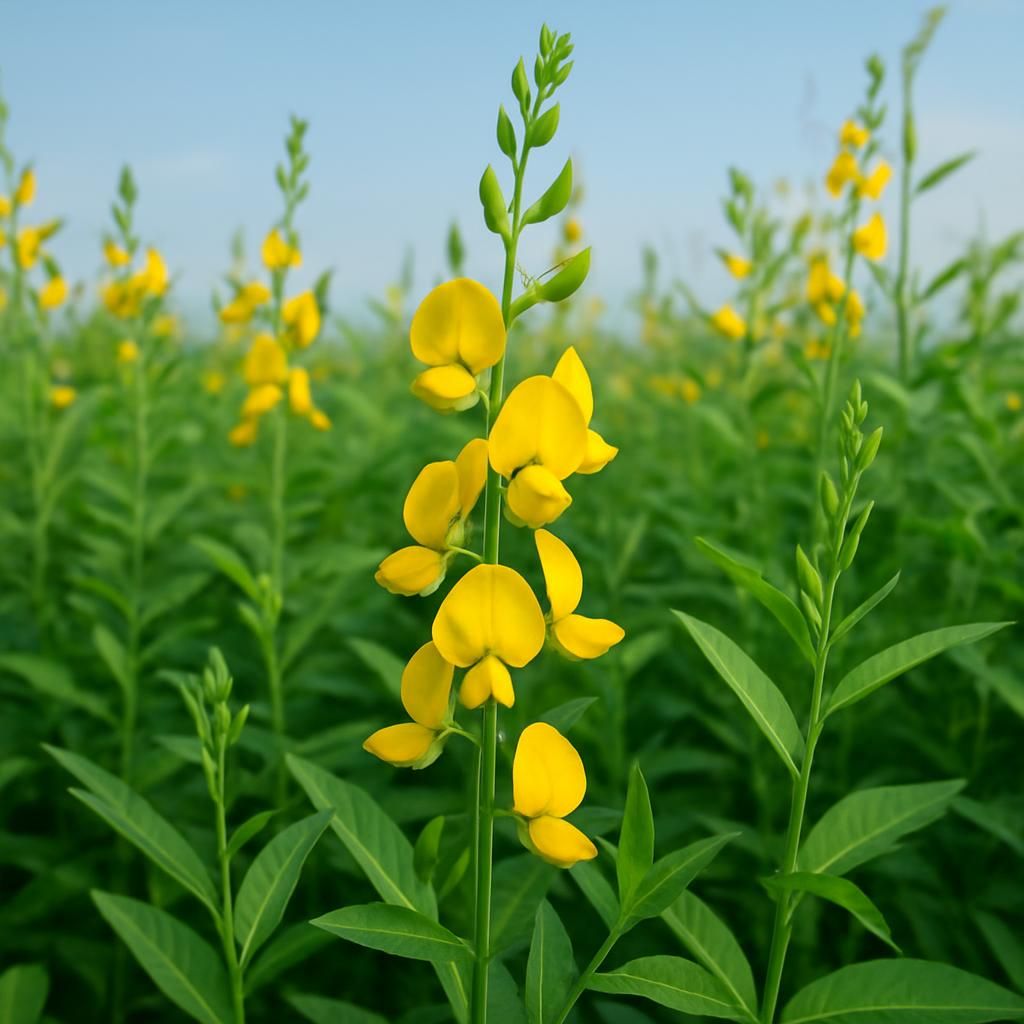
Introduction to sunn hemp
Sunn hemp (Crotalaria juncea) is an annual tropical legume that has become a cornerstone of sustainable agriculture in warm climates. Originally cultivated in India for its strong bast fiber, it is now widely grown as a green manure and cover crop because of its exceptional nitrogen-fixing ability and rapid biomass production. Farmers value sunn hemp for its ability to improve soil structure, suppress nematodes, and provide organic matter in as little as 60–90 days. Its drought tolerance and low input requirements make it an economical choice for both smallholders and large-scale operations seeking to reduce synthetic fertilizer use.
Botanical Profile of sunn hemp
Crotalaria juncea belongs to the Fabaceae family and is characterized by an erect, herbaceous stem that can reach 1–3 meters in height. The plant produces bright yellow, pea-like flowers arranged in terminal racemes, followed by inflated pods containing numerous small, kidney-shaped seeds. Its deep taproot system efficiently mines subsoil nutrients and improves soil aeration. The leaves are simple, lanceolate, and covered with fine hairs that help reduce transpiration in hot environments. Because it is a short-day plant, flowering is triggered when day length falls below approximately 12 hours, making timing critical in equatorial regions.
Soil, pH, and Climate Requirements for sunn hemp
Sunn hemp performs best on well-drained sandy loam to clay loam soils but tolerates a wide range of textures provided drainage is adequate. It thrives in tropical and subtropical climates with temperatures between 20 °C and 35 °C and requires at least 500 mm of rainfall or supplemental irrigation during establishment. The crop is moderately drought tolerant once established but sensitive to waterlogging and frost.
| Parameter | Ideal Range | Notes |
|---|---|---|
| Soil Type | Sandy loam to clay loam | Avoid heavy clays without drainage |
| Soil pH | 5.5–7.5 | Optimal nitrogen fixation above pH 6.0 |
| Temperature | 20–35 °C daytime | Growth slows below 15 °C |
| Annual Rainfall | 500–2000 mm | Supplemental irrigation needed if <500 mm |
| Altitude | 0–1500 m | Performs well up to moderate elevations |
| Frost Tolerance | None | Kill occurs at 0 °C or below |
Step-by-Step Planting & Propagation
- Select certified seed free of Crotalaria-specific pathogens. Inoculate with a compatible Rhizobium strain (Crotalaria-specific or cowpea-type) if the field has no history of sunn hemp.
- Prepare a fine, weed-free seedbed by disking or rototilling to 15 cm depth; incorporate any lime or phosphorus according to soil test results.
- Sow seeds at 25–40 kg/ha when soil temperature reaches 18 °C or higher. Drill seeds 2–3 cm deep in rows 30–45 cm apart or broadcast and lightly cover.
- For faster cover, increase seeding rate to 50–60 kg/ha; for fiber production, use wider rows (60–75 cm) and lower density.
- Irrigate lightly after sowing to ensure uniform emergence; avoid overwatering that could cause crusting.
- Germination occurs in 3–7 days; thin seedlings if stands exceed 150 plants/m² for fiber crops.
Care & Maintenance regimes for sunn hemp
Sunn hemp requires minimal intervention once established. Weed control is critical during the first 30 days; thereafter the crop’s rapid growth shades out competitors. Irrigation is usually unnecessary after establishment unless rainfall is below 25 mm per week. Fertilizer needs are low because of biological nitrogen fixation, but a starter dose of phosphorus (20–30 kg P₂O₅/ha) benefits early root development on deficient soils.
| Practice | Schedule | Rate / Method |
|---|---|---|
| Water | Week 1–3 after sowing | Light irrigation to maintain field capacity |
| Water | Week 4–8 | 25–30 mm/week if rainfall <25 mm |
| Fertilizer | At planting | 20–30 kg P₂O₅/ha banded 5 cm below seed |
| Fertilizer | 30–40 days after emergence | Optional 10–15 kg K₂O/ha on sandy soils |
| Pruning | 45–60 days (optional) | Cut back to 30 cm to encourage branching for fiber |
| Termination | 60–120 days depending on goal | Mow or roll-crimp before flowering for green manure |
Pests, Diseases & Organic Management
Sunn hemp is relatively resistant to most insect pests, but young seedlings may be attacked by cutworms and grasshoppers. Occasional infestations of aphids or leafhoppers can occur during dry spells. The most serious disease is anthracnose caused by Colletotrichum species, which produces sunken lesions on stems and pods in prolonged wet weather. Root-knot nematodes may build up if sunn hemp is grown repeatedly without rotation. Organic management includes crop rotation with non-hosts such as corn, timely mowing to break disease cycles, and encouraging beneficial insects through border plantings of marigold.
Harvesting, Curing & Optimal Storage
For green manure, terminate the crop at early flowering (60–90 days) by mowing or rolling and incorporate biomass to 15–20 cm depth within 24 hours to maximize nitrogen release. For fiber, harvest at full bloom or early pod set when stem lignin content is optimal; cut plants at ground level and ret in water or dew for 7–14 days until fibers separate easily. Dry fiber bundles in the shade to 12 % moisture before baling. Seed harvest occurs when pods turn dark brown; thresh and store at <10 % moisture in cool, dry conditions to maintain viability for up to three years.
Companion Planting for sunn hemp
Sunn hemp pairs well with corn and sorghum in relay systems, providing nitrogen while the cereal crops utilize the fixed nitrogen later in the season. It also serves as a living mulch under banana and mango orchards, suppressing weeds and nematodes. Avoid planting near legumes that share similar pests; instead, use it as a break crop before tomato or pepper plantings to reduce soil-borne disease pressure. Its rapid growth also makes it an effective nurse crop for slower-establishing perennials such as asparagus.