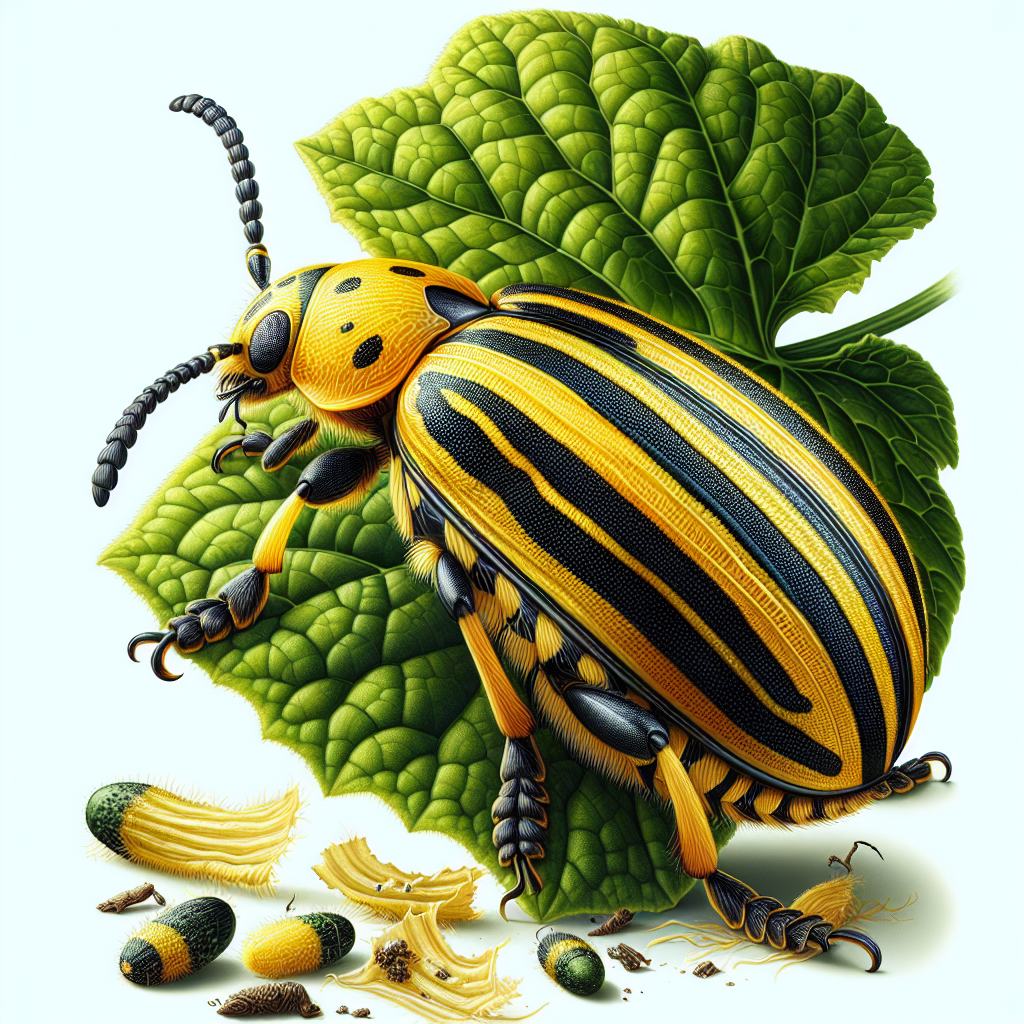
Introduction to Striped Cucumber Beetle
The striped cucumber beetle, scientifically known as Acalymma vittatum, ranks among the most destructive pests targeting cucurbit crops across North America. These beetles emerge in spring, drawn to young plants by their volatile cues, where they chew on leaves, petioles, and blossoms. Beyond direct feeding, they transmit Erwinia tracheiphila, the causal agent of bacterial wilt, which wilts and kills vines rapidly, often leading to 100% crop loss in severe infestations. Adult beetles overwinter in plant debris and soil, emerging when soil temperatures reach 15°C (59°F), synchronizing with cucurbit planting. This guide provides professional-grade diagnostics, lifecycle insights, and organic management strategies optimized for small farms and home gardens. Early detection is critical, as populations explode exponentially without intervention. For comprehensive pest control, integrate this with monitoring for related threats like squash bugs and vine borers.
Identifying Symptoms & Damage
Striped cucumber beetle damage manifests in distinct patterns on cucumber, squash, and melon crops. Adults create notched, skeletonized leaves with irregular holes, especially on cotyledons and young true leaves, stunting seedlings. Look for shiny, black excrement (frass) on foliage and sticky honeydew attracting ants. Flowers suffer heavy defoliation, reducing pollination and fruit set; scarred fruits show grooves and depressions, rendering them unmarketable. Larvae, pale with brown heads, bore into roots and stems belowground, causing wilting and lodging.
The hallmark diagnostic is bacterial wilt: vines suddenly collapse with one-sided wilting, brown vascular discoloration in stems (cut test: milky bacterial ooze). Differentiate from drought by checking for beetle presence—yellow beetles with three black stripes on each wing cover, about 5-7mm long. Eggs are pale yellow, laid in soil clusters near plants. Compare to spotted cucumber beetle, which has black spots instead of stripes and is a stronger wilt vector. Use a hand lens for larvae ID; scout weekly with yellow sticky traps. Economic thresholds: 1 beetle per plant pre-bloom, 5+ post-bloom. For visual diagnostics, see Spring Pest Patrol: Organic AI Strategies to Shield Your Crops from Common Invaders.
Lifecycle and Progression of Striped Cucumber Beetle
Understanding the lifecycle is key to timing interventions. Adults overwinter in leaf litter, woodpiles, or hedgerows, entering diapause in fall. Emergence peaks in late spring (May-June) when air temps hit 20-25°C (68-77°F). Females lay 400-800 eggs in soil cracks near cucurbit bases over 4-6 weeks. Eggs hatch in 7-10 days into larvae that feed on roots for 2-4 weeks (three instars), pupating in soil for 7-10 days. One to three generations occur per season, with peak activity July-August in northern regions.
Total cycle: 40-60 days. Second-generation adults vector wilt most efficiently. Monitor with traps; populations double every 2 weeks under optimal conditions. In southern states, continuous breeding yields 4+ generations. Lifecycle aligns with cucumber growth stages: seedlings attract first arrivals, blooms see peak feeding. Disrupt by targeting eggs/larvae pre-adult emergence. For related pests, see cucumber beetles.
Environmental Triggers & Risk Factors
Striped cucumber beetles thrive in warm, humid conditions: soil >15°C triggers emergence, daytime highs >25°C boost flight and oviposition. Early-planted cucurbits act as traps, drawing migrants from weedy borders. Poor sanitation—leaving debris—provides overwintering sites. Continuous cropping without rotation favors buildup; fields near woodlands or last year's cucurbits see 5x higher pressure. Drought stresses plants, increasing susceptibility to wilt transmission. High nitrogen promotes tender foliage, attracting more beetles. Weed hosts like wild cucumber exacerbate invasions. Risk spikes in reduced-till systems retaining residue. Mitigate with delayed planting (2 weeks post-risk) and border traps. Climate change extends seasons, intensifying multi-generation cycles. Pair with weather-aware strategies from Why 80% of Small Farms Battle Weather Disasters - And How Hyper-Local AI Forecasts Can Save Your Harvest.
Organic Control & Treatment Plans
Organic management emphasizes IPM: prevention first, then mechanical, biological, then targeted organics.
1. Cultural Controls: Row covers (floating fabric) exclude adults until bloom; remove for pollination. Rotate 2-3 years away from cucurbits. Trap crops: plant blue Hubbard squash borders to lure beetles away from main crop. Kaolin clay (Surround WP) creates protective film; apply at 50-100g/L, reapply post-rain.
2. Mechanical: Hand-pick beetles early morning into soapy water. Yellow sticky traps (10/acre) monitor/capture. Vacuum with shop vac for small plots.
3. Biological: Release beneficial nematodes (Heterorhabditis bacteriophora) against larvae (10^6/1000sqft, evenings). Encourage predators: ladybugs, green lacewings, tachinid flies via yarrow and nasturtium borders. Kaolin sprays deter feeding.
4. Organic Insecticides: Neem oil (azadirachtin 0.03%) disrupts larvae/hormones; apply evenings, 3-5x at 7-day intervals. Pyrethrins + PBO for knockdown (rotate to avoid resistance). Bacillus thuringiensis ineffective on adults. For wilt, rogue infected plants immediately.
Treatment Timeline: Scout weekly; treat at 1/plant. Combine: clay + neem for synergism. Efficacy: 70-90% reduction. Always buffer near pollinators.
Preventing Striped Cucumber Beetle in the Future
Long-term prevention builds resilient systems. Select resistant varieties: 'Marketmore 76 Cucumber' ([/wiki/marketmore-76-cucumber]), 'Eden's Jewel' melon. Plant late (June) to miss first generation. Mulch with straw (3-4") suppresses soil eggs. Tillage buries pupae, reducing emergence 50%. Perimeter sprays or traps intercept migrants. Companion plant with radish (repels) or marigold (nematodes disrupt larvae). Clean fields post-harvest: chop/flail vines, disk in. Use reflective mulches disorient adults. Monitor with AI tools for early warnings. Crop rotation with non-hosts like potato or corn breaks cycles. Soil health via cover crops (clover) boosts plant vigor. Annual plans prevent 80% infestations. See Soil Health Mastery: 5 Proven Strategies for Small Farms to Build Fertile Ground Without Breaking the Bank for foundational resilience.
Crops Most Affected by Striped Cucumber Beetle
Primarily Cucurbitaceae family: cucumber (all types, e.g., Marketmore, Persian), squash (zucchini, butternut, acorn), pumpkin, watermelon, cantaloupe, honeydew. Seedlings suffer most; fruits scar in melons/squash. Minor damage on eggplant, beans. Economic impact highest on pickling cucumber (80% losses possible). Wild cucurbits serve as reservoirs.