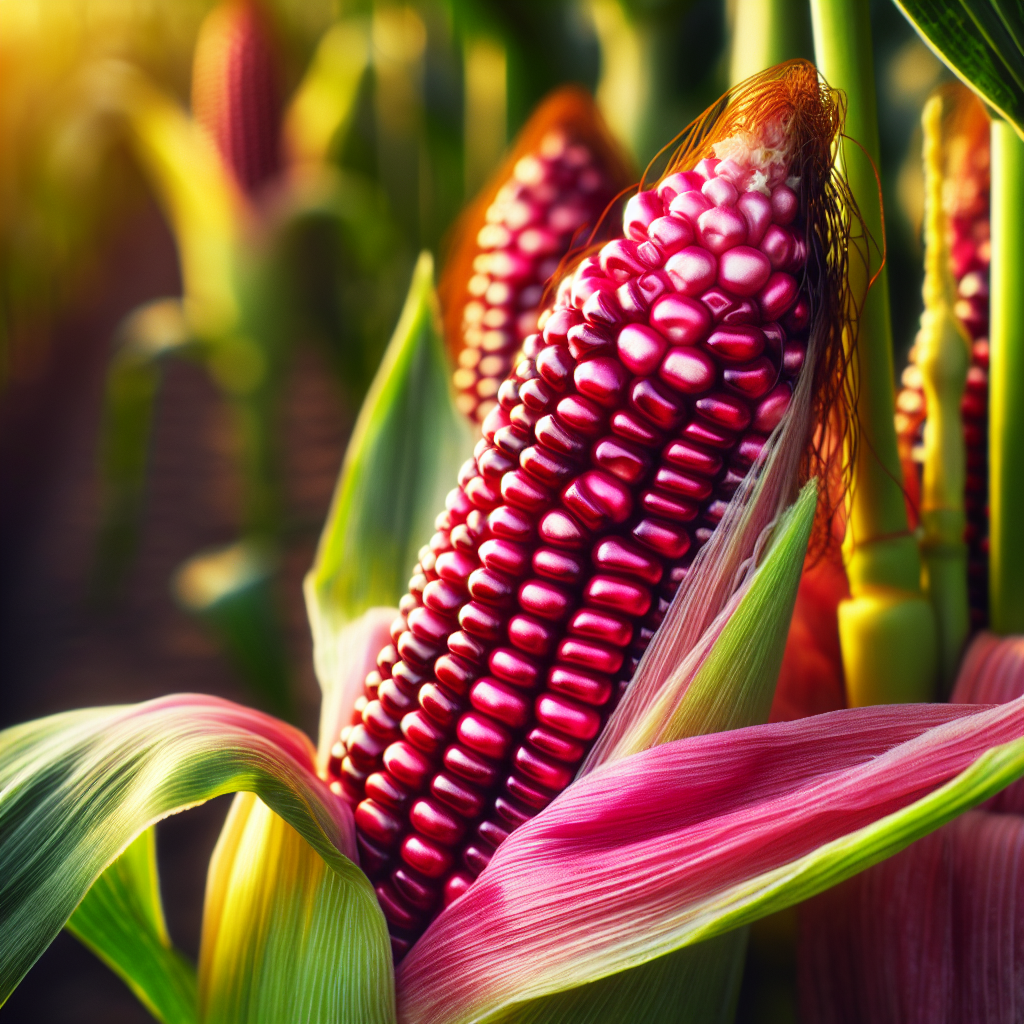
Introduction to Strawberry Popcorn
An heirloom popcorn with unmistakable visual appeal, this variety produces compact ears typically 2 to 4 inches long, tightly packed with glossy, deep red kernels on plants that usually reach 4 to 6 feet tall. Its charm lies in the unusual combination of ornamental beauty and practical use: the ears are attractive enough for autumn displays, wreaths, and dried arrangements, yet the kernels are also fully edible and suitable for popping.
Unlike sweet corn, which is harvested in the milk stage for fresh eating, popcorn is grown to full physiological maturity and then dried for storage and use. Strawberry Popcorn is valued by home gardeners, small-scale growers, and specialty market producers because it occupies less space than many field corns while adding high visual value. For a broader look at maize culture, see our Corn guide.
Historically, popcorn traces back thousands of years in the Americas, where specific forms of maize with hard, moisture-sealed kernels were selected for their ability to explode when heated. Strawberry Popcorn belongs to that tradition but stands out as a novelty heirloom due to ear color, size, and decorative utility. The red pericarp does not mean the popped flakes will be red; once popped, they are generally pale, sometimes with small darker hull fragments.
For growers, the key to success is understanding that this crop behaves like maize but with tighter tolerance around maturity and curing. If ears are harvested too wet, popped quality is poor. If plants are stressed during pollination, ear fill declines sharply. If overfertilized with nitrogen, plants may become lush and weak at the expense of kernel development. Good management therefore focuses on sun, spacing, even soil moisture, and correct dry-down.
Botanical Profile of Strawberry Popcorn
This is a cultivar group within the species Zea mays, specifically the popcorn type, Zea mays everta. Popcorn differs structurally from sweet, dent, and flour corn because the kernel endosperm is exceptionally hard and the outer hull is relatively strong. Inside the kernel is a small amount of water. When heated, internal pressure rises until the hull ruptures and the starch expands into the familiar popped flake.
Plants are annual, warm-season grasses with fibrous roots, upright culms, broad linear leaves, a terminal male inflorescence called the tassel, and axillary female inflorescences that develop into ears. Each silk corresponds to a single potential kernel; incomplete pollination causes gaps on the ear. Because of this biology, Strawberry Popcorn performs best when planted in blocks rather than a single long row. Wind pollination is far more efficient in grouped plantings.
Cultivar traits typically include:
- Plant height of about 4 to 6 feet, occasionally taller in fertile soils
- Ear length of about 2 to 4 inches
- 1 to 2 ears per plant under normal garden conditions
- Red to burgundy kernel coloration, sometimes with tonal variation
- Strong ornamental value alongside culinary use
- Mid-season maturity, often around 95 to 110 days depending on climate
Its compact ear size is not a defect but a defining trait. Yields per ear are lower than commercial popcorn hybrids, but the crop compensates with specialty appeal. Because it is open-pollinated or heirloom in many seed lines, some variation in plant height, ear size, or color intensity may appear unless seed has been carefully maintained in isolation.
Isolation matters. Corn cross-pollinates readily with other maize types. If grown near sweet corn, dent corn, or another popcorn variety flowering at the same time, the genetic purity of saved seed may be compromised. This does not usually affect the current season's edible ears but will affect seed saved for future planting. For seed saving, isolate by distance, timing, or physical barriers with hand pollination if necessary.
Soil, pH, and Climate Requirements for Strawberry Popcorn
This crop performs best in full sun with at least 8 hours of direct light daily. Less than 6 hours usually reduces stalk vigor, pollination success, and kernel fill. Popcorn needs warm soil and a frost-free growing window long enough to carry the ears to full maturity and dry-down.
Ideal soil is a well-drained loam or sandy loam rich in organic matter but not excessively high in raw nitrogen. A target pH of 6.0 to 6.8 is optimal, though plants can tolerate roughly 5.8 to 7.2 if drainage and fertility are good. Below pH 5.8, phosphorus availability often declines and root growth may be less efficient. Above pH 7.2, micronutrient uptake, especially zinc and iron, can become less reliable, sometimes causing pale young leaves.
Soil texture influences irrigation strategy:
- Sandy soils warm early and suit fast establishment, but they dry quickly and require more frequent watering.
- Loams provide the best balance of aeration, water retention, and fertility.
- Heavy clay can work if deeply amended and never left waterlogged, but compaction often stunts roots and promotes uneven growth.
Before planting, incorporate 2 to 3 inches of finished compost into the top 6 to 8 inches of soil. Avoid uncomposted manure immediately before sowing because it can create excess vegetative growth and uneven nutrient release. Where fertility is uncertain, a soil test is strongly recommended. Popcorn generally benefits from moderate nitrogen, adequate phosphorus for root establishment, and strong potassium for stalk strength and kernel quality.
Temperature targets are important:
- Minimum soil temperature for planting: 60°F (16°C), with 65 to 70°F preferred for quick germination
- Ideal growing temperature: 70 to 86°F (21 to 30°C)
- Pollination stress risk increases above 95°F (35°C), especially with hot, dry wind
- Frost is lethal to young plants and can halt maturity in late season
Moisture should stay consistently available but never stagnant. As a practical root-zone target, aim for evenly moist soil in the top 6 inches during establishment, then deeper moisture down to 8 to 12 inches once plants are actively growing. If you squeeze soil from that depth and it forms a weak ball that breaks apart with a tap, moisture is usually near ideal. Warning signs of underwatering include rolled leaves by mid-morning, dull gray-green foliage, stunted tassel emergence, and poor ear fill. Warning signs of overwatering include persistently wet soil, yellow lower leaves unrelated to nitrogen deficiency, sour-smelling soil, slow growth despite fertility, and lodging from shallow root systems.
Strawberry Popcorn is best suited to temperate and warm-summer climates. In short-season regions, choose the warmest site available, preferably a south-facing bed with reflected heat. In very humid climates, wider spacing and good airflow reduce foliar disease pressure. In arid climates, wind protection helps prevent silk desiccation during pollination.
For general soil improvement principles, growers may also benefit from soil health strategies.
Step-by-Step Planting & Propagation
Propagation is by seed. Direct sowing is strongly preferred because maize dislikes root disturbance, and transplanted seedlings often lag behind direct-seeded plants.
Select an isolated, sunny site. Choose a bed far from other corn types if seed purity matters. Plan to sow in a block of at least 4 short rows rather than a single row. A minimum block width of 4 feet improves wind pollination.
Prepare the bed thoroughly. Remove perennial weeds, loosen soil to 8 to 10 inches, and incorporate compost. Rake to a fine seedbed. If the soil test indicates need, apply a balanced pre-plant fertilizer such as one in the range of 5-5-5 or 4-6-4.
Wait for warm soil. Do not rush planting into cold spring ground. Seeds planted into chilly, wet soil often rot or emerge unevenly. Sow after the last frost when the soil is consistently above 60°F.
Sow at correct depth and spacing. Plant seeds 1 to 1.5 inches deep in moist soil. In lighter soils or drying conditions, sow 1.5 inches deep; in heavy soils, closer to 1 inch is safer. Space seeds 8 to 10 inches apart within rows, with rows 24 to 30 inches apart. In small gardens, 12-inch in-row spacing can be used for easier access, but very tight spacing may reduce ear size.
Thin if necessary. If germination is dense, thin weak seedlings once plants reach 4 to 6 inches tall. Maintain final spacing to support airflow and full ear development.
Mulch after establishment. Once seedlings are 6 to 8 inches tall and soil is warm, add a light organic mulch such as straw or shredded leaves. Keep mulch 1 to 2 inches away from stalk bases to prevent excess moisture accumulation and pest sheltering.
Succession and seed saving. If growing for decorative harvest across a longer season, sow two plantings 10 to 14 days apart in climates with a long summer. If saving seed, select the healthiest true-to-type ears from vigorous plants, and maintain isolation from other corn during flowering.
Indoor starting is only justified in very short seasons and should use biodegradable pots planted intact to minimize root disruption. Even then, seedlings should be started only 2 to 3 weeks before transplanting and hardened off carefully.
Care & Maintenance regimes for Strawberry Popcorn
Once emerged, the crop benefits from steady, moderate attention rather than dramatic interventions. Its management can be divided into nutrition, irrigation, weed control, and structural support.
Irrigation is most critical during three phases: early establishment, rapid vegetative growth, and pollination through kernel fill. A general target is 1 to 1.5 inches of water per week from rain or irrigation, increasing toward the higher end in sandy soil or during hot weather. During tasseling and silking, moisture stress can sharply reduce pollination success, so the root zone should not be allowed to dry out beyond the top 2 to 3 inches. Deep irrigation once or twice weekly is better than daily shallow sprinkling because it encourages deeper rooting.
Drip irrigation or soaker hoses are ideal. Overhead irrigation is acceptable early in the day but less desirable in humid weather because wet foliage can encourage leaf disease. If using hand watering, apply enough water to moisten soil 8 inches deep, then wait until the upper 1 to 2 inches begin to dry before watering again.
Fertilization should be staged. At planting, a modest base fertility is sufficient. Side-dress when plants are 12 to 18 inches tall with a nitrogen source such as blood meal, feather meal, or a balanced granular fertilizer. A second, lighter side-dress can be applied just before tasseling if growth is pale or weak. Excess nitrogen late in the season is counterproductive; it delays maturity, softens growth, and can reduce drying quality.
Visual nutrient cues include:
- Nitrogen deficiency: older leaves yellowing from tip along the midrib in a V-shape
- Potassium deficiency: leaf edge scorching or firing, weak stalks
- Zinc deficiency: pale striping on younger leaves, more common in high-pH soils
Weed control is most important in the first 4 to 6 weeks. Young maize competes poorly with aggressive weeds. Cultivate shallowly to avoid root damage, since many feeder roots occupy the upper soil layer. Mulch helps conserve moisture and suppress weeds after the soil has warmed.
Hilling can improve anchorage. When plants are 12 to 18 inches tall, pull a small amount of soil around the base of the stalk. This supports brace root formation and reduces lodging in wind.
Because ears are small and ornamental, growers may be tempted to leave too many on weak plants. Resist removing healthy ears unnecessarily, but do monitor stalk strength. In low-fertility soil, one well-filled ear may be more realistic than two small poorly filled ears.
For seed production, rogue off-type plants before tasseling. Remove unusually tall, weak, poorly colored, or malformed individuals so pollen comes mostly from desirable plants.
Pests, Diseases & Organic Management
As with other maize types, the main threats are insects that attack seedlings, foliage, ears, or stems, plus fungal diseases encouraged by humidity and poor airflow.
Common pests include:
- Corn earworm: larvae enter ear tips and feed on kernels
- Cutworms: sever young seedlings at soil level
- Corn borers: tunnel into stalks, weakening plants
- Aphids: colonize tassels or leaf undersides, especially under stress
- Birds and Rodents: pull seedlings or damage maturing ears
Organic management starts with prevention. Use crop rotation and avoid planting corn in the same place year after year. Keep borders mowed to reduce rodent habitat. Encourage beneficial insects by nearby insectary plantings such as Thyme and Yarrow. Interplanting with Beans or other legumes can also diversify the system without significantly interfering if spacing is thoughtful.
For Cutworms, use paper or cardboard collars around seedlings in problem areas. For earworms, a small-scale but effective tactic is applying a few drops of food-grade mineral oil to the silk channel 5 to 7 days after silk emergence, once pollination has begun. Bacillus thuringiensis products may help with caterpillar pests when timed correctly.
Bird pressure can be severe at both seedling and drying-ear stages. Use row cover until plants are established, then remove before tasseling. As ears mature, organza bags, mesh sleeves, or netting can protect selected ears intended for seed or premium decorative sale.
Major diseases include Common rust, Northern corn leaf blight, Smut, and Seedling damping-off. Disease pressure rises with overhead irrigation, crowding, and long leaf wetness periods. Space plants properly, water early in the day, and remove badly infected debris after harvest. Smut galls should be removed before they rupture and release spores if seed purity and field cleanliness are priorities.
Avoid saving seed from diseased or weak plants. Start each season with clean, vigorous seed and a rotated planting site. A 3-year rotation away from maize is ideal where disease has been persistent.
Harvesting, Curing & Optimal Storage
This is the stage where many growers succeed or fail. Popcorn quality depends heavily on harvest timing and post-harvest curing.
Harvest only when ears are fully mature. Husk color should be tan to brown and papery, stalks often drying down, and kernels hard, glossy, and too firm to dent with a fingernail. If frost threatens and ears are nearly mature, harvest and finish drying indoors. Immature ears rarely cure into excellent popping quality.
For decorative use, harvest when color is fully developed and husks are dry enough to peel neatly. For culinary popping, allow maximum field drying if weather is dry and Birds are not a problem. Cut ears with a short shank attached and remove damaged or moldy specimens immediately.
Curing requires warmth, airflow, and patience. Peel husks back partially or fully and hang ears in bundles, place them on screens, or spread them in a single layer in a dry room with active ventilation. Ideal curing conditions are roughly 60 to 75°F with low to moderate humidity. Avoid sealed containers during this stage. Drying may take 2 to 6 weeks depending on starting moisture and ambient conditions.
The ideal kernel moisture for popping is typically around 13.5 to 14.5 percent. Without a moisture meter, test a few kernels after curing. If kernels shatter, produce tiny flakes, or fail to pop well, they may be too dry or still unevenly cured. If they pop chewy or poorly expanded, they may be too wet. To recondition over-dry popcorn, some growers add 1 tablespoon of water per quart jar of kernels, seal, shake daily for several days, and retest after moisture equalizes.
Once cured, shell kernels by hand or rub ears together. Store unshelled ears or shelled kernels in cool, dry, rodent-proof conditions. Glass jars, metal tins, or food-safe sealed containers work well once kernels are fully cured. Ideal storage temperatures are 40 to 60°F with stable low humidity. Under good conditions, popcorn remains viable for popping for years, though best expansion is usually within 1 to 2 years.
For seed storage, select only the most uniform, healthy ears from the best plants. Dry thoroughly, shell carefully, and store in airtight containers in a cool location. Add a desiccant packet if ambient humidity is high.
Companion Planting for Strawberry Popcorn
The best companions are those that either improve ecological balance, attract beneficial insects, or use space without suppressing the corn. Traditional intercropping systems often pair maize with legumes, but for Strawberry Popcorn, which is often grown partly for decorative ears, companions should be chosen with restraint so they do not overwhelm the smaller stalks or reduce airflow.
Good companions include Thyme, Yarrow, Clover, and Nasturtium. Thyme works as a low-growing aromatic groundcover nearby, helping reduce bare soil and attract beneficial insects while not competing heavily for vertical space. Yarrow is excellent for attracting predatory wasps, hoverflies, and other beneficial insects that help regulate pest populations. Clover can function as a living mulch between wider rows, fixing some nitrogen and suppressing weeds, though it must be mowed or managed so it does not compete during establishment. Nasturtium can act as a trap and pollinator-supporting companion at bed edges.
Beans are a classic maize companion, but with ornamental popcorn, use bush or restrained types rather than highly vigorous climbers unless the planting is specifically designed as a polyculture. Overly aggressive pole beans can shade the stalks and complicate harvest.
Avoid placing Strawberry Popcorn next to very heavy feeders that will compete strongly in the same root zone, or tall sprawling crops that interfere with wind pollination and airflow. Dense cucurbits can also make late-season harvest awkward in small plots.
A practical layout is to plant popcorn in a central block, border it with beneficial insect plants, and keep nitrogen-fixing covers or low companions in outer alleys rather than directly at the stalk base. This preserves airflow, supports pollination, and still captures the benefits of companion planting.