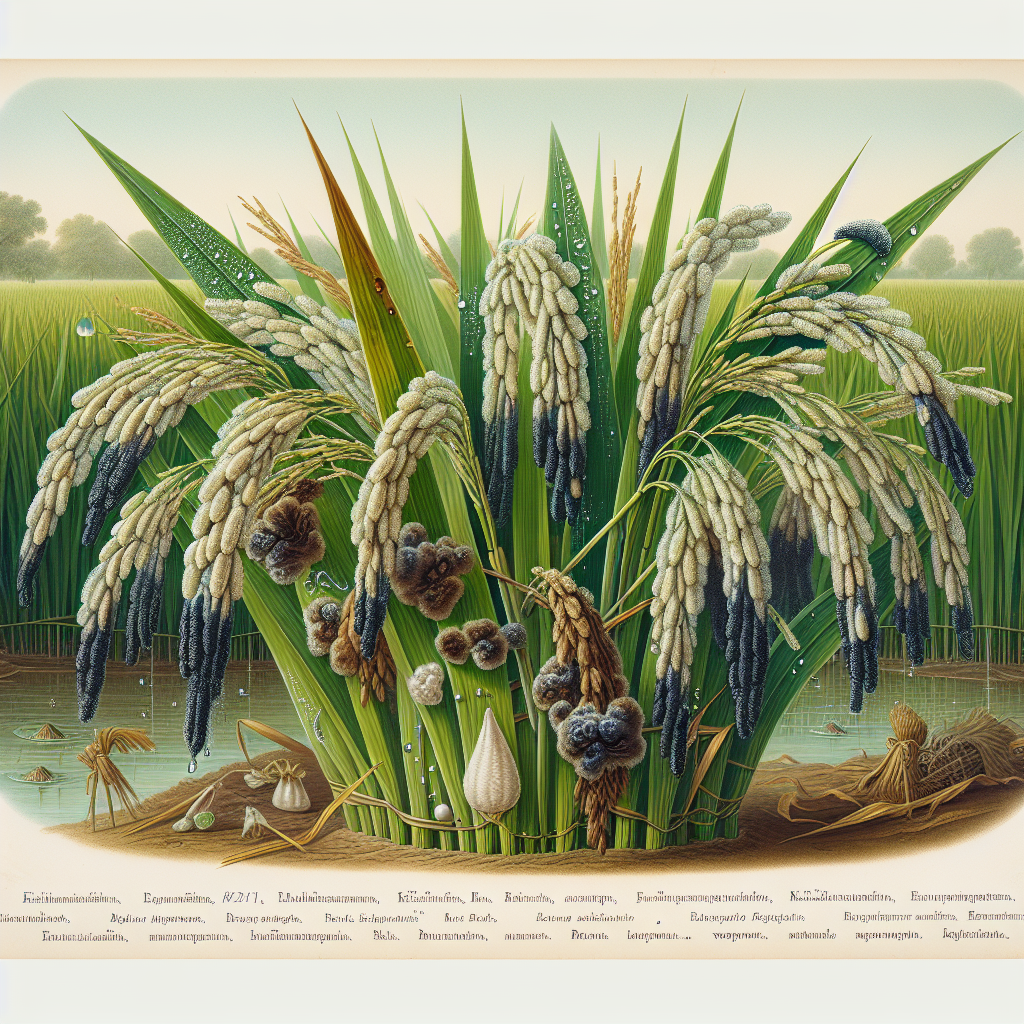
Introduction to Sheath rots
Sheath rots represent a complex of fungal diseases that target the leaf sheaths of cereal crops, most notably Rice (crop), where they cause substantial economic damage worldwide. Primarily incited by pathogens like Sarocladium oryzae (syn. Acremonium oryzae), Fusarium proliferatum, Fusarium semitectum, and Rhizoctonia oryzae, these diseases manifest during the reproductive stages of plant growth. Infected sheaths turn dark brown to black, often leading to lodging, reduced panicle exertion, and grain sterility. Global rice production suffers annual losses estimated at 10-20% in endemic areas, particularly in tropical and subtropical regions like Asia, Africa, and parts of the Americas. Understanding sheath rots is crucial for farmers aiming to safeguard yields, as timely diagnosis and integrated management can mitigate impacts effectively. This guide provides comprehensive diagnostic criteria, lifecycle insights, and organic strategies tailored for sustainable agriculture. For small-scale operations, early intervention using Soil Health Mastery: 5 Proven Strategies for Small Farms to Build Fertile Ground Without Breaking the Bank can enhance resilience against such diseases.
Identifying Symptoms & Damage
Accurate identification of sheath rots is foundational for effective management. Initial symptoms appear on the uppermost leaf sheaths at the boot stage or early heading, starting as small, water-soaked lesions that expand into irregular, grayish-white to straw-colored blotches. As infection progresses, these lesions turn dark brown to black, often with white mycelial growth or pinkish spore masses under humid conditions. The rotting sheath binds tightly around the culm, preventing panicle emergence (known as 'neck rot' in severe cases), resulting in white, empty panicles or 'whiteheads.'
Examine the sheath interior for shredding and presence of fungal sclerotia or mycelia. Differentiate from similar conditions like Fusarium (disease) sheath blight or Rhizoctonia (disease) by the absence of prominent sclerotia on outer leaf surfaces and the specific discoloration pattern. Damage assessment reveals 20-80% yield loss depending on infection timing; early infections cause sterility, while late ones reduce grain weight. In Wheat (crop) and Corn (crop), symptoms may mimic but are less severe, often confused with stalk rots (disease). Use a hand lens to spot microscopic conidia for confirmation. Severely affected fields show widespread lodging, exacerbating harvest losses.
Lifecycle and Progression of Sheath rots
The lifecycle of sheath rot pathogens is tightly synchronized with crop phenology, initiating from infected crop residues, seeds, or soilborne sclerotia. Sarocladium oryzae overwinters as mycelia in rice stubble, with conidia produced abundantly during warm, humid periods (25-30°C, >90% RH). Spores disseminate via wind, rain splash, or irrigation water, germinating on sheath surfaces wounded by insects like leafhoppers (pest) or mechanical injury.
Penetration occurs through stomata or wounds, with fungal hyphae colonizing the sheath cortex. Progression accelerates at booting (10-15 days before heading), where high nitrogen levels and dense canopies favor spread. Disease severity peaks during heading to milk stage, with secondary infections from conidial showers. In Barley (crop), similar cycles occur but with slower progression due to cooler climates. Pathogens persist in soil for 1-2 years, with Fusarium spp. showing longer viability via chlamydospores. Full cycle completes in 20-30 days, perpetuating epidemics in consecutive seasons without residue management. Understanding this progression allows for precise timing of interventions.
Environmental Triggers & Risk Factors
Sheath rots flourish under specific conditions: temperatures of 28-32°C, relative humidity >95%, and prolonged leaf wetness (>12 hours). High nitrogen fertilization (>150 kg/ha) promotes succulent sheaths, enhancing susceptibility. Poor field drainage, continuous flooding in rice paddies, and dense planting (>40 hills/m²) create microclimates ideal for spore germination. Risk amplifies in lowland, rainfed systems during prolonged rainy seasons or post-typhoon periods.
Susceptible varieties like traditional indicas and hybrids face higher incidence, compounded by stresses such as root-knot nematodes (pest) or nutrient imbalances. Crop rotation lapses, especially after Sorghum (crop) or Sugarcane (crop), build inoculum. Climate change exacerbates risks through erratic monsoons. In Oats (crop), cooler triggers (20-25°C) shift risks to late-season. Monitoring weather data and soil moisture is key; thresholds include 7-10 consecutive days of high RH.
Organic Control & Treatment Plans
Organic management of sheath rots emphasizes prevention and biocontrol, avoiding synthetic fungicides. Cultural Practices: Apply balanced nutrition (N:P:K 100:40:40 kg/ha) split-applied, avoiding excess nitrogen. Maintain water levels at 5 cm during critical stages to reduce humidity. Remove and burn infected debris post-harvest to eliminate inoculum.
Biological Controls: Seed-treat with Trichoderma harzianum (10 g/kg seed) or Pseudomonas fluorescens (20 g/kg) for antagonism. Foliar sprays of Bacillus subtilis (5 g/L) at boot stage, repeated twice at 10-day intervals, suppress pathogen growth by 40-60%. Integrate neem oil (2 ml/L) with garlic-chili extracts for repellency against vectors.
Resistant Varieties & Timing: Plant moderately resistant cultivars like IR36 or improved hybrids. Time sowing to evade peak humidity windows. For active infections, rogue severely affected tillers and apply silicon-rich amendments (20 kg/ha potassium silicate) to bolster cell walls.
Integrated Plan: Week 1 (boot stage): Biocontrol spray. Week 2: Silicon foliar. Monitor weekly; threshold >10% incidence triggers action. Field trials show 50-70% reduction in severity. Combine with companion planting of marigold (crop) for nematode suppression.
Preventing Sheath rots in the Future
Long-term prevention hinges on cultural fortification and rotation. Implement 2-3 year rotations with legumes (crop) or mustard (crop) to disrupt pathogen cycles. Solarize soil pre-season (6 weeks, 40-50°C) to kill sclerotia. Use certified, disease-free seeds treated organically.
Enhance field sanitation: Deep plow residues (>15 cm) and flood fields intermittently to desiccate inoculum. Promote airflow via optimal spacing (20x20 cm) and prune dense canopies. Foliar silicon and micronutrients (Zn, Mn) at tillering build tolerance. Scout weekly using 1m² quadrats; act below 5% incidence.
Resistant variety adoption, coupled with weather-based alerts, minimizes outbreaks. Community-level residue management curbs regional spread. Track progress with yield mapping; sustainable practices yield 15-25% higher net returns over time.
Crops Most Affected by Sheath rots
Sheath rots predominantly afflict gramineous crops, with Rice (crop) suffering the highest incidence (up to 90% in endemic zones). Wheat (crop), Corn (crop), Barley (crop), and Sorghum (crop) experience milder forms, often overlapping with Fusarium (disease) stalk rots. Tropical rices like Basmati and Jasmine varieties are highly vulnerable during grain filling. In Oats (crop) and Rye (crop), cool-season strains show sporadic outbreaks. Management across these crops shares organic strategies, emphasizing humidity control.