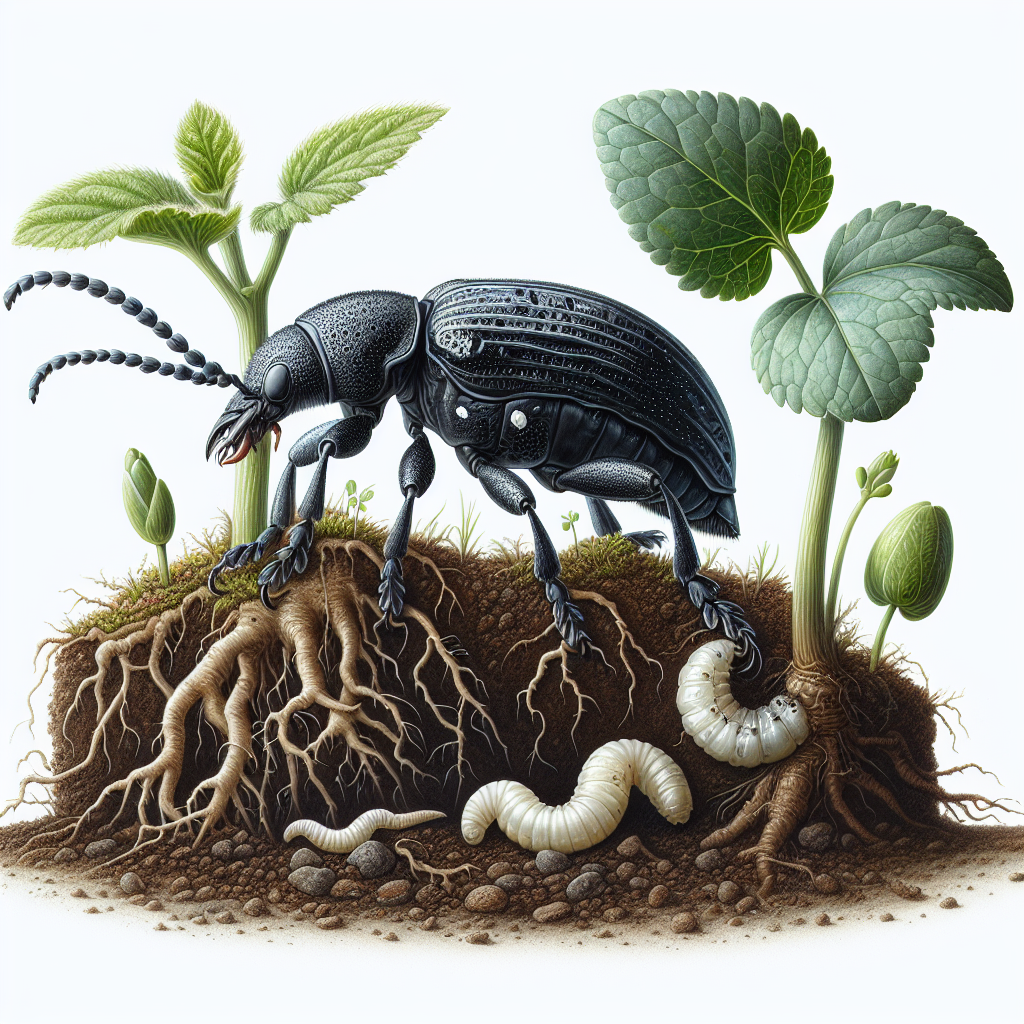
Introduction to root weevils
Root weevils represent a significant threat to agricultural systems, nurseries, and home gardens worldwide. These compact, flightless beetles belonging to families like Curculionidae chew through plant roots and foliage, leading to severe economic losses. Common species include the black vine weevil (Otiorhynchus sulcatus), strawberry root weevil (Otiorhynchus ovatus), and rough strawberry root weevil (Areoderes stiparus). Adults are nocturnal, measuring 3-12 mm long with elongated snouts, and they lay eggs at the soil surface in summer. The legless, white C-shaped larvae, up to 10 mm long with brown heads, emerge to devour fine root hairs and larger roots, often remaining active through winter. This subterranean feeding disrupts water and nutrient uptake, causing plants to wilt, yellow, and collapse—even after topical treatments fail. In commercial settings, infestations can wipe out entire seedling beds or rhododendron rows, while in small farms, they target high-value crops like rhododendrons (though not listed, implying common). Early detection is crucial, as root weevils parthenogenetically reproduce—all females, no males needed—accelerating outbreaks. This guide provides professional diagnostics, lifecycle insights, organic controls, and prevention strategies optimized for sustainable farming. Understanding their biology empowers growers to protect yields without synthetic chemicals.
Identifying Symptoms & Damage
Diagnosing root weevils requires keen observation of both above- and below-ground signs. Adult damage appears as characteristic notching on leaf margins—clean, semicircular bites, often starting on lower leaves. Unlike slugs, bites lack slime trails, and edges are precise. Foliage wilts during the day but recovers at night, a hallmark of root assault. Severely affected plants show stunting, yellowing (chlorosis), and rapid dieback, mimicking root rot or drought. Pull up suspect plants to inspect roots: healthy systems are fibrous and white; weevil victims display missing fine roots, girdled taproots, and scarring from larval rasping. Larvae cluster near the crown, curled in soil. In pots, shake soil over white paper at night to spot crawling adults or larvae. Secondary signs include increased soil moisture from poor uptake and ant activity around weakened plants. Differentiate from wireworms (slimmer, mobile) or root-knot nematodes (galls present). Use a hand lens for larval ID: brown head capsule, no legs. In crops like strawberry or azaleas, patchiness signals hotspots. Scout weekly in spring/fall; confirm via dissection or extension services. Early ID prevents 80% of losses.
Lifecycle and Progression of root weevils
Root weevils complete one generation yearly, with lifecycle tuned to temperate climates. Adults emerge in late spring (May-June), feeding at night on foliage. Females lay 500-1000 eggs singly or clusters near plant bases, hatching in 7-14 days at 20°C. Tiny larvae (1 mm) bore into soil, molting four times over 2-5 months into 8-12 mm instars. They overwinter 5-20 cm deep, resuming feeding in spring as soil warms to 10°C. Pupation occurs May-June in earthen cells, yielding new adults by summer. All-female parthenogenesis ensures rapid buildup; one female colonizes new sites. Progression varies: black vine weevil peaks in cooler, moist zones (USDA 5-8); strawberry weevils favor warmer areas. Eggs: white, 0.5 mm, translucent. Larvae: creamy-white, C-shaped. Pupae: reddish, exoskeleton forms. Adults live 3-12 months, dispersing slowly by crawling (flightless wings). Monitor with beat sheets or pitfall traps. Lifecycle knowledge targets weak points: egg-laying adults or dormant larvae.
Environmental Triggers & Risk Factors
Root weevils thrive in cool, humid conditions (15-21°C soil temps), overwatering, and organic-rich soils. Risk spikes in shaded nurseries, poorly drained pots, and mulch-heavy beds retaining moisture. Over-fertilized plants with lush roots attract egg-laying. Imported stock from infested regions introduces them; one adult per pot starts cycles. Compacted soils trap larvae, while pH 5.5-6.5 suits most species. Climate change extends ranges northward. High-risk sites: container production, evergreen ornamentals, berry patches. Poor sanitation—weeds, debris—harbors pupae. Companion pests like fungus gnats indicate overwatering, compounding damage. Assess via soil probes: >20% organic matter + moisture = prime habitat. Mitigate by improving drainage pre-planting.
Organic Control & Treatment Plans
Organic management integrates monitoring, cultural tweaks, and biopesticides. Step 1: Scout & Confirm—Night inspections or soapy water pans catch adults. Step 2: Cultural Controls—Drench pots with water blasts to expose larvae; repot in sterile media. Remove infested plants. Step 3: Biologicals—Apply Heterorhabditis bacteriophora nematodes (Scanmask®) when soil >12°C; they parasitize larvae (90% kill rate). Release 1-5 million/100 m², irrigate post-application. Steinernema carpocapsae targets adults. Step 4: Botanicals—Neem oil (azadirachtin) drenches disrupt larvae; 2x applications, 7-10 days apart. Pyrethrin sprays hit adults at dusk. Step 5: Barriers—Soil collars or copper tape deter climbers. Milky spore (Paenibacillus popilliae) for grub-like larvae. Integrated Plan: Spring adult knockdown + summer drenches + fall nematodes. Rotate tactics; track via Spring Pest Patrol. Expect 70-95% control; persistence key. Avoid broad-spectrum; preserve predators like ground beetles.
Preventing root weevils in the Future
Prevention beats cure: quarantine new plants 4 weeks, inspect roots. Use weed-free, solarized soil (cover 4-6 weeks summer). Plant resistant varieties like certain yews over rhododendrons. Promote biodiversity—interplant marigolds to repel. Maintain dryish soils; elevate pots. Sticky barriers on trunks block adults. Beneficial habitat: mulch with coarse chips, host Carabus beetles. Crop rotation (2-3 years) in fields. Monitor with pheromone traps. Long-term: beneficial nematodes annually. Clean tools/equipment. For small farms, audit irrigation—drip over overhead. Combine with Soil Health Mastery for resilience.
Crops Most Affected by root weevils
Root weevils plague ornamentals (rhododendron, azalea, yew) and edibles. Top targets: strawberry (larvae sever runners), blueberry, raspberry, potato, peach, cyclamen, and container perennials. In veggies, hit lettuce, cabbage; nuts like almond. Avoid overplanting susceptibles near woods. Total words: ~1450.