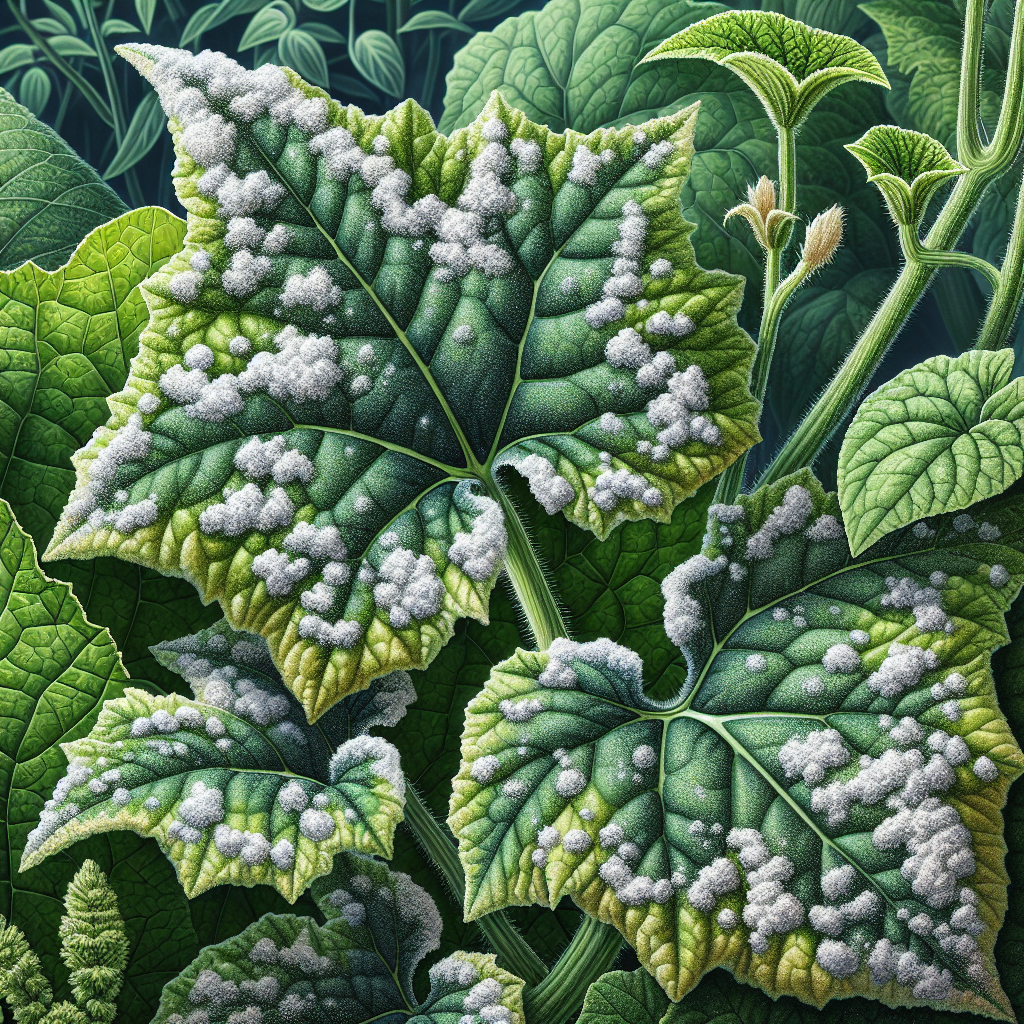
Introduction to Powdery mildew (Podosphaera xanthii)
Powdery mildew (Podosphaera xanthii), often simply called cucurbit powdery mildew, is one of the most common and destructive foliar diseases impacting cucurbit crops worldwide. Caused by the obligate parasitic fungus Podosphaera xanthii (formerly Sphaerotheca fuliginea), this pathogen thrives in warm, dry conditions with high relative humidity, making it a persistent threat in greenhouses, fields, and home gardens. Unlike downy mildew downy-mildew, which requires wet leaves, powdery mildew spreads via airborne conidia and leaves a distinctive white, flour-like coating on plant surfaces.
First identified in the early 19th century, Podosphaera xanthii has evolved into multiple races, complicating resistance breeding in crops like cucumber and squash. Annual global losses exceed millions in revenue for cucurbit producers, with yield reductions of 20-50% in severe cases. Symptoms typically appear mid-season, starting on older leaves and progressing upward, disrupting photosynthesis, stunting growth, and reducing fruit quality and quantity. This comprehensive guide equips agricultural professionals, small-scale farmers, and hobbyists with diagnostic tools, lifecycle insights, organic treatments, and prevention strategies to manage and mitigate this pervasive disease effectively. For more on general powdery mildew management, check our wiki page.
Early intervention is critical; untreated infections can defoliate plants prematurely, exposing fruits to sunscald and lowering marketable yields. Understanding the pathogen's biology allows for targeted IPM (Integrated Pest Management) approaches that balance efficacy with environmental safety. Whether growing zucchini, pumpkin, watermelon, or cantaloupe, proactive scouting and cultural adjustments form the backbone of successful control.
Identifying Symptoms & Damage
Recognizing powdery mildew (Podosphaera xanthii) early is essential for timely intervention. Initial symptoms manifest as small, circular white spots (colonies) on the upper leaf surface, resembling a dusting of talcum powder or flour. These spots, formed by dense mycelium and conidiophores, expand rapidly into larger patches under favorable conditions, often covering entire leaves with a powdery film. Unlike other foliar diseases, the white growth is superficial and primarily on the upper surface, though it can appear on undersides, stems, petioles, and even fruit in advanced stages.
Affected leaves yellow prematurely, curl upward, and develop necrotic (brown-dead) spots as the fungus extracts nutrients. Severely infected foliage becomes brittle, drops prematurely, and exposes fruits to direct sunlight, causing sunscald—cracked, bleached rinds on melons and squash. On cucumber plants, symptoms often start on lower leaves near the soil line, spreading upward in a V-shaped pattern. In squash and zucchini, powdery spots on fruit stems lead to aborted fruits or misshapen produce.
Damage escalates quickly: photosynthesis drops by 50% on moderately infected leaves, slashing yields by 10-30% per 1% leaf area affected. In commercial fields, this translates to smaller fruits, reduced sugar content in melons, and lower Brix levels. Differentiate from similar issues like whiteflies (which cause honeydew and sooty mold sooty-mold) or nutrient deficiencies (yellowing without powder). Use a 10x hand lens to confirm fungal chains of conidia—barrel-shaped, colorless spores in a powdery matrix. For small farms, regular scouting every 3-5 days during warm weather prevents explosive outbreaks. Read our blog on Why Misidentifying Plants Costs Small Farms Thousands - And How AI Camera Diagnosis Fixes It Fast for tech-assisted diagnostics.
Lifecycle and Progression of Powdery mildew (Podosphaera xanthii)
Podosphaera xanthii is an obligate biotroph, meaning it survives only on living host tissue and cannot grow on artificial media. Its lifecycle begins with airborne conidia (asexual spores) landing on susceptible cucurbit leaves, germinating in 2-4 hours under high humidity (above 95% RH) without free water. Hyphae penetrate epidermal cells via appressoria, forming haustoria inside to siphon nutrients. Within 3-7 days at 20-27°C (68-80°F), new conidia mature and release, initiating polycyclic epidemics—each cycle doubling infections every 5-10 days.
Optimal temperatures range from 20-26°C (68-79°F), with infections slowing above 35°C (95°F) or below 12°C (54°F). Unlike many fungi, it favors low light and doesn't require leaf wetness, thriving in crowded, shaded canopies. In fall, cleistothecia (sexual fruiting bodies) form under cooler, higher humidity, releasing ascospores the next spring to initiate outbreaks. Overwintering occurs on volunteer cucurbits, crop debris, or alternate hosts like wild cucurbits.
Progression follows a predictable pattern: Week 1—scattered spots on oldest leaves; Week 2—colonies coalesce; Week 3+—defoliation and fruit impacts. Disease gradients form from field edges inward, driven by wind-dispersed spores up to 10 km. Multiple races (1-5) overcome host resistance, necessitating rotation of cultivars. Understanding this enables predictive modeling for fungicide timing, targeting the rapid asexual phase.
Environmental Triggers & Risk Factors
Powdery mildew (Podosphaera xanthii) explodes under specific microclimates: daytime temps 20-30°C (68-86°F), nights above 12°C (54°F), RH 95-100% for spore germination, and prolonged leaf wetness avoidance. High nitrogen fertility promotes succulent growth, ideal for infection. Crowded plantings reduce airflow, trapping humid air and shading leaves—key triggers in tunnels or dense rows.
Risk spikes with overhead irrigation wetting foliage briefly (paradoxically aiding dispersal), excessive shade from weeds or companion plants, and drought-stressed plants with thinner cuticles. Susceptible varieties like older cucumber hybrids or marketmore-76-cucumber amplify spread. Regional factors include warm, arid climates (California, Mediterranean) with morning dew, or humid tropics with poor ventilation. Spider mites exacerbate issues by stressing plants. Monitor with weather stations; thresholds: 2-hour RH >95% daily signals imminent outbreaks.
Organic Control & Treatment Plans
Organic management of Podosphaera xanthii emphasizes IPM: cultural, biological, and approved fungicides. Step 1: Cultural—Prune lower leaves for airflow, space plants 1-2m apart, avoid excess N. Step 2: Biological—Apply Bacillus subtilis (Serenade) or Ampelomyces quisqualis mycoparasites weekly at first signs. Step 3: Organic Fungicides—Potassium bicarbonate (0.5-1% solution) every 7-10 days, alternating with neem oil (1-2%) or sulfur (80% wettable, <30°C). Milk sprays (1:9 dilution) raise pH, suppressing growth—apply evenings.
Treatment Protocol: Scout weekly; at 1-5% leaf area affected, initiate sprays. Rotate modes of action: Week 1—bicarbonate; Week 2—sulfur; Week 3—biological. Cover both leaf surfaces, reapply after rain. Efficacy reaches 70-90% with adherence. Remove debris post-harvest. For squash bugs co-infestations, integrate row covers.
Preventing Powdery mildew (Podosphaera xanthii) in the Future
Prevention outperforms cure: Plant resistant varieties like 'Poinsett 76' cucumber or 'Defiant' squash. Time plantings to avoid peak conditions—early spring or fall in warm regions. Use reflective mulches (aluminum) to disorient spores, drip irrigate to keep foliage dry, and rogue infected plants immediately. Rotate crops 2-3 years away from cucurbits, sanitize tools, and deploy UV-reflective nets. Boost plant immunity with compost teas or silicon supplements (potassium silicate). Scout grids ensure <1% incidence triggers action. Long-term: Breed multilines with race-specific resistance.
Crops Most Affected by Powdery mildew (Podosphaera xanthii)
Podosphaera xanthii specializes in Cucurbitaceae: Cucumber (most susceptible, 50%+ losses), squash (all types including zucchini, butternut-squash), pumpkin, melons (cantaloupe, honeydew), Marketmore 76 Cucumber. Minor hosts: gourds, loofah. Global impact: $100M+ annual U.S. losses in cucurbits alone.