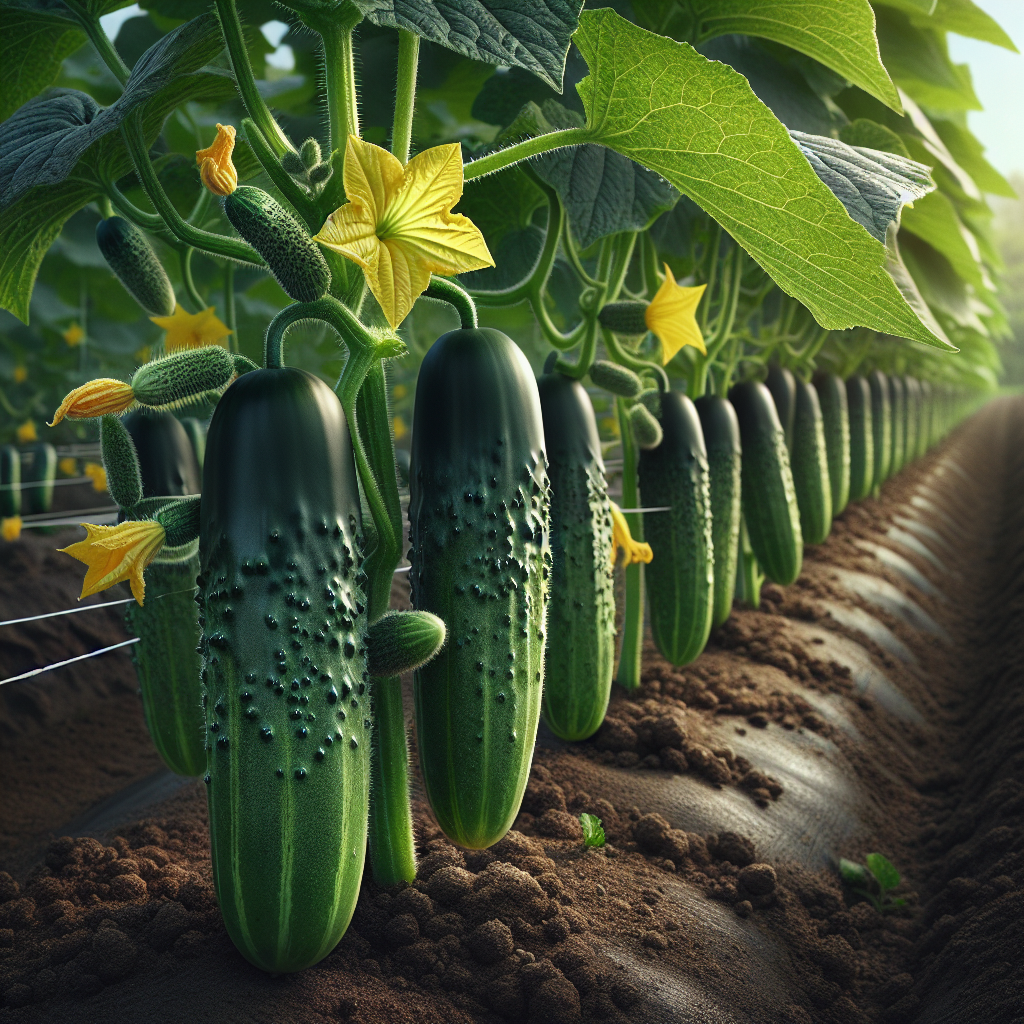
Introduction to Marketmore 76 Cucumber
Developed at Cornell University and released in the 1970s, this variety became popular because it answered a practical grower need: a reliable slicing cucumber that stayed productive under disease pressure and variable weather. It is widely recognized as one of the benchmark open-pollinated cucumbers for fresh eating, with straight to slightly tapered fruits, dark green skin, white flesh, and a mild, non-bitter flavor when grown under even moisture and harvested on time. Unlike many highly specialized modern hybrids, it offers a useful balance of resilience, seed-saving potential, and dependable field performance.
This is primarily a fresh-market slicing type rather than a true pickling cucumber. Fruits are usually best harvested around 7 to 9 inches long, though they can remain usable slightly beyond that if quality has not declined. Marketmore 76 is especially valued by growers who want a vine cucumber suitable for trellising, succession planting, and harvest over several weeks rather than a single flush.
As a cucumber, it shares the core growth habits of the species; for a broader species background, see the general Cucumber guide. For gardeners refining fertility and structure before planting, practical soil-building concepts are also covered in soil health strategies.
Botanical Profile of Marketmore 76 Cucumber
This cultivar belongs to the family Cucurbitaceae, the same family as melons, squash, and pumpkins. It is a warm-season annual vine with a shallow to moderately spreading root system concentrated heavily in the top 8 to 12 inches of soil, which explains its sensitivity to irregular watering and root-zone compaction. Seedlings emerge with two thick cotyledons, followed by rough, triangular true leaves with pronounced venation and a slightly abrasive surface due to fine hairs.
The plant is monoecious, meaning it typically bears separate male and female flowers on the same plant. Male flowers usually appear first, often several days before female flowers, which can alarm inexperienced growers but is completely normal. Female flowers are identifiable by the tiny immature cucumber, technically an inferior ovary, directly behind the blossom. Pollination is primarily by bees, especially honeybees and native solitary bees. Inadequate pollination leads to misshapen fruits, tip abortion, or yellowing young cucumbers that fail to size up.
Marketmore 76 is generally indeterminate in harvest habit, continuing to flower and fruit as long as heat, fertility, moisture, and pest pressure remain within a favorable range. Vines commonly run 5 to 6 feet or more if allowed to sprawl, but can be managed vertically on trellises. Leaves are medium to large and provide moderate fruit shading, which helps reduce sunscald in hot regions while still allowing good airflow if spacing is adequate.
Fruits are cylindrical, dark green, and slightly blocky when harvested at prime maturity. Skin is firmer and more textured than many thin-skinned greenhouse types, which contributes to better garden durability but also means overmature fruit can become coarse if left too long on the vine. Marketmore 76 is known for tolerance or resistance to several common cucumber diseases, particularly in comparison with older heirloom slicers, though exact performance still varies by seed line and regional pathogen pressure.
Soil, pH, and Climate Requirements for Marketmore 76 Cucumber
This variety performs best in fertile, well-drained loam or sandy loam with high biological activity and abundant organic matter. A target soil pH of 6.0 to 6.8 is ideal. It can still grow at pH 5.8 to 7.2, but nutrient efficiency begins to drop outside the preferred range. At low pH, calcium and magnesium availability can become limiting, while excessively high pH may reduce availability of iron, manganese, and phosphorus.
Drainage is non-negotiable. Cucumbers are vigorous when soil oxygen is abundant, but roots decline quickly in waterlogged ground. If water stands for more than 24 hours after rain or irrigation, expect slowed growth, pale foliage, root disease, and reduced fruit set. Raised beds 6 to 10 inches high are strongly recommended in heavier clay soils. Before planting, work in finished compost at about 1 to 2 inches over the bed surface, plus balanced organic fertility based on soil test results. A target soil organic matter level of 4 to 6% is excellent for moisture buffering and nutrient supply.
Warmth is essential. Seeds germinate best at soil temperatures between 80 and 95°F (27 to 35°C), though acceptable germination begins around 70°F (21°C). Below about 60°F (16°C), emergence is slow and uneven, and seedlings become vulnerable to damping-off. Air temperatures of 75 to 90°F (24 to 32°C) drive rapid vine growth and flowering. Growth stalls below 55°F (13°C), and chilling injury can occur after prolonged exposure to cool nights even without frost. Frost kills plants outright.
Consistent soil moisture is critical for Marketmore 76 because uneven water supply is one of the main triggers of bitterness, curved fruit, poor texture, and blossom drop. Aim to keep the top 6 to 8 inches of soil evenly moist but never saturated. In practical terms, soil should feel cool and crumbly, not dusty, and should form a weak ball in the hand that breaks apart with light pressure. If the soil smears, feels sticky, or smells sour, it is too wet. If leaves wilt by mid-morning rather than only during extreme afternoon heat, the plant is under water stress.
Humidity matters too. Moderate humidity supports growth, but persistently damp foliage and crowded canopies increase risk of Powdery Mildew, Angular Leaf Spot, and other foliar issues. Good airflow, morning irrigation, and trellising are especially beneficial in humid temperate and subtropical summers.
Step-by-Step Planting & Propagation
Start with high-quality seed, especially if sowing into cool spring soils where weak seed lots fail unevenly. Because cucumbers dislike root disturbance, direct sowing is often superior once conditions are warm enough. Transplants are useful for gaining 2 to 3 weeks in short-season climates, but they should be started only 2 to 3 weeks before setting out.
Prepare the bed thoroughly. Loosen soil to 10 to 12 inches deep, remove perennial weeds, and incorporate compost plus fertility amendments. Avoid fresh manure, which can push excessive vine growth and elevate disease pressure.
Wait for real warmth. Sow or transplant only after danger of frost has passed and soil temperature at 2 inches deep is at least 70°F (21°C), preferably warmer.
Direct sow seeds 1/2 to 1 inch deep. In lighter sandy soils, 1 inch is acceptable; in heavier soils, stay closer to 1/2 inch. Space seeds 8 to 12 inches apart if growing on a trellis, then thin to the strongest plants. For bushier field spacing without trellis, allow 18 to 24 inches between plants.
Space rows properly. Maintain 4 to 5 feet between rows for sprawling vines, or 3 to 4 feet between rows if trellised and pruned lightly. Good spacing is one of the easiest ways to reduce fungal pressure.
For hills, sow 3 to 4 seeds per hill in mounds about 12 to 18 inches across, spacing hills 3 to 4 feet apart. Thin to 1 or 2 strong plants after establishment.
If using transplants, sow in 3 to 4 inch biodegradable pots or soil blocks to reduce transplant shock. Harden plants for 4 to 5 days in protected outdoor conditions, then transplant carefully before roots circle heavily in the container.
Mulch after the soil has warmed. Organic mulch such as clean straw helps reduce splash-borne disease and stabilize moisture, but apply only once the soil is truly warm; early mulching in cool climates can slow establishment.
Install support early. A trellis 5 to 6 feet tall made from netting, welded wire, or sturdy twine improves straightness, reduces fruit rot, increases airflow, and makes harvest easier.
Propagation is almost always by seed. Because Marketmore 76 is open-pollinated, seed saving is possible if plants are isolated from other cucumber varieties to avoid crossing. Isolation distances for genetic purity can be substantial in open pollination because bees travel widely. Saved seed should come from fully mature, overripe fruits left on healthy vines until skin yellows and seed is fully developed.
Care & Maintenance regimes for Marketmore 76 Cucumber
Feed for steady growth rather than excessive lushness. Cucumbers need nitrogen, potassium, calcium, magnesium, and a full range of micronutrients, but too much nitrogen produces rampant vines with delayed flowering and softer tissue that attracts pests. A moderate preplant application of balanced fertilizer works well, followed by side-dressing when vines begin to run and again at first heavy fruit set if growth appears pale or slowed. If using organic inputs, blood meal or feather meal should be conservative, while compost, fish hydrolysate, and potassium-rich amendments can support balanced development.
Irrigation should deliver roughly 1 to 1.5 inches of water per week in mild weather, rising to 2 inches or more during hot, windy fruiting periods in sandy soil. Drip irrigation is strongly preferred. The key is root-zone consistency: repeated cycles of drought stress followed by heavy soaking lead to bitter fruit, cracked cucumbers, and blossom abortion. In actively fruiting plants, the top 2 inches should rarely become bone dry. Morning watering is ideal. Evening overhead irrigation that leaves leaves wet overnight significantly raises disease risk.
Watch the foliage for diagnostic clues. Slight afternoon droop on very hot days can be normal if plants recover by evening. Persistent limpness, dull leaf color, and smaller new leaves indicate inadequate moisture or root damage. Overwatered plants often show yellowing lower leaves, slowed growth, edema-like blistering, and increased susceptibility to root rots. If stems at the soil line become soft or dark, investigate drainage immediately.
Trellised systems produce cleaner fruit and can improve marketable yield. Guide young vines onto netting manually until tendrils secure them. Heavy pruning is not necessary, but removing the lowest yellowing leaves and any severely diseased foliage improves airflow. Avoid aggressive pruning that exposes fruit to intense sun or removes too much photosynthetic area.
Pollination support is often overlooked. Do not spray insecticidal materials, even organic ones, during open bloom when bees are active. Poor pollination causes fruits that are narrow at one end, hooked, or aborted when small. If bee activity is low, plant flowering insectary companions nearby and avoid broad-spectrum controls.
Weed management is important early. Cucumbers compete poorly during establishment because their root system is shallow and their canopy takes time to close. Keep the first 4 to 6 weeks especially clean. Use shallow cultivation only; deep hoeing can sever roots and set plants back.
Succession sowing every 2 to 3 weeks through the early warm season can extend harvest and reduce the impact of midseason disease collapse. In many climates, a second sowing after the first flush is more productive than trying to nurse old vines through severe pest and mildew pressure.
Pests, Diseases & Organic Management
The main insect pests are Cucumber Beetles, Aphids, Spider Mites, Squash Bugs in some regions, and occasionally Thrips. Striped and spotted Cucumber Beetles are particularly serious because they not only chew leaves and scar fruit, but can vector Bacterial Wilt. Young seedlings are most vulnerable. Floating row cover used immediately after planting is highly effective, but it must be removed at flowering unless hand pollination is planned.
Aphids colonize tender growth and the undersides of leaves, causing curling, sticky honeydew, and transmission of mosaic viruses. Small populations can be suppressed with strong water sprays or insecticidal soap applied carefully during cooler hours. Spider Mites become more serious in hot, dusty conditions and cause stippling, bronzing, and fine webbing. Increasing humidity around the root zone through mulching, minimizing dust, and preserving predatory mites helps reduce outbreaks.
Key diseases include Powdery Mildew, Downy Mildew, Angular Leaf Spot, Anthracnose, Bacterial Wilt, and viral complexes such as Cucumber Mosaic Virus. Marketmore 76 has a reputation for useful disease tolerance, but tolerance is not immunity. Once pathogen pressure is high, cultural practices determine whether the planting remains productive.
For organic management, begin with prevention:
- Rotate cucurbits out of the same bed for at least 3 years where disease pressure is significant.
- Use drip irrigation instead of overhead watering.
- Trellis plants to speed leaf drying.
- Remove heavily infected leaves early, but do not over-defoliate.
- Destroy crop residue promptly after final harvest.
- Avoid working among plants when foliage is wet.
Powdery Mildew appears as white, dusty patches on older leaves, usually later in the season. It reduces photosynthesis and shortens harvest duration. Sulfur or potassium bicarbonate products can help if applied early, but good spacing and resistant genetics are the foundation. Downy Mildew causes angular yellow lesions bounded by veins, with gray-purple growth on leaf undersides in humid conditions; it can collapse plantings quickly. Fast sanitation and regional awareness are important.
Bacterial Wilt is especially devastating because plants may look healthy, then suddenly wilt irreversibly. Control centers on cucumber beetle suppression rather than treatment after symptoms appear. Viral diseases often produce mottled, distorted leaves and malformed fruit; rogue badly affected plants if infection is severe, and control vectors like Aphids.
Beneficial companion plantings can support integrated pest management. Radish, Sunflower, and Thyme are often used around cucumber plantings to diversify habitat and attract beneficial insects, though companioning should complement, not replace, sound sanitation and rotation.
Harvesting, Curing & Optimal Storage
Harvest frequently and at the correct stage. For Marketmore 76, prime harvest is usually when fruits are 7 to 9 inches long, uniformly dark green, firm, and before seeds enlarge noticeably. Waiting too long reduces eating quality, thickens the skin, coarsens the seed cavity, and signals the plant to slow additional fruit production.
Use a knife or pruners, or twist carefully without tearing the vine. Harvest every 1 to 2 days in peak season. Oversized fruits left on the plant act as reproductive sinks, diverting energy away from new flowering and fruit set. Cull misshapen or yellowing fruit promptly.
Unlike onions or winter squash, cucumbers are not cured. They are highly perishable, high-moisture fruits and should be shaded immediately after harvest. Field heat removal is important. Never leave picked cucumbers in direct sun or stacked deeply in hot containers, as softening and moisture loss begin fast.
For best storage, keep fruits at about 50 to 55°F (10 to 13°C) with 90 to 95% relative humidity. Below roughly 45°F (7°C), chilling injury can develop, causing pitting, water-soaked areas, and rapid breakdown once returned to room temperature. In a typical household refrigerator, cucumbers often keep only about 5 to 7 days before quality declines because temperatures are usually colder than ideal. Wrapping fruit loosely or storing in perforated plastic helps reduce moisture loss.
Handle fruit gently. Skin abrasions become entry points for decay organisms. Wash only just before use unless food safety requires immediate washing, since free surface moisture can shorten storage life.
If saving seed, allow selected fruits to remain on the vine far beyond eating stage until fully mature, enlarged, and yellow to orange-yellow depending on environment. Extract seed from softened mature fruit, ferment briefly if desired to clean pulp, rinse thoroughly, and dry completely before storage.
Companion Planting for Marketmore 76 Cucumber
Useful companion choices emphasize pollinator support, pest distraction, and efficient space sharing rather than folklore alone. Radish can be interplanted early as a quick crop and may help occupy soil before cucumber vines spread. Thyme works well at bed edges, where its flowers attract beneficial insects and its low habit does not compete heavily for light. Sunflower can function as a pollinator attractor and wind filter, though it should be placed so it does not shade cucumbers excessively.
Other compatible neighbors include lettuce and shallow-rooted greens planted early before vine expansion, plus non-competing insectary herbs nearby. Avoid crowding cucumbers with aggressive sprawling cucurbits like pumpkins or large squash, which can increase humidity and intensify competition. Keep a sensible distance from potatoes in tight gardens if disease management and airflow are already difficult.
The best companion strategy for this variety is ecological balance: flowering species for pollinators, aromatic herbs for beneficial insect recruitment, and quick-maturing intercrops that are harvested before cucumber vines dominate the bed. In production systems, companion planting works best when paired with crop rotation, trellising, mulching, and disciplined harvest intervals.