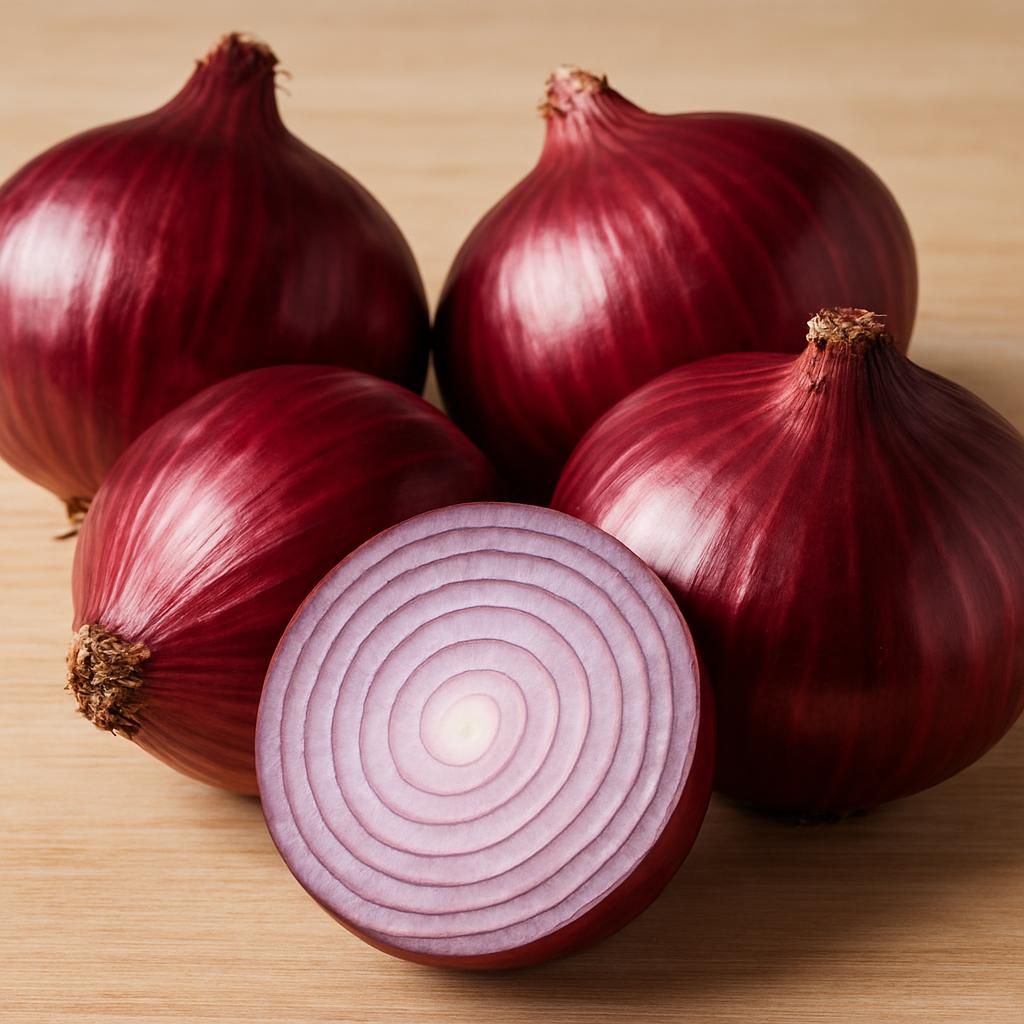
Introduction to Onion (Red Wethersfield)
Red Wethersfield is a classic long-day red onion variety developed in the 19th century in Connecticut. It produces large, flattened-globe bulbs with glossy mahogany-red skins and crisp white flesh streaked with pink concentric rings. The variety is renowned for its pungent flavor when raw, which mellows to a sweet, rich taste when cooked or caramelized. Because it requires 14–16 hours of daylight to bulb properly, it performs best in northern latitudes above 35°N. Growers value its hardiness, disease resistance, and ability to store for 6–8 months under proper conditions.
Botanical Profile of Onion (Red Wethersfield)
Red Wethersfield belongs to the Amaryllidaceae family. Plants form a rosette of hollow, blue-green leaves that reach 12–18 inches tall. Each bulb develops from a single growing point; the concentric fleshy scales store carbohydrates and sulfur compounds responsible for pungency. The variety is open-pollinated, allowing seed savers to maintain genetic diversity. Flowering stalks (scapes) emerge in the second year if vernalized; seed heads produce hundreds of small black seeds. Onion is the parent species for all modern bulb onions.
Soil, pH, and Climate Requirements for Onion (Red Wethersfield)
Red Wethersfield demands loose, fertile, well-drained loam or sandy loam soils free of stones that could deform bulbs. Heavy clay restricts root expansion and increases rot risk. Raised beds or ridges improve drainage in wet climates. The crop prefers full sun (minimum 8 hours) and cool temperatures during early growth.
| Parameter | Ideal Range | Notes |
|---|---|---|
| Soil Type | Sandy loam to loam | Stone-free, deep tilth |
| Soil pH | 6.0–7.0 | Below 5.8 increases clubroot risk |
| Organic Matter | 3–5 % | Incorporate well-rotted compost |
| Day Length | 14–16 hours | Long-day requirement for bulbing |
| Temperature (growth) | 55–75 °F (13–24 °C) | Cool spring; avoid prolonged heat |
| Frost Tolerance | Hardy to 20 °F (-7 °C) | Seedlings tolerate light frost |
Step-by-Step Planting & Propagation
- Start seeds indoors 8–10 weeks before the last spring frost in cell trays filled with sterile seed-starting mix. Maintain 60–70 °F soil temperature for 70 % germination within 7–10 days.
- Harden off seedlings for 7–10 days, then transplant when they reach pencil thickness and outdoor soil is at least 50 °F.
- Set transplants 1 inch deep, 4 inches apart in rows 12–18 inches apart. For direct seeding, sow ½ inch deep and thin to the same spacing.
- In southern zones below 35°N, plant short-day or intermediate-day red varieties instead.
- Use Garlic or Shallots (Zebrune) rotation to break pest cycles.
Care & Maintenance regimes for Onion (Red Wethersfield)
Consistent moisture and balanced fertility are critical. Over-fertilization with nitrogen after bulb initiation produces thick necks and poor storage.
| Growth Stage | Water Schedule | Fertilizer Schedule | Pruning / Other |
|---|---|---|---|
| Seedling (0–4 wks) | Keep top inch moist; 0.5 in/week | ¼ strength balanced liquid weekly | None |
| Vegetative (4–8 wks) | 1–1.5 in/week; drip irrigation ideal | Side-dress ½ cup 10-10-10 or fish emulsion | Weed weekly; mulch with straw |
| Bulb Swell (8–12 wks) | Reduce to 0.75 in/week | High-phosphorus, low-nitrogen (5-10-10) | Cease nitrogen; hill soil slightly |
| Pre-Harvest (2 wks) | Withhold water 7–10 days before lift | None | Break tops if lodging occurs |
Pests, Diseases & Organic Management
Common insect threats include onion thrips, cutworms, and onion maggot. Diseases such as downy mildew, purple blotch, and botrytis neck rot can reduce yields. Practice 3–4 year rotations with non-allium crops. Floating row covers exclude maggot flies at planting. Apply neem oil or insecticidal soap for thrips at the first sign of silvery streaking. Copper-based fungicides or Bacillus subtilis products manage fungal leaf spots. Remove and destroy infected foliage to limit overwintering inoculum.
Harvesting, Curing & Optimal Storage
Harvest when 50–75 % of tops have fallen and bulbs show full color. Lift carefully with a fork to avoid bruising. Cure in a warm (75–80 °F), well-ventilated area for 10–14 days until necks are dry and papery. Trim roots and tops to 1 inch. Store at 32–40 °F with 65–70 % relative humidity in slatted crates or mesh bags; good air circulation prevents sprouting and rot. Properly cured Red Wethersfield bulbs remain marketable for 6–8 months.
Companion Planting for Onion (Red Wethersfield)
Onions deter carrot rust fly and cabbage loopers when planted near Carrot and Cabbage. Avoid planting near Peas or Beans because alliums can inhibit legume nodulation. Marigold and Nasturtium provide additional pest-repellent benefits and attract beneficial insects. Lettuce appreciates the light shade provided by onion foliage in early summer. Rotate away from other alliums to prevent shared soil-borne pathogens.