Introduction to Liberty Apple
Developed in New York as part of a long-term breeding effort to combine fruit quality with durable disease resistance, this cultivar has become one of the most respected apples for growers who want dependable crops without intensive fungicide programs. Its parentage includes complex disease-resistant breeding lines and traditional quality apples, with the variety released in the late 20th century after extensive testing for scab resistance and orchard performance.
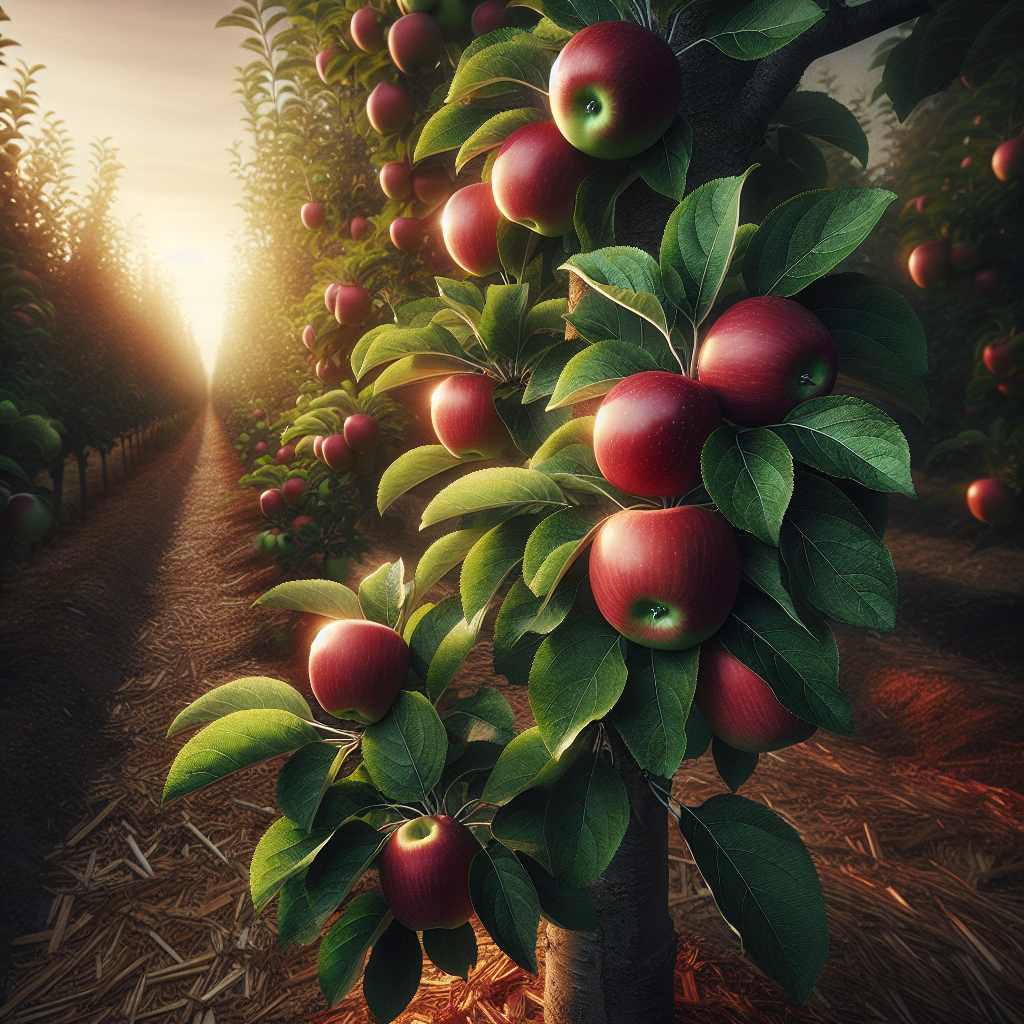
The fruit is typically medium-sized, with a deep red to dark burgundy blush over a greenish-yellow background, and flesh that is cream-colored, juicy, and firm. Flavor is usually sprightly rather than bland, balancing sweetness with noticeable acidity. That profile makes it useful both fresh and in the kitchen. It is often harvested in mid-season to mid-late season, depending on location, and performs especially well in northern and northeastern apple-growing regions.
For growers comparing cultivars, Liberty is often chosen when disease pressure is high, summers are humid, and a resilient orchard is more important than producing highly cosmetic supermarket fruit. If you want broader apple background, see our Apple guide. Liberty is not completely maintenance-free, but it is among the most forgiving apples for small orchards, homesteads, and ecologically managed plantings.
Botanical Profile of Liberty Apple
This is a clonally propagated cultivar of Malus domestica, typically grafted onto rootstocks that determine mature tree size, anchorage, drought tolerance, and bearing age. Like other apples, it is a deciduous pome fruit tree in the Rosaceae family. Trees form flower buds on spurs and short shoots, and crop load is heavily influenced by pruning, pollination, and biennial bearing pressure.
Tree vigor is generally considered moderate, though actual growth habit depends strongly on the rootstock. On dwarfing rootstocks such as M.9 or B.9, the tree remains compact and precocious, often fruiting within 2 to 3 years. On semi-dwarf stocks such as M.26 or MM.106, it develops a more substantial canopy and stronger framework. Standard rootstocks produce larger trees, but they are less commonly used in intensive plantings because of delayed bearing and greater pruning and harvest labor.
Bloom period is usually mid-season. That matters because it affects pollination compatibility and frost exposure. Liberty is not reliably self-fertile for commercial purposes and benefits from cross-pollination by another mid-blooming apple nearby. Fruit is borne on spurs, so preserving productive fruiting wood while renewing older, shaded wood is central to long-term management.
One of the defining traits is resistance to apple scab, historically linked to the Vf resistance source used in breeding. In practice, this greatly reduces defoliation and fruit spotting in regions where Venturia inaequalis is a chronic problem. However, resistance to one disease does not eliminate vulnerability to others. Cedar apple rust, Fire blight, Powdery mildew, sooty blotch, flyspeck, and various insect pests can still affect trees depending on climate and orchard sanitation.
Fruit texture is usually crisp when properly harvested, and the apples hold shape fairly well in cooking. Storage life is respectable but not indefinite; flavor often mellows after a few weeks in cold storage. The fruit can become less distinctive if overripe on the tree, so harvest timing is more important than many new growers realize.
Soil, pH, and Climate Requirements for Liberty Apple
This cultivar performs best in well-drained loam or sandy loam with moderate water-holding capacity and high biological activity. Ideal soil depth is at least 24 to 36 inches before hardpan, dense clay, or rock limits root exploration. Poor drainage is one of the fastest ways to weaken young apple trees. If water stands for more than 24 hours after heavy rain, root oxygen becomes limiting, feeder roots die back, and susceptibility to crown and root diseases rises sharply.
Target soil pH is 6.0 to 6.8, with 6.2 to 6.5 being especially favorable for balanced nutrient availability. Below pH 5.8, calcium, magnesium, and phosphorus availability often decline, while manganese and aluminum may become excessive. Above pH 7.0, iron, zinc, and manganese deficiencies become more likely, especially on calcareous soils. A pre-plant soil test is essential. If lime is needed, incorporate it months before planting because pH correction in orchard soils is slow.
Organic matter around 3% to 5% is ideal for most orchard sites. Too little organic matter reduces moisture buffering and nutrient cycling. Excessively rich, highly manured soils can push rank vegetative growth, which delays fruiting and increases Fire blight risk. Nitrogen should be moderate, not lavish.
Liberty is best adapted to temperate climates with a distinct winter chill period and warm but not extreme summer heat. It is generally dependable in USDA zones roughly 4 through 8, though local heat, humidity, and rootstock choice matter. Winter chilling is required for uniform bud break and flowering. In warm-winter regions with inadequate chilling, flowering may be prolonged and uneven, reducing pollination efficiency and fruit set.
Full sun is non-negotiable for fruit color, sugar accumulation, and bud initiation. Trees need at least 8 hours of direct sunlight daily. Shaded trees may survive, but fruit color will be weaker, canopy humidity higher, and disease pressure significantly worse.
Moisture management should be precise. During establishment, maintain soil moisture in the main root zone at a consistently moist but aerated level, roughly comparable to a soil that forms a weak ball in the hand but does not smear or ooze water. In practical terms, the top 2 inches may dry somewhat between irrigations, but the 6- to 12-inch depth should remain lightly moist. Chronic saturation causes yellowing leaves, poor extension growth, darkened roots, and sometimes a sour soil smell. Drought stress shows as dull leaves, leaf curl during afternoon heat, reduced shoot growth, fruit drop, and small fruit.
Spring frost is a real risk during bloom. The open king bloom and side blossoms are vulnerable once temperatures fall below about 28 to 30°F (-2 to -1°C), depending on stage. Good orchard siting means planting on gentle slopes with air drainage rather than frost pockets.
Step-by-Step Planting & Propagation
Commercially and practically, this cultivar is propagated by grafting rather than seed. Seedling offspring will not come true to type and are unsuitable if the goal is authentic Liberty fruit quality and disease profile.
Select a rootstock based on your system. Dwarf rootstocks are ideal for high-density plantings and easy harvest but usually require permanent staking. Semi-dwarf rootstocks offer a balance of vigor and manageability. Choose rootstocks compatible with your soil drainage, winter temperatures, and intended spacing.
Source dormant, certified disease-free nursery trees. One-year feathered whips or well-structured branched trees are best. Avoid trees with bark wounds, circling roots, or swollen crown tissue.
Prepare the site the season before planting if possible. Remove perennial weeds in at least a 3- to 4-foot strip or circle. Correct pH and phosphorus or potassium deficiencies before planting because post-plant incorporation is difficult.
Plant in early spring in cold climates, or late fall to winter in regions with mild winters and workable soil. Bare-root trees should be planted while dormant. Keep roots damp and shaded before planting; even 15 to 20 minutes of drying wind can damage fine roots.
Dig a hole wide enough to spread roots naturally, usually 2 to 3 times the root spread, but no deeper than needed. The graft union should remain 2 to 4 inches above the finished soil line, especially on dwarfing rootstocks, to prevent the scion from rooting and negating the rootstock's size control.
Backfill with native soil rather than heavily amended pocket soil. Light compost incorporation across a broader area is acceptable, but creating a rich bowl in otherwise poor soil can discourage outward root exploration.
Water immediately after planting to settle soil around roots. A newly planted tree generally needs enough water to moisten the root zone 10 to 12 inches deep. In many soils, that means 3 to 5 gallons at planting for bare-root dwarf trees and more for larger stock.
Install support if on dwarf rootstock. A sturdy stake or trellis should go in at planting to avoid later root injury.
Head the tree appropriately. Unbranched whips are often headed at 30 to 36 inches to induce scaffold formation. Feathered trees may need selective branch retention and leader management depending on the training system.
Mulch with wood chips or shredded bark 2 to 4 inches deep, keeping mulch 3 to 6 inches away from the trunk to prevent vole habitat and crown rot.
Spacing depends on rootstock and training. Dwarf trees may be spaced 3 to 6 feet in-row and 10 to 14 feet between rows. Semi-dwarf trees often need 10 to 16 feet in-row and 14 to 18 feet between rows. Standard trees need substantially more.
Pollination planning is essential. Plant at least one compatible mid-blooming apple cultivar within pollinator flight distance, generally within 50 feet for home orchards or interplanted rows in commercial blocks.
Care & Maintenance regimes for Liberty Apple
The first three years determine much of the tree's lifetime structure and productivity. During establishment, prioritize root growth, scaffold selection, weed suppression, and avoiding overcropping. Any fruit allowed on a very young tree diverts carbohydrates from canopy and root development. On dwarf trees, removing most fruit in year 1 and often year 2 improves long-term performance.
Irrigation should be adjusted by soil type and weather, not calendar alone. Young trees commonly require 5 to 10 gallons once or twice weekly in moderate weather, but sandy soils may need more frequent smaller applications, while loams hold moisture longer. Mature trees need deep irrigation during critical periods: bloom through cell division after fruit set, and again during dry late summer conditions if rainfall is deficient. The goal is to avoid severe water deficits during fruit sizing. Drip irrigation is preferred because it keeps foliage dry and reduces disease spread.
Nutrient management should follow annual leaf and soil testing where possible. As a general rule, apple trees need modest nitrogen compared with many annual crops. Excess nitrogen creates lush, Fire blight-prone shoots and softer fruit. Young non-bearing trees may receive small spring nitrogen applications to support framework development. Bearing trees often need less, especially if shoot growth already exceeds 12 to 18 inches annually on mature scaffolds. Low vigor, pale leaves, and short extension growth can indicate deficiency; excessively long, upright watersprouts often indicate surplus.
Calcium matters for fruit firmness and storage quality. In marginal soils or heavy cropping years, foliar calcium sprays may improve storage performance and reduce bitter pit-like disorders, though Liberty is not the most notorious cultivar for calcium issues. Maintain even soil moisture because fluctuating water supply reduces calcium movement into fruit.
Training systems include central leader, tall spindle, and modified leader forms. For most growers, a central leader system is practical. Maintain one dominant leader, establish wide-angled scaffold branches, and prevent narrow crotches that split under crop load. Use limb spreaders or clothespins early while wood is still flexible.
Winter pruning should remove dead, diseased, crossing, and shaded wood while preserving fruitful spurs. Summer pruning can help control vigor and improve light penetration, especially in dense canopies. The objective is not simply smaller trees, but a canopy where dappled light reaches all productive wood. Poor light distribution reduces red color development, lowers soluble solids, and accelerates spur decline.
Fruit thinning is critical. Apples often set more fruit than the tree can size properly. Thin when fruitlets reach about 10 to 15 mm diameter, ideally leaving one fruit per cluster and spacing apples roughly 6 to 8 inches apart on branches. This improves size, color, return bloom, and branch strength. Failure to thin can trigger biennial bearing, where a heavy crop year is followed by a light one.
Weed control around the root zone is especially important for young trees. Grass competes aggressively for water and nitrogen. Maintain a vegetation-free strip at least 2 to 3 feet wide on each side of the trunk row. Living groundcovers are better kept in alleyways than directly at the trunk.
Trunk protection is important in winter. Use guards against rodents and sunscald, especially on young trees. Check guards regularly so they do not trap moisture or insect pests.
For orchard floor improvement and fertility planning, the principles in soil health strategies are especially helpful when establishing long-lived perennial systems.
Pests, Diseases & Organic Management
The great advantage here is strong resistance to apple scab, which can dramatically reduce spray needs in humid regions. In susceptible cultivars, scab causes olive-black leaf lesions, premature defoliation, and blemished fruit; Liberty largely avoids the worst of that problem. Still, resistance should be treated as a tool, not a guarantee. Pathogen populations can shift, and mixed disease pressure remains real.
Fire blight is one of the most serious threats, especially in warm, wet bloom periods and on overfertilized trees. Symptoms include blackened blossoms, shepherd's-crook shoot tips, and cankers on limbs. Organic management relies on reducing succulent nitrogen-driven growth, pruning out strikes well below visible symptoms during dry weather, sanitizing tools between cuts, and avoiding excessive pruning that stimulates lush regrowth. In severe regions, blossom-time organic sprays approved locally may be considered as part of an integrated program.
Cedar apple rust may appear as bright orange leaf spots and fruit lesions where junipers are nearby. Resistance is better than in some apples but not absolute. Improve airflow, reduce nearby alternate host pressure if feasible, and monitor spring weather patterns.
Powdery mildew can infect terminals and young leaves, causing gray-white fungal growth and distorted shoots. Prune infected shoots during dormancy and maintain an open canopy.
Summer rots, sooty blotch, and flyspeck become more problematic in extended humid weather, especially if fruit remains shaded or the canopy stays wet. Good pruning, sanitation, and adequate spacing are often more effective than reactive treatments.
Key insect pests include codling moth, plum curculio, apple maggot, aphids, mites, and scale. codling moth larvae tunnel directly into fruit; plum curculio causes crescent-shaped egg-laying scars and internal feeding; apple maggot creates winding tunnels in flesh. Organic control is strongest when multiple tactics are combined:
- Remove and destroy dropped fruit weekly during pest-active periods.
- Use pheromone traps for codling moth monitoring.
- Bag individual fruit after thinning in small plantings.
- Apply kaolin clay films where appropriate to deter egg laying and feeding.
- Encourage beneficial insects with flowering borders and minimal broad-spectrum sprays.
- Use dormant oil to suppress overwintering scale, mite eggs, and some aphid populations.
aphids often flare on lush shoots. Beneficial insects such as lacewings, syrphid flies, and lady beetles often keep them below damaging levels if insecticide use is restrained. Heavy infestations causing curled terminals may justify targeted soap or oil applications, but avoid spraying during pollinator activity.
Rodents and deer can be devastating in winter. voles girdle trunks under mulch or snow cover, while deer browse buds and young shoots. Keep mulch back from trunks, mow nearby vegetation, use trunk guards, and fence where deer pressure is significant.
Sanitation is a core disease management practice: remove mummified fruit, prune dead wood, rake heavily infected leaves if other diseases are present, and never compost diseased material unless the pile reaches reliably high temperatures.
Harvesting, Curing & Optimal Storage
Fruit is usually ready from late September into October in many northern regions, though exact timing depends on climate, rootstock, crop load, and seasonal weather. Harvest maturity should be judged by more than skin color. Liberty can color early, especially in cool nights, before flavor and starch conversion are fully developed.
Professional indicators include background color shift from hard green toward yellow-green, easier separation from the spur when lifted and twisted, dark brown seed color in many fruits, and starch reduction when tested. For home growers, taste is still one of the best indicators: the flesh should be crisp and juicy, with balanced sweet-tart flavor rather than starchy blandness.
Pick carefully by hand, rolling the fruit upward so the stem stays attached. Do not yank downward, which tears spurs and reduces next year's fruiting sites. Handle gently; bruising shortens storage life and invites rot.
Unlike onions, potatoes, or garlic, apples are not "cured" in the classic dry-down sense. What they benefit from is rapid cooling after harvest. Move fruit to shade immediately, then refrigerate as soon as possible. Ideal storage is 30 to 32°F (-1 to 0°C) with 90% to 95% relative humidity. At lower humidity, apples shrivel. At warmer temperatures, respiration accelerates and texture softens.
Store only sound fruit. One bruised or infected apple can spread decay through a box. Sort out cracked, insect-damaged, or overripe fruit for immediate use in sauce, cider, or baking. In good cold storage, Liberty often keeps for several weeks to a few months, though it is not among the longest-storing apples. Flavor often improves briefly after harvest as acidity mellows, then declines if held too long.
Avoid storing apples near produce highly sensitive to ethylene unless separation is possible. Apples release ethylene gas, which can accelerate ripening or senescence in nearby crops.
Companion Planting for Liberty Apple
The most useful companions around apple trees are those that improve pollinator activity, attract beneficial insects, and suppress competitive weeds without creating dense, humid conditions around the trunk. Orchard companion planting should focus on the dripline and alleyways, not right against the bark.
Thyme is valuable as a low-growing aromatic groundcover in sunny edges. It helps occupy space, attracts pollinators when in bloom, and does not usually compete as aggressively as turfgrass if kept away from the immediate trunk zone.
Yarrow is excellent for drawing in predatory and parasitic insects. Its umbels are especially useful to hoverflies and small wasps that help regulate aphids and other orchard pests. Plant it where it receives sun and can naturalize without crowding young tree roots.
Clover can be used in alleyways or managed strips as a nitrogen-contributing living cover, but it should be monitored carefully around young trees because any living understory competes for water. In established orchards, clover can improve soil structure, support pollinators, and reduce erosion when mowed appropriately.
Nasturtium is often used in diversified plantings to attract beneficial insects and serve as a trap or distraction plant for some soft-bodied pests. It is especially useful in mixed home orchards where aesthetics and ecological diversity matter.
Keep all companion species several inches away from the trunk itself. The critical zone immediately around young trunks should remain mulch-dominant and free of dense vegetation. If using flowering companions, stagger bloom periods so beneficial insects have forage before, during, and after apple bloom, but avoid creating a jungle-like understory that traps humidity or gives rodents cover.