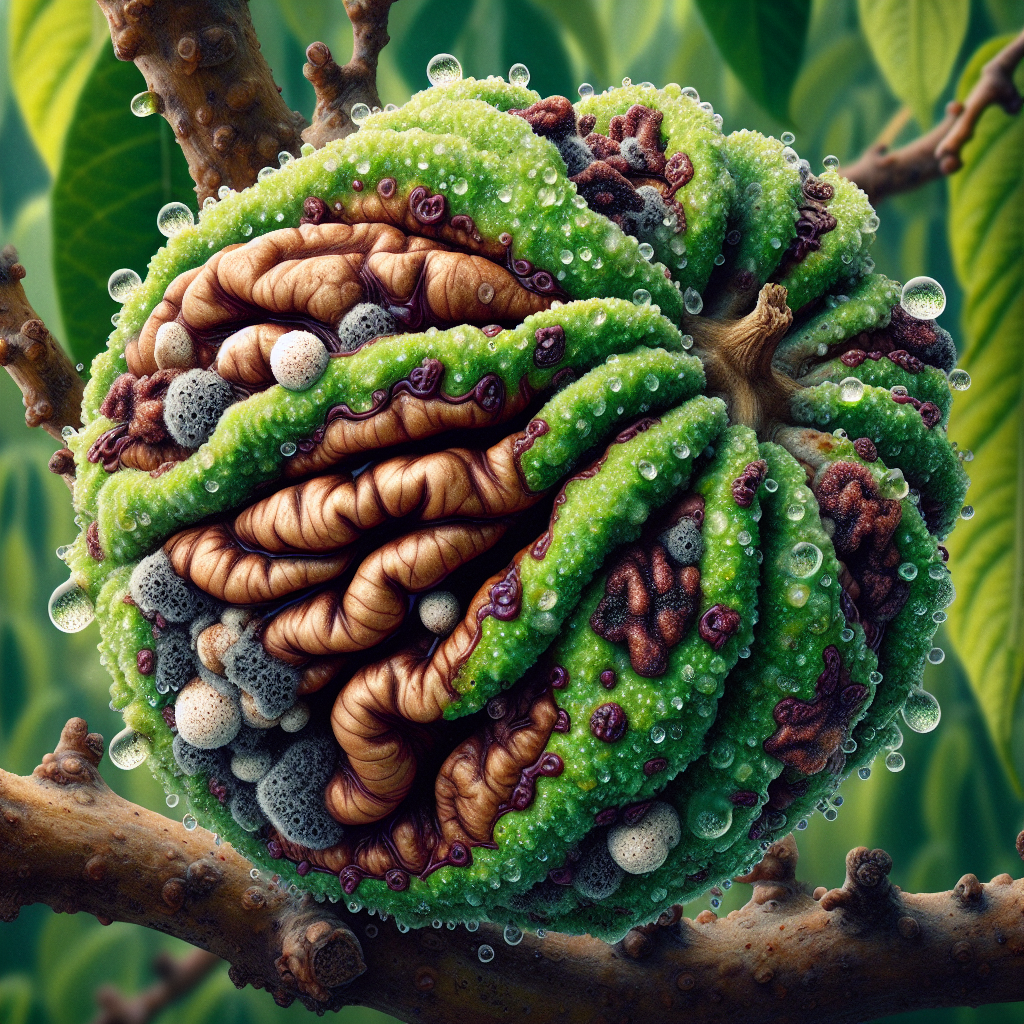
Introduction to husk rot
Husk rot is a serious fungal disease that strikes at the heart of nut production, particularly targeting the protective outer husks of developing fruits in crops like pecan, walnut, and chestnut. Caused mainly by species of the oomycete genus Phytophthora, including P. palmivora and P. nicotianae, this pathogen exploits prolonged periods of moisture on fruit surfaces, leading to soft, water-soaked lesions that progress to full rot. First identified in subtropical and tropical nut orchards, husk rot has spread globally wherever humid conditions coincide with susceptible varieties, causing yield losses of up to 50-80% in severe outbreaks.
As a soil- and splash-borne disease, husk rot spreads via rain-splashed spores, irrigation runoff, and contaminated tools or equipment. Unlike foliar diseases, it specifically attacks the husk, sparing the inner nut in early stages but rendering fruits unmarketable due to decay and secondary infections from pests like sap beetles. Farmers often confuse it with hull rot or shuck disorders, but diagnostic signs like sporangia under wet husks distinguish it. Early detection is critical, as advanced rot leads to nut drop and mycotoxin contamination. This guide provides professional-grade diagnostics, lifecycle insights, organic treatments, and prevention strategies to safeguard your harvest. For small farms battling weather unpredictability, tools like hyper-local forecasts can be a game-changer—check out Why 80% of Small Farms Battle Weather Disasters - And How Hyper-Local AI Forecasts Can Save Your Harvest.
Understanding husk rot's biology empowers growers to implement integrated management, reducing reliance on chemical sprays while boosting resilience. In high-risk areas like the southeastern U.S., Gulf Coast, and parts of Australia, proactive scouting during rainy seasons is non-negotiable. This disease not only impacts yield but also quality, with rotted husks staining nuts black and promoting aflatoxin buildup. By combining cultural controls with organic amendments, producers can achieve sustainable suppression, often below economic threshold levels.
Identifying Symptoms & Damage
Early symptoms of husk rot appear as small, water-soaked spots on the husk surface, typically 3-10 mm in diameter, often near the stem end or injuries. These lesions expand rapidly under humid conditions (>90% RH), turning dark brown to black with a fuzzy white mycelial growth or sporangia visible under magnification. Husks become soft and slippery, easily detaching from the nut, and emit a fermented odor due to secondary bacterial invasion. In advanced stages, the entire husk rots away, leaving shriveled or mummified nuts that drop prematurely.
Damage manifests as 20-100% fruit loss depending on timing—early infections abort nuts entirely, while mid-season rot ruins marketability. In pecan orchards, affected shucks fail to split naturally, trapping kernels and inviting hickory shuckworm or pecan nut casebearer. Walnuts show similar husk breakdown, with black slime oozing from cracks, while chestnuts exhibit rapid bur decay, compromising seed viability. Differentiate from anthracnose by the absence of sunken cankers or from Phytophthora root rot by targeting only husks, not roots or trunks.
Scout weekly during wet weather: slice open suspect husks to check for watery flesh and white sporulation. Use a hand lens (10x) to spot lemon-shaped sporangia, confirmatory for Phytophthora. Yield impacts are severe in dense canopies where humidity lingers; trees under stress from root-knot nematodes or drought show exacerbated symptoms. Economic thresholds vary: remove >5% infected husks per tree to prevent spread. Secondary effects include reduced photosynthesis from defoliation and increased susceptibility to Botryosphaeria panicle and shoot blight.
Lifecycle and Progression of husk rot
Phytophthora spp. persist in soil as thick-walled oospores or chlamydospores, surviving years without a host. Primary infection begins with zoospores motile in saturated soils, splashing onto husks during rain. Under 20-30°C and free water >8 hours, biflagellate zoospores encyst, germinate, and penetrate husk epidermis directly or via wounds. Mycelium ramifies internally, producing sporangia in 3-5 days that release new zoospores in wet cycles.
The disease progresses in phases: incubation (2-7 days), lesion expansion (1-2 cm/day in optimal conditions), sporulation (under persistent leaf wetness), and nut drop (10-21 days post-infection). Multiple cycles occur per season in rainy climates, with peak activity July-September. Unlike obligate parasites, Phytophthora is necrotrophic, killing tissue outright. Overwinters in debris or infected roots, reinfecting via splash or tools. Progression accelerates in alkaline soils (pH>7) or with excess nitrogen, weakening husk cuticles.
In walnut, progression from spot to full rot takes 7-14 days; in pecans, 5-10 days under irrigation. Secondary inoculum from rotted husks fuels epidemics, with spores viable 48 hours in films of water. Understanding this polycyclic nature underscores sanitation's role—remove debris to break the cycle.
Environmental Triggers & Risk Factors
Husk rot thrives in warm (25-32°C), wet conditions with >48 hours leaf wetness, common in humid subtropics. Poor drainage, heavy clay soils, and overhead irrigation create splash zones, elevating risk 3-5x. High-density planting (>200 trees/acre) traps humidity, while shallow roots from compacted soils stress trees, mimicking Phytophthora crown rot. Susceptible varieties like 'Desirable' pecan or 'Hartley' walnut amplify outbreaks.
Excessive N-fertilization (>150 kg/ha) promotes lush husks prone to infection; drought stress followed by rain triggers microcracks for entry. Contaminated floodwater or equipment spreads oospores miles downstream. Climate change intensifies risks with erratic storms—pair monitoring with Why Misidentifying Plants Costs Small Farms Thousands - And How AI Camera Diagnosis Fixes It Fast. pH>7.5 favors P. nicotianae; low sunlight in crowded canopies extends wetness periods.
Organic Control & Treatment Plans
Organic management centers on cultural IPM: prune for airflow (20-30% canopy removal), avoiding spring growth flushes. Apply 4-6 inches mulch (not touching trunks) to suppress soil splash, using composted pine bark for acidity. Phosphonate-based organics like potassium phosphite (3-5 gal/acre, 0-0-27 NPK) boost SAR, applied at pink bud and repeated every 21 days during rain forecasts—efficacy >70% in trials.
Trichoderma harzianum (e.g., RootShield) drenches soil at 1 lb/100 gal, colonizing roots against Phytophthora. Copper octanoate (Bonide Liquid Copper) sprays (1-2 gal/100 gal) at early symptoms halt spread, OMRI-listed for organics. Remove and burn infected husks weekly; solarize soil pre-planting (clear plastic, 6 weeks summer). Bacillus subtilis (Serenade) alternates with phosphites for resistance management. In heavy infections, trunk-inject phosphorous acid—systemic and rainfast.
Integrated plans: Scout + forecast → preventive phosphite → curative copper/Bacillus. Rotate with hairy vetch cover crops to suppress soil inoculum. Trials show 85% control combining sanitation + biorationals vs. 40% fungicides alone.
Preventing husk rot in the Future
Site selection is foundational: well-drained ridges, pH 6.0-6.8, avoiding low spots. Plant resistant rootstocks like 'Pawnee' pecan or 'Paradox' walnut hybrids. Drip irrigate, scheduling <1 inch/week, avoiding midday wetting. Annual soil tests guide balanced nutrition—K:Ca 3:5 ratio hardens husks.
Sanitation protocols: deep plow debris post-harvest, disinfect tools (10% bleach). Companion plantings like marigold deter nematodes. Boost microbiome with mycorrhizal inoculants at planting. Monitor via sticky traps for vectors, apps for wetness hours. Long-term: breed resistant cultivars, diversify orchards with pistachio. Annual phosphite pre-season prevents 90% incidence.
Crops Most Affected by husk rot
Primarily pecan (up to 70% loss), walnut, chestnut, and macadamia. Secondary: avocado husks (Hass avocado), cashew, and pistachios. Tropicals like mango show minor husk issues. Focus on nuts with fibrous, moisture-retaining husks.