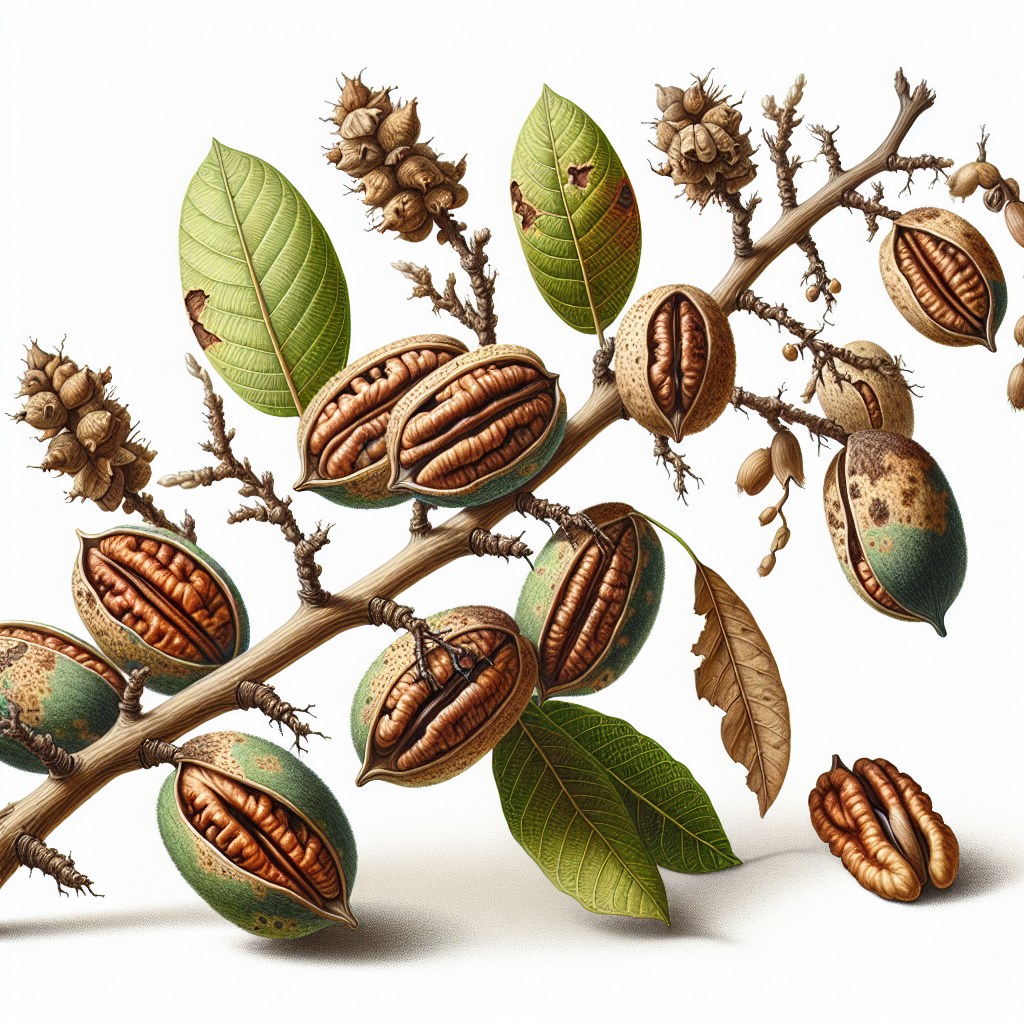
Introduction to shuck disorders
Shuck disorders represent a critical challenge for nut growers, especially those cultivating pecans, where the shuck—the green, fleshy outer covering of the nut—fails to develop properly or exhibits abnormal symptoms. Unlike infectious diseases caused by fungi, bacteria, or viruses, shuck disorders are primarily physiological, triggered by abiotic factors such as water stress, nutrient deficiencies, high temperatures, and hormonal imbalances. These issues manifest during the critical kernel fill stage, leading to significant economic losses through reduced nut quality, increased sticktights (nuts that fail to fill and remain stuck in the shuck), and blank nuts (empty shells).
In pecan production, shuck disorders like shuck decline, vivipary (premature sprouting within the shuck), and black shuck necrosis can reduce yields by 20-50% in severe cases. Early identification and management are essential, as these disorders often mimic pest or disease symptoms, such as those from hickory shuckworm or pecan scab. This guide provides professional-grade diagnostic criteria, lifecycle insights, and organic management strategies tailored for small to medium-scale orchards. By understanding triggers and implementing preventive measures, growers can safeguard harvests and improve long-term orchard health. For small farms optimizing operations, tools like those in Why Timing Kills Small Farm Profits - And How AI Task Scheduling Saves Your Harvests can help schedule critical interventions precisely.
Identifying Symptoms & Damage
Accurate diagnosis begins with recognizing distinct symptoms of shuck disorders. Primary signs include uneven shuck maturation, where parts of the shuck remain green while others yellow prematurely. Common manifestations are:
- Stuck shuck or sticktights: Shucks fail to split open at maturity, trapping underdeveloped kernels. Affected nuts feel light and rattle loosely in the shell.
- Shuck decline: Shucks turn brown, leathery, and necrotic from the base upward, often with a distinct black line demarcating healthy and dead tissue.
- Vivipary: Shoots emerge prematurely from kernels still enclosed in the shuck, triggered by high humidity and temperature fluctuations.
- Shuck mottling: Irregular yellow-brown spots or chlorotic areas on shucks, progressing to necrosis without fungal sporulation.
Damage assessment involves shaking branches over a tarp to count sticktights (target <5% incidence). Kernels from affected nuts show poor filling, with thin, shriveled meat and low oil content, reducing market value by up to 70%. Differentiate from biotic issues: shuck disorders lack mycelium, insect frass, or pathogen spores visible under 10x magnification. Associated damage includes premature leaf drop and reduced photosynthesis, compounding yield losses in subsequent seasons. In companion crops like peach orchards interplanted with pecans, monitor for cross-stress from shared root-knot nematodes.
Lifecycle and Progression of shuck disorders
Shuck disorders follow a predictable progression tied to pecan phenology, from shuck elongation (Stage 3) through kernel fill (Stage 5-6) to dehiscence (Stage 7). Symptoms typically emerge 60-90 days after pollination during gel stage, when rapid cell division demands optimal water and zinc availability.
- Initiation (Early kernel fill): Subtle chlorosis at shuck tips due to water deficit or zinc deficiency.
- Progression (Mid-kernel fill): Shuck walls thicken abnormally, vascular tissues collapse, leading to necrosis. High ethylene production exacerbates decline.
- Climax (Late kernel fill): Shucks fail to split; kernels abort, forming blanks. Vivipary occurs if humidity >85% and temps >32°C.
- Resolution: Unaffected nuts dehisce normally; disorders halt further nut development but do not spread.
The 'lifecycle' is annual, with severity influenced by prior-year carryover stress like Phytophthora root rot. Progression accelerates under heat waves, completing in 10-14 days versus 4-6 weeks under ideal conditions. Scouting every 7-10 days during kernel fill is crucial for early intervention.
Environmental Triggers & Risk Factors
Shuck disorders thrive under specific abiotic stresses:
- Water stress: Deficit irrigation during kernel fill (>20% soil moisture drop) causes stomatal closure and ABA accumulation, aborting shuck growth.
- Nutrient imbalances: Zinc deficiency (<20 ppm in leaves) impairs auxin transport; excess nitrogen delays maturity.
- Temperature extremes: >35°C days or <15°C nights disrupt carbohydrate partitioning.
- Soil factors: Compacted, saline soils (>4 dS/m) or pH >8.0 limit root uptake.
- Cultural practices: Over-thinning or mechanical injury predisposes shucks to decline.
Risk is highest in young orchards (<5 years), sandy soils, and regions with erratic rainfall like the U.S. Southeast. Varieties like Desirable and Stuart show higher susceptibility than Elliot or Sumner. Co-occurring issues like armyworms can mimic or exacerbate symptoms.
Organic Control & Treatment Plans
Organic management emphasizes prevention over cure, as disorders are not curable post-onset. Integrated strategies include:
- Irrigation scheduling: Drip systems maintaining 20-30% volumetric water content during kernel fill. Mulch with 4-6 inches of wood chips to retain moisture.
- Nutrient optimization: Foliar zinc sulfate (2-3 lbs/acre, 3 applications at 2-week intervals) from gel stage. Soil drench with compost tea for micronutrients.
- Canopy management: Prune to 40-50% light interception; thin nuts to 50-60 per tree for 'on' years.
- Biological amendments: Apply mycorrhizal inoculants and Trichoderma at planting to enhance root health against secondary root rots.
- Monitoring: Use pressure bomb for water status; tissue testing every 21 days.
Treatment timeline: Initiate at half-shell hardening. For active cases, remove affected clusters to redirect resources. Success rates exceed 70% with proactive IPM, avoiding synthetic hormones or fungicides.
Preventing shuck disorders in the Future
Long-term prevention builds resilient orchards:
- Site selection: Well-drained loams with pH 6.0-7.0; avoid low-lying frost pockets.
- Cultivar choice: Plant resistant varieties like 'Caddo' or 'Lakota'.
- Soil health program: Annual cover crops (clover), gypsum for sodic soils, and no-till to boost organic matter >3%.
- Irrigation infrastructure: Automated systems with tensiometers calibrated to ETo.
- Nutrient budgeting: Annual soil tests; maintain Zn:Fe ratio <1:10.
- Record-keeping: Track weather, irrigation, and yields to predict risks.
Integrated with pest monitoring for black pecan aphids, these practices reduce incidence to <2%. Rotate with sorghum in off-years to break stress cycles.
Crops Most Affected by shuck disorders
Primarily pecans, with episodic occurrences in hickory, walnut (Chandler Walnut), and chestnut (American Chestnut). Pecans account for 95% of cases due to their thin shucks and high water demand. Secondary crops include pecan relatives and stone fruits with husk-like structures, though true shuck disorders are nut-specific.