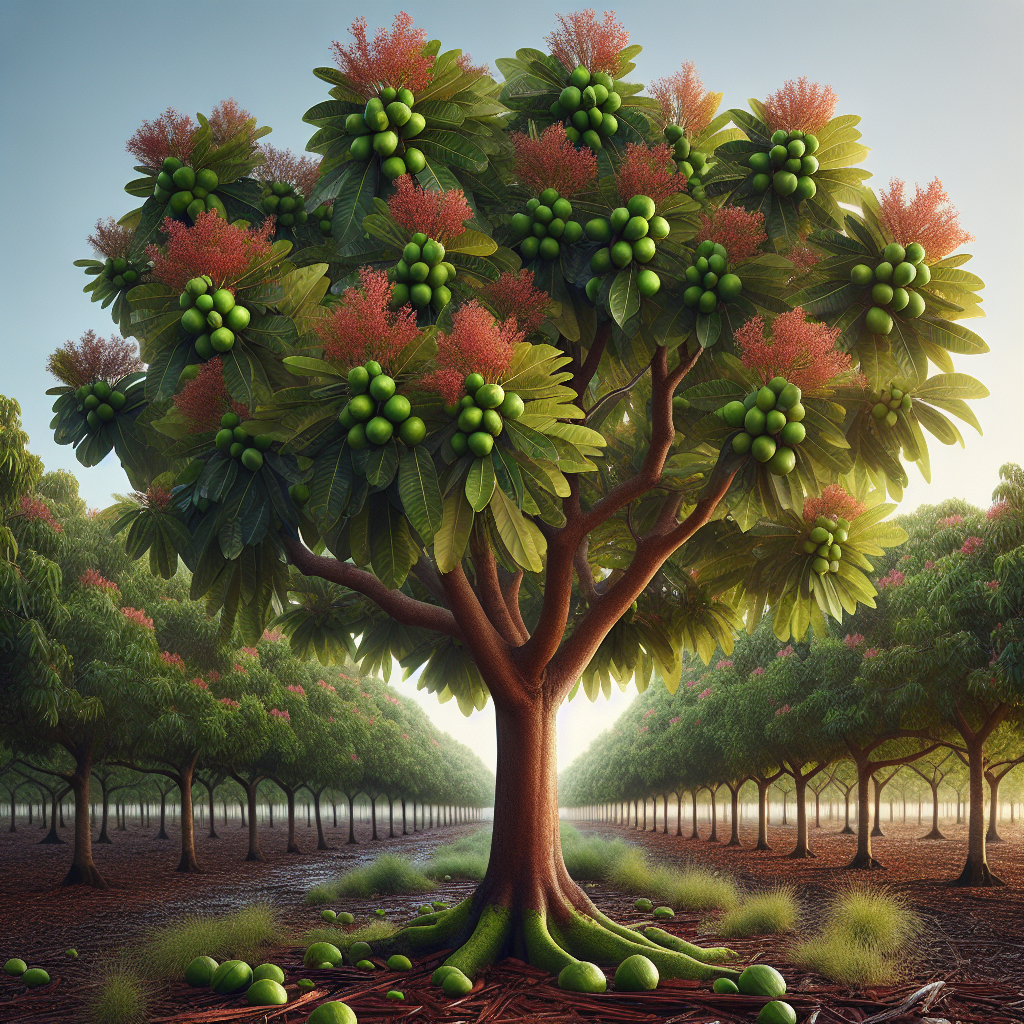
Introduction to Beaumont Macadamia
A widely planted hybrid macadamia selection, this cultivar is believed to have originated in Australia and is commonly recognized as a cross between Macadamia integrifolia and Macadamia tetraphylla. That parentage explains many of its field traits: strong vigor, a relatively spreading tree habit, attractive reddish to pink young foliage, and dependable cropping where chill is limited but humidity and rainfall can fluctuate. Compared with finer-shell, premium-kernel cultivars, it is often chosen by growers because it establishes quickly, flowers heavily, and can serve both as a commercial tree and as a pollinizer in mixed orchards.
Its strengths are real, but so are its management demands. Beaumont is not a neglect-tolerant nut tree. It responds poorly to waterlogging, compacted soil, chronic salinity, and overly shaded planting sites. In return for good drainage, balanced fertility, and canopy control, it can produce substantial yields of hard-shelled nuts with good flavor and strong kernel oil content. Growers new to macadamias should understand that this is a long-lived orchard species; site preparation decisions made before planting often determine productivity for decades.
For a broader species overview, see the Macadamia guide. If you are improving orchard floor fertility and structure before planting, the principles in soil health strategies are especially relevant.
Botanical Profile of Beaumont Macadamia
This cultivar belongs to the family Proteaceae, a botanical group notable for its specialized nutrient uptake and sensitivity to excessive phosphorus. That one fact alone shapes fertilizer strategy: macadamias, including Beaumont, should never be treated like heavy-feeding citrus or stone fruit trees. Overapplication of phosphorus can damage roots and disrupt trace element balance.
Beaumont is typically classified as a hybrid between M. integrifolia and M. tetraphylla. The integrifolia background contributes smoother shell characteristics and commercial nut quality, while the tetraphylla influence often shows up in stronger vigor, rougher shell tendencies, and a degree of adaptation to slightly cooler subtropical sites. In the field, Beaumont often develops into a medium-to-large evergreen tree, frequently reaching 8-12 meters if unpruned, with a broad crown and dense branch framework.
Leaves are leathery, glossy, and arranged in whorls, commonly with serrated margins more typical of hybrid or tetraphylla-influenced material. The new flush is one of the cultivar's most recognizable ornamental features, often emerging bronze, pink, or red before hardening to green. Flowering occurs on pendent racemes bearing many small, cream to pinkish flowers. Pollination is primarily by insects, especially bees, and although Beaumont can set a crop on its own, cross-pollination with other compatible macadamia cultivars usually improves nut set and yield consistency.
The fruit is a follicle with a green husk surrounding an extremely hard shell and edible kernel. Nuts mature over an extended period rather than in one perfectly synchronized flush. In many regions, mature nuts fall naturally when ready, which is the preferred harvest indicator. Kernel recovery can be lower than in elite crack-out cultivars because Beaumont often has a thick shell, but its reliability and vigor make it valuable in mixed plantings.
Soil, pH, and Climate Requirements for Beaumont Macadamia
This tree demands one non-negotiable condition: rapid drainage with adequate moisture retention. Ideal soil is a deep, friable loam or sandy clay loam with at least 1 meter of penetrable rooting depth. Heavy clay can be used only if planted on large mounds or ridges and if internal drainage is demonstrably good after prolonged rain. If water stands for more than 24-48 hours in the root zone, the risk of root decline and Phytophthora infection rises sharply.
Optimal soil pH is mildly acidic, roughly 5.2 to 6.5. Below pH 5.0, aluminum and manganese toxicity can reduce root growth; above pH 6.8, iron, zinc, and manganese deficiencies become more common, particularly in calcareous soils. Beaumont is less forgiving of alkaline conditions than some backyard growers expect. On high-pH sites, leaves may yellow between veins, new growth may appear weak, and nut set can decline even when irrigation is adequate.
Organic matter should be moderate and biologically active, but avoid creating a perched, soggy planting pocket by adding rich compost only into the hole. It is better to amend broadly across the row or orchard block and use surface mulches after planting. Macadamia feeder roots occupy the upper soil layers, so surface conditions matter enormously. A mulch ring 8-12 cm deep, kept 15-20 cm away from the trunk, helps stabilize temperature, reduce evaporation, and support root health.
Climatically, Beaumont is best suited to warm subtropical to tropical highland conditions. Ideal average temperatures are about 20-30°C during active growth, with flowering and nut fill performing best where extreme heat is moderated by humidity or maritime influence. Young trees are vulnerable to frost injury; mature trees can tolerate brief light frosts, but repeated freezes damage leaves, flowers, and young stems. Sustained temperatures below about -2°C can cause serious injury, especially in exposed sites.
Wind is another critical factor. Strong hot winds desiccate flower racemes, interfere with pollinator activity, and increase premature nut drop. Cold winds can scar foliage and slow establishment. In windy districts, windbreaks are strongly recommended, but they should be porous rather than solid, so airflow is reduced without creating damaging turbulence.
Water needs are steady rather than extreme. During establishment, the root zone should remain evenly moist but never saturated. As a practical target, soil in the top 20-30 cm should feel cool and slightly moist when squeezed, not muddy or anaerobic. Warning signs of overwatering include dull yellowing leaves, lack of new flush, blackened feeder roots, sour-smelling soil, and nuts dropping before maturity. Underwatering shows as folded or drooping leaves during the hottest part of the day that do not recover by evening, reduced shoot extension, small nuts, and poor kernel fill.
Step-by-Step Planting & Propagation
Commercially, Beaumont is almost always propagated vegetatively, usually by grafting onto seedling rootstocks. Seed propagation does not produce type-true trees and should be reserved for rootstock production or breeding. If buying nursery stock, select grafted trees with a clear graft union, a straight central leader, healthy white roots visible at the container edge, and no root spiraling or severe circling.
Choose a full-sun site with enough room for the tree's mature spread. Spacing depends on management intensity, but 8 × 4 meters, 8 × 5 meters, or 10 × 5 meters are common high-density to moderate orchard layouts. Wider spacing may be needed if pruning is minimal. In home plantings, keep trees well away from septic fields, poorly drained low spots, or hardscape that limits root expansion.
Before planting, deep-rip compacted ground if needed, especially in old pasture or former construction sites. Correct major pH issues several months ahead rather than at planting. Build mounds 30-60 cm high in marginally heavy soils. Install irrigation before planting so soil can be wetted uniformly.
Planting sequence:
- Water the nursery tree thoroughly a few hours before planting.
- Dig a hole no deeper than the root ball and about 1.5 to 2 times as wide.
- Gently remove the tree and tease out circling roots only if they are severe; do not excessively disturb a fragile root ball.
- Set the tree so the top of the root ball sits level with or slightly above surrounding soil.
- Backfill with native soil rather than a rich amended mix.
- Water in deeply to eliminate air pockets.
- Stake only if the site is windy; allow slight movement for trunk strengthening.
- Mulch broadly, but keep mulch off the trunk.
Immediately after planting, reduce top growth only if necessary to balance a damaged root system. Excessive heading can delay framework development. During the first 12-18 months, train for a strong structure by selecting 3-5 well-spaced scaffold limbs beginning at a workable height. Remove low, weak, crossing, or narrow-angled shoots.
If propagating yourself, grafting is preferred over cuttings, which are difficult and inconsistent. Side veneer and whip grafting onto healthy seedling rootstocks are commonly used. Perform grafting during active but not excessively hot growth conditions, and maintain high humidity around the scion until union occurs.
Care & Maintenance regimes for Beaumont Macadamia
Young Beaumont trees benefit from frequent, moderate irrigation rather than infrequent flooding. On well-drained soils, this often means 10-20 liters two or three times weekly during warm establishment weather, adjusted for rainfall, soil texture, and evaporative demand. In sandy soils, smaller daily pulses through drip may work better; in heavier loams, longer intervals are safer. The goal is moisture penetration to 30-40 cm without prolonged saturation.
Mature trees require deeper irrigation, particularly from flowering through nut fill. Depending on canopy size and climate, orchard trees may need the equivalent of 25-50 mm of water per week in dry periods. Monitor with soil probes or by checking moisture at 15, 30, and 45 cm depths. If the top layer is dry but deeper soil remains adequately moist, delay irrigation; shallow frequent watering encourages weak surface rooting.
Nutrition should be modest, split, and tissue-guided. Because macadamias are phosphorus-sensitive, use fertilizers low in P unless confirmed deficiency exists. Nitrogen drives canopy growth, but too much produces lush vegetative flush at the expense of flowering and can increase susceptibility to pests. Young trees may receive light, frequent nitrogen applications through the warm season; mature cropping trees usually perform better with nitrogen split into 2-4 applications timed around post-harvest recovery, spring flush, and early nut development.
Potassium is important for nut fill and tree resilience, while calcium, boron, zinc, and manganese can be limiting on some soils. Boron deserves special caution: too little reduces flower fertility and nut set, but too much is toxic. Foliar analysis is the professional standard for adjusting micronutrients. Pale leaves with green veins may indicate iron or manganese issues; small distorted new leaves can suggest zinc problems.
Pruning Beaumont is essential because of its vigor. The best strategy is annual light structural pruning rather than severe episodic cuts. Objectives are to maintain light penetration, remove dead or diseased wood, preserve access for harvest, and prevent overly tall canopies that shift production out of reach. Remove upright water shoots, congested interior growth, and limbs that sweep to the ground. After heavy pruning, expect a strong vegetative response; rebalance with careful nitrogen management.
Weed control around the trunk is critical, especially for young trees. Maintain a vegetation-free circle at least 1 meter wide in the first years. Avoid string-trimmer damage to bark. In mature orchards, a managed sward between rows is useful, but competition must not extend into the active root zone.
Mulching is highly beneficial. Coarse wood chips, leaf litter, or composted bark help maintain the cool, aerated surface conditions that macadamia feeder roots prefer. Refresh mulch as it decomposes, but do not bury the crown or create wet bark contact at the trunk.
Pests, Diseases & Organic Management
The major disease risk in Beaumont is root and collar decline associated with poor drainage, especially Phytophthora cinnamomi. Prevention is far more effective than rescue. Plant only in well-drained sites, avoid overirrigation, sanitize tools and machinery moving from infested ground, and never pile mulch against the trunk. Early symptoms include reduced vigor, thinning canopy, yellowing, branch dieback, and sparse, undersized nuts. Excavating near the crown may reveal necrotic bark and compromised feeder roots.
Husk spot, Flower blights, and various Fungal leaf diseases may appear in humid climates. Good airflow, canopy thinning, sanitation, and avoiding overhead irrigation late in the day can markedly reduce pressure. Remove mummified or rotting nuts when practical in small plantings.
Common insect issues vary by region but can include Stink bugs, Nut borers, Scale insects, Thrips, and Mites. Stink bug feeding can cause premature nut drop or kernel damage. Scale infestations are often associated with dense, dusty canopies and low biological balance. Inspect the underside of leaves, racemes, and young husks regularly, especially during flowering and early nut set.
Organic management works best as an integrated program:
- Encourage beneficial insects with flowering groundcovers such as Clover, Yarrow, and Thyme in row middles or orchard margins.
- Keep canopies open so predators and parasitoids can move effectively.
- Wash dusty foliage in very dry climates where feasible, since dust favors Mites.
- Use horticultural oils cautiously for scale and mite suppression, applying only under suitable temperatures to avoid phytotoxicity.
- Employ sticky monitoring traps and routine scouting rather than calendar spraying.
- Remove heavily infested twigs or branches promptly.
Rodents can also become a hidden problem, feeding on fallen nuts and undermining orchard sanitation. Frequent harvest pickup, clean berms, and avoiding dense weedy refuges around trunks help limit losses.
Nutritional disorders are often mistaken for disease. On alkaline or poorly aerated soils, chlorosis may resemble infection. Always inspect roots, drainage, irrigation frequency, and recent fertilizer history before assuming a pathogen is responsible.
Harvesting, Curing & Optimal Storage
Beaumont nuts are usually harvested after natural drop rather than picked green from the tree. Mature nuts fall when the husk begins to split or when full maturity has been reached, depending on local conditions. Frequent collection is important because nuts left on wet ground absorb moisture, mold more readily, and become vulnerable to rodents and insects. In humid weather, daily or every-other-day pickup is ideal; in dry weather, intervals can be slightly longer but should still be regular.
After collection, remove the outer husk as soon as possible, preferably within 24 hours. Delayed dehusking traps moisture and heat around the shell, increasing the risk of discoloration and kernel quality loss. Sound in-shell nuts should then be dried gradually. Freshly harvested nuts can have high moisture levels, and safe storage requires reduction to a stable level before cracking or long holding.
For small-scale curing, spread nuts in a single layer on racks in a shaded, well-ventilated area. Forced-air drying at low temperatures is more reliable than sun drying, especially in humid climates. The target for in-shell storage is typically around 10% shell moisture, while kernels for long storage are usually dried further to roughly 1.5-3% moisture depending on processing goals. Overheating during drying can cause rancidity, kernel browning, and loss of the buttery texture macadamias are prized for.
A practical indicator of progress is shell sound and kernel crispness after test cracking, but professional growers should use moisture testing where possible. Once adequately dried, store nuts cool, dry, and protected from insects. In-shell nuts generally store better than shelled kernels. Kernels are rich in oil and can absorb odors, so airtight containers in cool storage are preferred. Refrigeration or freezing significantly extends shelf life and slows oxidative rancidity.
If cracking for fresh consumption, expect variation in shell hardness and kernel recovery. Beaumont's shell can be notably hard, so use an appropriate cracker rather than improvised tools that shatter kernels.
Companion Planting for Beaumont Macadamia
Companion planting around a macadamia orchard should be functional rather than decorative. The best companions reduce erosion, support pollinators and natural enemies, improve surface organic matter, and avoid aggressive competition with shallow feeder roots. Low-growing, non-invasive species are superior to tall, thirsty intercrops directly beneath the canopy.
Clover is one of the most useful companions in alleyways and orchard margins because it covers soil, supports beneficial insects, and contributes biologically active residue. It should still be managed so it does not crowd the trunk zone of young trees. Yarrow provides nectar resources for parasitoids and predatory insects while tolerating mowing and mixed orchard systems. Thyme, especially in dry subtropical plantings or on berm edges, offers pollinator forage with minimal height and low shading.
In some mixed subtropical gardens, carefully managed Ginger can occupy outer, partially shaded zones beyond the immediate trunk area, where irrigation is already available. However, it should not be planted densely enough to create constant humidity around the crown or to complicate nut pickup.
Avoid deep cultivation companions, large nutrient-demanding annuals, and anything requiring frequent digging under the canopy. Beaumont has a sensitive surface root system, and repeated soil disturbance can reduce tree performance. Think of the orchard floor as a living mulch system: stable, lightly competitive, biologically active, and easy to keep clean at harvest.