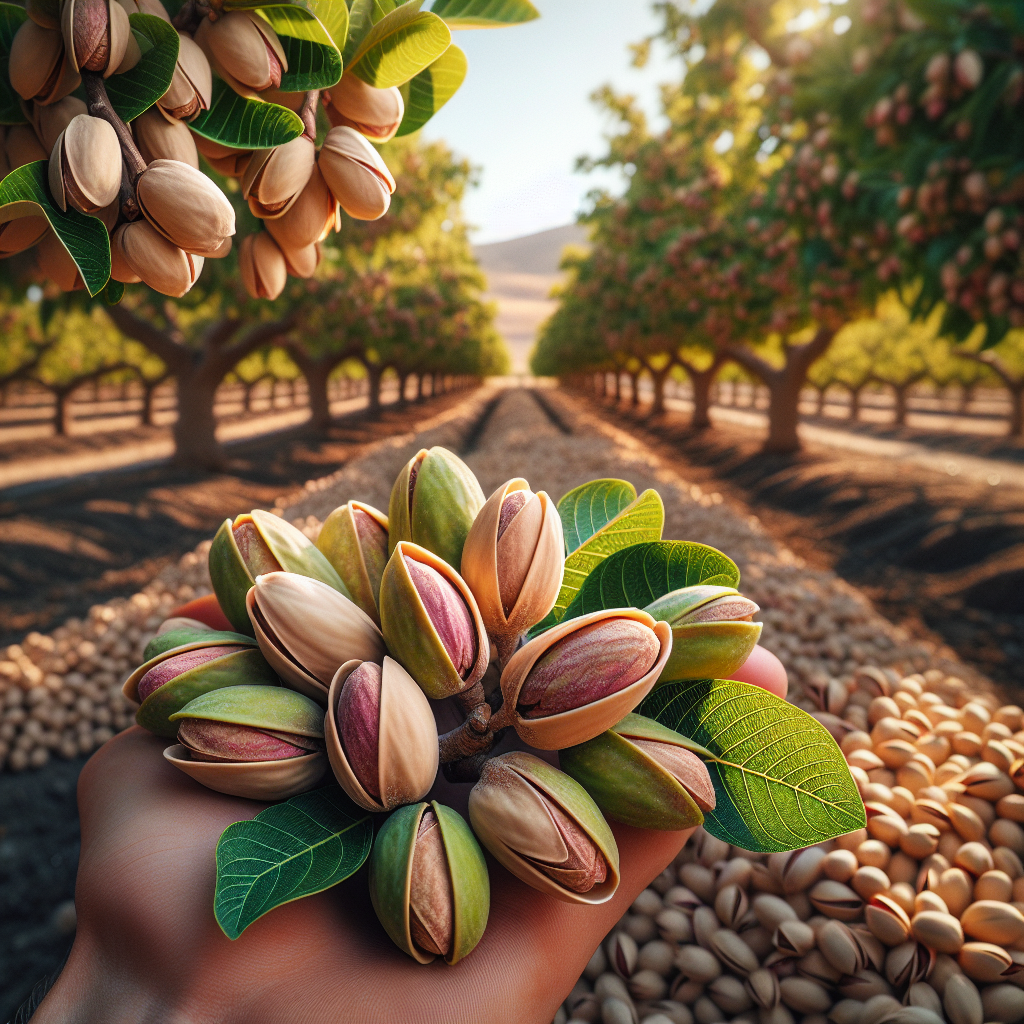
Introduction to Kerman Pistachio
Developed from Iranian germplasm and widely established in California and other semi-arid production zones, this cultivar became the industry benchmark because of its nut size, bright kernel color, and strong market acceptance. It is a female selection, which means it cannot set a commercial crop without a compatible male pollinizer nearby, most commonly the cultivar Peters. The tree is slow to come into full bearing, but once mature it can remain productive for decades under proper management.
This is not a forgiving backyard fruit tree in the way peaches or citrus can be. It is a highly specialized desert nut crop adapted to alkaline soils, intense summer heat, and low atmospheric humidity. Growers who match its climatic needs are rewarded with excellent shell splitting and premium kernels; growers who place it in humid, poorly drained, or insufficiently chilled locations often struggle with blank nuts, fungal pressure, irregular bearing, and weak growth. For broader species context, see Pistachio.
Kerman is also notable for its pronounced alternate bearing habit. In heavy crop years, the tree may produce abundant clusters but reduce flower bud initiation for the following season, resulting in a lighter return bloom. Managing this tendency through irrigation balance, nutrition, pruning discipline, and timely harvest is central to successful production.
Botanical Profile of Kerman Pistachio
This cultivar belongs to the Anacardiaceae family, the same botanical family as mango, cashew, and sumac. The species Pistacia vera is dioecious, meaning male and female flowers are borne on separate trees. Kerman is the female fruiting type, while male pollenizers are interplanted to ensure wind pollination during bloom.
Trees are deciduous and moderately vigorous, typically trained to a broad vase or modified central structure depending on orchard system and harvest equipment. Mature height commonly ranges from 20 to 30 feet, with a similar spread if left unpruned. Bark becomes gray and fissured with age, and older scaffolds can be quite durable, though young wood is vulnerable to sunburn and mechanical injury.
Leaves are compound, leathery, and usually composed of three to five broad leaflets. Their thick cuticle reflects the species' adaptation to arid environments and reduces transpiration under hot conditions. Flowers are apetalous, wind-pollinated, and appear in panicles before or alongside leaf expansion. Because there are no showy petals or nectar rewards, bees are not the primary pollination vector; orchard airflow and male tree placement matter more than pollinator habitat for fruit set itself.
The fruit is technically a drupe. The edible kernel is enclosed by a hard shell, itself covered by a fleshy hull that blushes pinkish or cream at maturity. Commercial quality is strongly tied to natural shell splitting. Good splitting depends on cultivar genetics, crop load, irrigation management, heat accumulation, and timely harvest. Unsplit shells, blank nuts, and small kernels all reduce packout value.
Kerman blooms relatively late compared with some older female cultivars, which can be an advantage in areas with spring frost risk. However, it also requires substantial winter chilling, often estimated around 800 to 1,000 chill hours depending on the model used and local conditions. Insufficient chill can lead to weak and uneven leaf-out, poor bloom overlap with male trees, and reduced nut set.
Commercial orchards usually graft Kerman onto vigorous rootstocks such as UCB1, prized for vigor and tolerance to soil-borne challenges, or occasionally other Pistacia rootstocks selected for salinity, verticillium, or nematode considerations. Rootstock choice influences tree size, precocity, disease resilience, and adaptation to marginal soils.
Soil, pH, and Climate Requirements for Kerman Pistachio
This cultivar performs best in deep, well-drained soils with good internal aeration. Ideal textures include sandy loam, loam, gravelly loam, or well-structured alluvial soils with rooting depth of at least 5 to 6 feet. While pistachio is more tolerant of salinity and alkalinity than many nut crops, it is far less tolerant of waterlogging. Even short periods of saturated root zones during warm weather can depress root respiration, invite Phytophthora, and reduce tree vigor.
The preferred soil pH is roughly 7.0 to 8.0, though trees can remain productive slightly outside that range if drainage is excellent and nutrient management is adjusted. In strongly acidic soils below pH 6.5, pistachios often perform poorly unless liming is used and micronutrient imbalances are corrected. In highly calcareous soils, iron and zinc deficiencies may appear as interveinal chlorosis on young leaves even when total soil nutrient levels are high.
Soil salinity tolerance is moderate to good, but it has limits. Electrical conductivity in the root zone should ideally remain below about 4 dS/m for optimal young tree establishment; mature trees can tolerate somewhat more, but yield and nut fill may still decline as salt accumulates. Sodium hazards should be monitored through soil and irrigation water analysis, especially in arid regions where evaporation concentrates salts. Periodic winter or post-harvest leaching may be necessary where water quality is marginal.
Climatically, this is a true hot-summer tree. It needs long, dry, high-heat summers for shell hardening and kernel fill, and it needs cold winters for dormancy release. Ideal summer conditions include daytime highs frequently above 95°F (35°C), low summer rainfall, and low relative humidity. Nighttime warmth during nut fill supports development, but extreme heat above about 110°F (43°C) can stress young trees if irrigation is inadequate.
Winter dormancy is equally important. Trees generally tolerate winter cold to around 10°F (-12°C) once fully dormant, sometimes lower for short durations depending on acclimation, but spring growth is sensitive to freeze events. Late frosts after bud swell can damage flowers and reduce cropping. Regions with warm winters and humid summers are usually poor candidates. Persistent summer humidity increases disease pressure and can interfere with hull drying and harvest quality.
Air drainage is often overlooked. Planting on slight slopes or in sites with good cold-air movement helps reduce frost risk. Avoid low pockets where spring cold settles. Also avoid wind tunnels during bloom unless male tree placement has been designed carefully, because excessive directional wind can create uneven pollen distribution and physical abrasion on young shoots.
Good orchard floor management matters too. Bare, compacted, crusted soils repel irrigation water and reduce infiltration, while excessive weed cover directly under emitters competes with young trees. Many growers use a managed alleyway cover with a weed-free strip in the tree row. For ideas on building resilient orchard ground, see soil health strategies.
Step-by-Step Planting & Propagation
Propagation for true-to-type production is done by grafting, not by seed. Seedling pistachios are genetically variable and unsuitable when uniform yield, shell split, and nut size are required. Purchase nursery trees already budded or grafted onto an appropriate rootstock for your soil and disease profile.
- Select a fully sun-exposed site with no shade from buildings or taller trees. Pistachios require maximum light interception for flower bud formation and nut development.
- Test soil at multiple depths before planting. Measure pH, salinity, sodium adsorption ratio, boron, chloride, organic matter, and texture. If a hardpan exists within the top 3 feet, rip or fracture it before orchard establishment.
- Verify pollinizer design. Since Kerman is female, include male trees at an appropriate ratio, often around 1 male for every 8 to 24 female trees depending on wind direction, orchard geometry, and local bloom conditions. Place males where prevailing winds can carry pollen through female rows.
- Plant during dormancy, usually late winter to early spring, when soils are workable but not saturated. In very mild climates, dormant-season planting can start earlier.
- Dig a planting hole only as deep as the root system and at least twice as wide. Do not create a glazed basin in clay soils. The graft union should remain above the final soil line.
- Backfill with native soil rather than rich compost blends. Over-amended holes can create a container effect that discourages roots from moving into surrounding soil.
- Water immediately after planting to settle soil around roots. The first irrigation should moisten the root zone thoroughly to a depth of roughly 18 to 24 inches.
- Stake if necessary in windy sites, but avoid tight ties and remove support once the trunk is stable.
- Whitewash young trunks with diluted interior white latex paint, commonly a 1:1 paint-to-water ratio, to prevent southwest injury and sunburn.
- Begin structural training during the first growing season. Select scaffold branches starting around 36 to 42 inches above ground if mechanical harvest and trunk shaking are planned.
Spacing depends on vigor, rootstock, and management system. Traditional orchards may use 18 x 18 feet, 19 x 19 feet, or 20 x 20 feet spacing. Higher-density systems can be used initially, but long-term crowding reduces light penetration and increases pruning costs. In small plantings, allow enough room for mature canopy spread and machinery access.
For propagation by budding or grafting in a nursery setting, T-budding and patch budding are common when bark slips well. Scionwood must come from healthy, productive mother trees with known cultivar identity. Sanitation is essential because trunk and vascular diseases can be spread through contaminated tools.
Care & Maintenance regimes for Kerman Pistachio
Irrigation is the single most important management lever after site selection. Kerman tolerates drought better than many tree crops, but profitable nut filling requires consistent moisture in the active root zone during spring and summer. The goal is not constant wetness but a repeated cycle of deep wetting followed by partial drying. In most mature orchards, moisture should be maintained primarily in the top 2 to 4 feet of soil, depending on texture and rooting depth.
In sandy soils, irrigate more frequently with smaller sets because water moves quickly downward and the soil holds less available moisture. In heavier loams, irrigate less often but more deeply. A practical target is to avoid allowing more than about 40 to 50% depletion of available soil water during active nut sizing. Pressure chamber readings, tensiometers, neutron probes, or capacitance sensors are ideal for professional scheduling. In the absence of instruments, warning signs of under-irrigation include dull, slightly folded leaves by mid-morning, reduced terminal growth, premature hull hardening, and smaller kernels. Signs of overwatering include persistent wet soil smell, yellowing leaves despite adequate fertility, weak pale shoot growth, gumming at the crown, and reduced oxygen around roots causing tree stagnation.
Young trees need frequent but modest irrigation while roots establish. Mature bearing trees often require the heaviest water inputs from late spring through shell hardening and kernel fill, then a gradual reduction near harvest to support access and reduce hull disease risk. Never impose severe water stress during bloom, early nut set, or kernel filling if high yields are the goal.
Nutrition should be based on annual leaf analysis and soil testing. Nitrogen is the main driver of canopy growth and nut production, but excess nitrogen can create overly vegetative trees, softer tissues, and inefficient production. Young nonbearing trees may receive split nitrogen applications from spring into midsummer. Mature orchards often receive nitrogen in several doses timed from leaf-out through early kernel development. Deficiency shows as pale foliage, short shoots, and weak canopy density.
Potassium becomes increasingly important in bearing orchards because heavy crops export large amounts. Low potassium can contribute to poor kernel fill, weak shoots, and marginal leaf scorch. Zinc and boron are also especially important in pistachio production. Zinc deficiency often appears on young leaves as small, narrow blades with interveinal chlorosis; boron deficiency can reduce fruit set and produce malformed clusters. Foliar sprays are frequently used where soil availability is limited.
Pruning in the first 3 to 5 years focuses on architecture. Build a strong trunk and well-spaced scaffolds capable of supporting future crops and mechanical harvest. Once the orchard enters production, pruning becomes more restrained. Excessive annual removal of fruiting wood can reduce yield and stimulate undesirable vegetative growth. The aim is to maintain light penetration, remove broken or diseased limbs, and manage canopy height for harvest efficiency.
Alternate bearing management is a long-term discipline. Avoid letting trees carry excessively heavy crops without adequate water and nutrients, because this suppresses next year's flower buds. Some growers adjust nitrogen and irrigation after heavy crop years to support post-harvest carbohydrate recovery. Early, efficient harvest also helps preserve leaf function and subsequent bud formation.
Weed management should keep a competition-free strip around young trunks, especially during establishment. Mulch is used cautiously in arid orchards; while it conserves water, it can also increase trunk humidity and create rodent habitat. Organic systems often rely on cultivation, mowing, and targeted mulches away from direct trunk contact.
Pests, Diseases & Organic Management
The most serious production losses often come from a combination of environmental stress and opportunistic pests or pathogens rather than from one issue alone. Healthy trees in well-drained, properly irrigated sites are far more resilient.
Navel orangeworm is among the most economically important insect pests in major pistachio regions. Larvae infest split nuts, contaminate kernels, and increase the risk of aflatoxin problems. Sanitation is critical: remove or destroy mummy nuts left after harvest, because they overwinter pest populations. Timely harvest reduces exposure of early split nuts. Mating disruption and biological control can be integrated where appropriate.
Soft scales, Mealybugs, and occasionally Aphids can build up on shoots and clusters, especially where dust, excess nitrogen, or disrupted beneficial insect populations occur. Natural enemies often provide substantial suppression if broad-spectrum insecticides are avoided. Ant control may be necessary because Ants protect honeydew-producing pests from predators.
Botryosphaeria panicle and shoot blight is a major disease in regions with spring or summer rain. It infects clusters, leaves, and shoots, especially where dense canopies and prolonged leaf wetness occur. Good airflow, sanitation pruning, and avoidance of overhead irrigation are important cultural defenses. Remove infected wood during dry weather and disinfect tools between cuts when disease pressure is significant.
Alternaria late blight is favored by warm, humid conditions and can defoliate trees or stain hulls near harvest. Kerman can be vulnerable in climates with monsoonal late summer patterns. Orchard ventilation, weed control that improves lower-canopy airflow, balanced nitrogen, and strategic harvest timing all help reduce severity.
Phytophthora crown and root rot is strongly associated with poor drainage and overirrigation. Symptoms include general decline, sparse foliage, leaf yellowing, gumming near the crown, and sudden collapse in severe cases. Prevention is much more effective than rescue: plant on well-drained soils, avoid ponding, and keep emitters positioned so water does not remain against the trunk.
Verticillium wilt can be devastating where orchards are planted after susceptible field crops, especially former cotton ground. Symptoms include branch dieback, wilt, vascular discoloration, and chronic decline. Rootstock selection and site history are essential preventive tools.
Birds may peck exposed nuts near maturity, and Rodents can damage irrigation lines and gnaw young bark. Trunk guards, habitat management, and orchard sanitation reduce losses.
Organic management begins with prevention: resistant rootstocks where possible, clean nursery stock, mummy nut removal, precise irrigation, moderate fertilization, and an open canopy. Habitat strips of beneficial insect-supporting plAnts can help, especially where they do not increase humidity immediately around trunks. Yarrow, Thyme, and Clover are among the more useful support species when managed carefully in alleyways rather than directly against the tree crown.
Harvesting, Curing & Optimal Storage
Harvest timing is critical for quality. Nuts are ready when the hull loosens from the shell, the shell has naturally split in a high percentage of nuts, and the hull color changes from firm green to a more yellowish or rosy cast depending on conditions. Delayed harvest increases staining, insect exposure, and disease risk.
In commercial orchards, harvest is usually mechanized by trunk shaking onto catching frames. In smaller plantings, limbs may be shaken onto clean tarps. Never allow harvested nuts to sit in warm piles for long periods. The fleshy hull must be removed quickly, ideally within 24 hours and preferably much sooner, because prolonged contact stains shells and encourages mold growth.
After hulling, wash if needed to remove adhering hull tissue, then dry promptly. For safe storage, reduce kernel moisture to roughly 4 to 6%. In practical terms, nuts should feel hard and crisp, with no leathery kernel texture. Drying can be done in forced-air systems or carefully in thin layers with warm, moving air. Excessive heat can darken kernels or reduce flavor quality.
Curing is less about fermentation and more about controlled drying and stabilization. Once dried, sort out closed-shell, insect-damaged, moldy, or stained nuts. Food safety matters greatly in pistachio production because nuts can support aflatoxin contamination if mishandled under warm, moist conditions.
For storage, keep nuts cool, dry, and protected from oxygen and pests. In-shell pistachios store better than shelled kernels because the shell provides some protection. At room temperature in airtight containers, quality may hold for several months if humidity is low. Under refrigeration, storage life is considerably extended, and under freezing conditions kernels can remain high quality for a year or more. Rancidity is accelerated by warmth, light, and exposure to air, so use opaque, sealed containers for premium quality retention.
Post-harvest orchard care should not be ignored. Leaves remaining after harvest rebuild reserves for next season. Continue appropriate irrigation and nutrient support until natural autumn senescence, but avoid excessive late-season vigor that could reduce cold hardiness.
Companion Planting for Kerman Pistachio
In commercial pistachio systems, companion planting is less about crowding plAnts beneath the canopy and more about designing an orchard floor that improves soil structure, suppresses erosion, supports beneficial insects, and limits dust without competing too heavily for water. The best companions are typically managed in alleyways or as seasonal strips rather than directly against the trunk.
Clover is one of the most useful choices because it can contribute nitrogen biologically, protect soil from crusting, and provide nectar for beneficial insects when mowed strategically. It is especially valuable in young orchards where soil organic matter is low, though irrigation demand and vole habitat must be monitored.
Yarrow offers strong beneficial insect support, attracting predatory wasps, hoverflies, and other natural enemies that help regulate soft-bodied pests. It is drought-tolerant once established and fits well in perennial insectary borders or selected alley strips.
Thyme is well suited to dry orchard margins and low-water insectary zones. Its aromatic foliage and long bloom period make it useful for attracting pollinator and predator communities without producing excessive biomass.
In some regions, winter annual covers such as Barley are used between rows to reduce erosion, improve infiltration, and provide trafficability during wet periods, then terminated before peak summer water demand. The key rule with any companion is to prevent competition in the immediate root zone of young trees. Keep the area around the trunk free of dense vegetation, especially in the first several years.
Avoid companions that require frequent irrigation, create dense shade, or host overlapping pests and diseases. The orchard floor should remain a support system for tree performance, not a competing crop. In pistachio, restraint and placement matter more than diversity for its own sake.