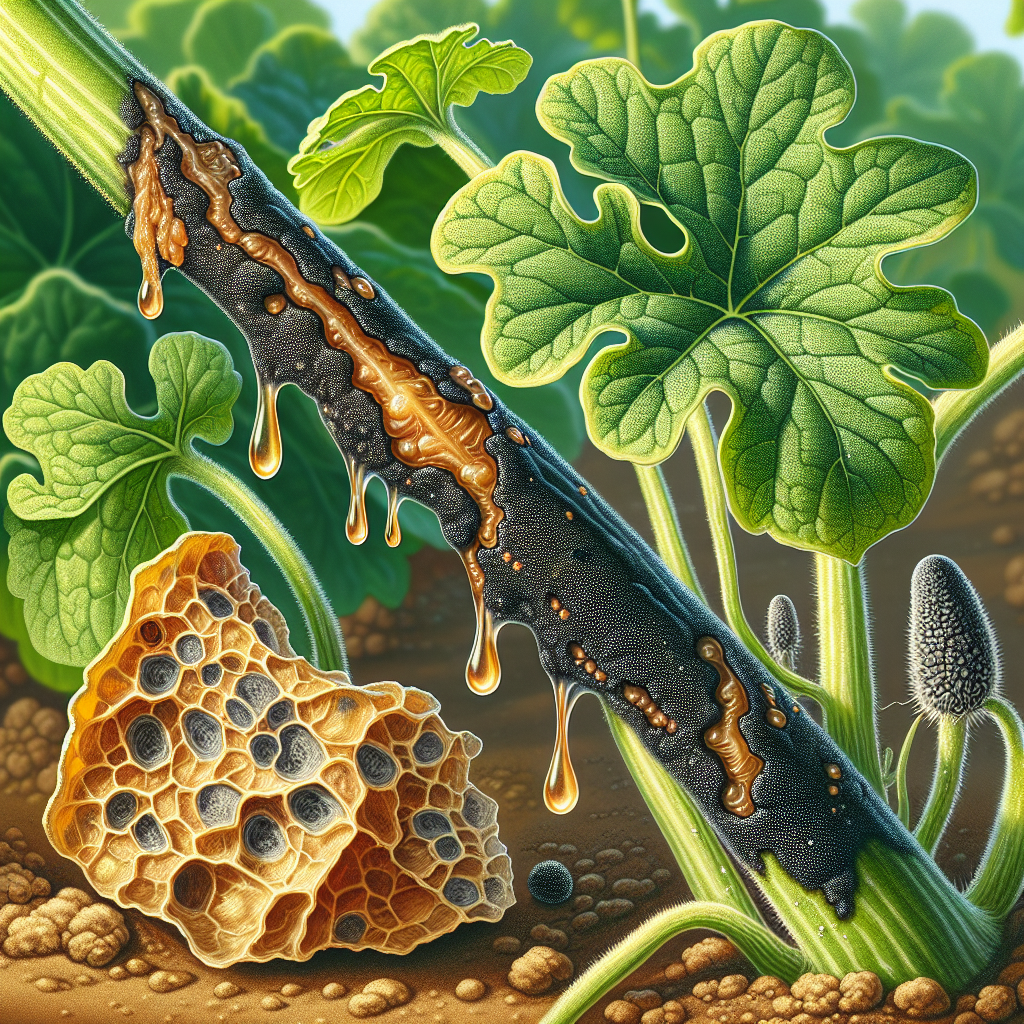
Introduction to gummy stem blight
Gummy stem blight, caused by the fungus Didymella bryoniae (previously known as Phoma cucurbitacearum in its anamorph stage), stands as one of the most devastating diseases impacting cucurbit crops worldwide. This pathogen targets vital growing regions such as the Southeastern United States, where high humidity and warm temperatures create ideal conditions for its proliferation. Farmers growing watermelon, cantaloupe, honeydew, cucumber, and other melons face annual threats from this disease, which can reduce yields by up to 50-100% in severe outbreaks.
The disease earned its name from the characteristic "gummy" exudate—sticky, amber-colored ooze—that seeps from infected stems and lesions, a hallmark sign of advanced infection. Spores spread via wind, rain splash, and contaminated tools, making it highly contagious in dense plantings. Early detection and integrated management are crucial, as chemical controls alone often fall short against resistant strains. This guide provides professional-grade diagnostic tools, lifecycle insights, organic treatments, and prevention strategies to safeguard your cucurbit harvest. For small farms struggling with disease identification, tools like those in Why Misidentifying Plants Costs Small Farms Thousands - And How AI Camera Diagnosis Fixes It Fast can revolutionize your approach.
Understanding gummy stem blight's biology empowers growers to implement proactive measures. The fungus overwinters in crop debris, seeds, and alternate hosts, releasing ascospores and conidia during favorable weather. Symptoms often mimic other issues like anthracnose or Phytophthora blight, necessitating precise diagnosis. With climate change intensifying humid conditions, this disease's incidence is rising, demanding vigilant monitoring and resilient farming practices.
Identifying Symptoms & Damage
Accurate identification of gummy stem blight is the cornerstone of effective management. Initial symptoms appear on lower leaves as small, water-soaked spots that expand into circular to irregular lesions with tan to brown centers and darker borders. These leaf spots may develop lighter grayish centers as the fungus sporulates, often accompanied by a faint halo. Unlike powdery mildew, which produces white powdery growth, gummy stem blight lesions remain dark and sunken.
Stem infections are the most diagnostic and destructive. Look for elongated, brown to black cankers that girdle stems, leading to wilting of distal parts. The signature "gummy" exudate—a sticky, pinkish to reddish-brown ooze—emerges from cracks in the cankers, especially after rain. In advanced stages, stems shred longitudinally, exposing vascular tissue. Petiole lesions cause leaf drop, creating a thinned canopy vulnerable to sunscald on fruits.
Fruit symptoms include firm, dark brown rot starting at the calyx end or from stem attachment points. Rotted areas may crack, allowing secondary invaders like fruit rots. Seedlings exhibit water-soaked stems at soil line, resembling damping-off. Damage quantification: Vine collapse leads to 30-70% yield loss in melons; fruit rot affects marketability. Differentiate from Alternaria leaf spot by the gummy ooze and absence of concentric rings. Use a hand lens to spot black pycnidia (fruiting bodies) in lesions for confirmation. Lab tests via ELISA or PCR provide definitive diagnosis if field symptoms are ambiguous.
Lifecycle and Progression of gummy stem blight
Didymella bryoniae follows a polycyclic lifecycle, enabling multiple infection cycles per season. Primary inoculum arises from pseudothecia in overwintered plant debris, producing wind-dispersed ascospores during wet periods (April-June). Conidia from pycnidia on infected tissues splash via rain, infecting wounds or stomata. Optimal infection occurs at 77-82°F (25-28°C) with leaf wetness >12 hours.
Germ tubes penetrate within 6-12 hours, forming appressoria. Incubation lasts 3-7 days, with symptoms under high humidity. New pycnidia form 7-14 days post-infection, releasing conidia in guttation droplets. Ascospores, key for long-distance spread, mature in perithecia after mating. The pathogen survives 2+ years in debris, with seeds carrying latent infections. Progression accelerates in dense canopies: early season on seedlings, mid-season on vines, late-season on fruits. Epidemics peak during prolonged leaf wetness (>48 hours cumulative). Understanding this cycle informs timing of controls.
Environmental Triggers & Risk Factors
Gummy stem blight flourishes in warm (68-86°F), humid environments with frequent leaf wetness. Night temperatures >68°F with daytime highs >86°F trigger epidemics. Overhead irrigation, poor air circulation, and high plant density (>2 plants/sq ft) exacerbate spread. Acidic soils (pH <6.0) and excessive nitrogen promote succulent growth, ideal for infection.
Risk spikes after heavy rain or prolonged dew. Contaminated transplants, tools, and volunteer cucurbits serve as bridges. Crop rotation failure (<3 years) leaves inoculum. Regions like Florida, Georgia, and the Carolinas report highest incidence due to climate. Secondary stressors like root-knot nematodes or whiteflies weaken plants, increasing susceptibility. Monitor with weather stations tracking leaf wetness hours; thresholds >20 hours/week signal high risk.
Organic Control & Treatment Plans
Organic management integrates cultural, biological, and OMRI-listed fungicides. Cultural: Scout weekly; rogue infected plants promptly. Avoid overhead watering; use drip irrigation. Prune for airflow. Apply compost teas to boost microbiome.
Biological: Trichoderma harzianum (RootShield) suppresses via mycoparasitism; apply at planting and 14-day intervals. Bacillus subtilis (Serenade) produces lipopeptides inhibiting pathogen; foliar sprays every 7-10 days. Streptomyces lydicus (Actinovate) colonizes roots.
Organic Fungicides: Copper octanoate (Cueva) at 0.5-2 gal/A; 5-7 day intervals, avoiding phytotoxicity. Potassium bicarbonate (MilStop) disrupts fungal cells; every 7 days. Sulfur (Kumulus) for early season. Regalia (Reynoutria extract) induces SAR.
Integrated Plan: Week 1 post-transplant: Preventives. Scout + biofungicide at first symptoms. Rotate modes of action. Tank-mix with hort oil for sticker. Post-harvest: Till debris; solarize soil. Yields recover 20-40% with timely intervention. Always check labels for cucurbit safety.
Preventing gummy stem blight in the Future
Prevention trumps cure. Select resistant varieties like 'Crimson Sweet' watermelon or 'Athena' muskmelon. Rotate with non-hosts (corn, tomato) for 3-4 years. Sanitize tools with 10% bleach. Use disease-free seeds/transplants; hot water treat (122°F, 25 min).
Site selection: Well-drained fields, >200 ft from last cucurbit crop. Mulch with straw to reduce splash. Balanced fertility: Avoid excess N; maintain pH 6.2-6.8. Monitor with sticky traps for spores. Fallow + cover crops (clover) suppress inoculum. Grafted plants on resistant rootstocks show promise. Long-term: Breed for polygenic resistance. Soil Health Mastery: 5 Proven Strategies for Small Farms to Build Fertile Ground Without Breaking the Bank offers complementary tactics.
Crops Most Affected by gummy stem blight
Primarily cucurbits: Watermelon (most susceptible, 50-100% loss), muskmelon/cantaloupe (40-80%), honeydew, pumpkin, squash, cucumber (20-50%), gourds. Minor on squash varieties. No reported impact on non-cucurbits like squash relatives occasionally. Global distribution: Americas, Europe, Asia. Economic hit: $10-50M annually in U.S. alone.