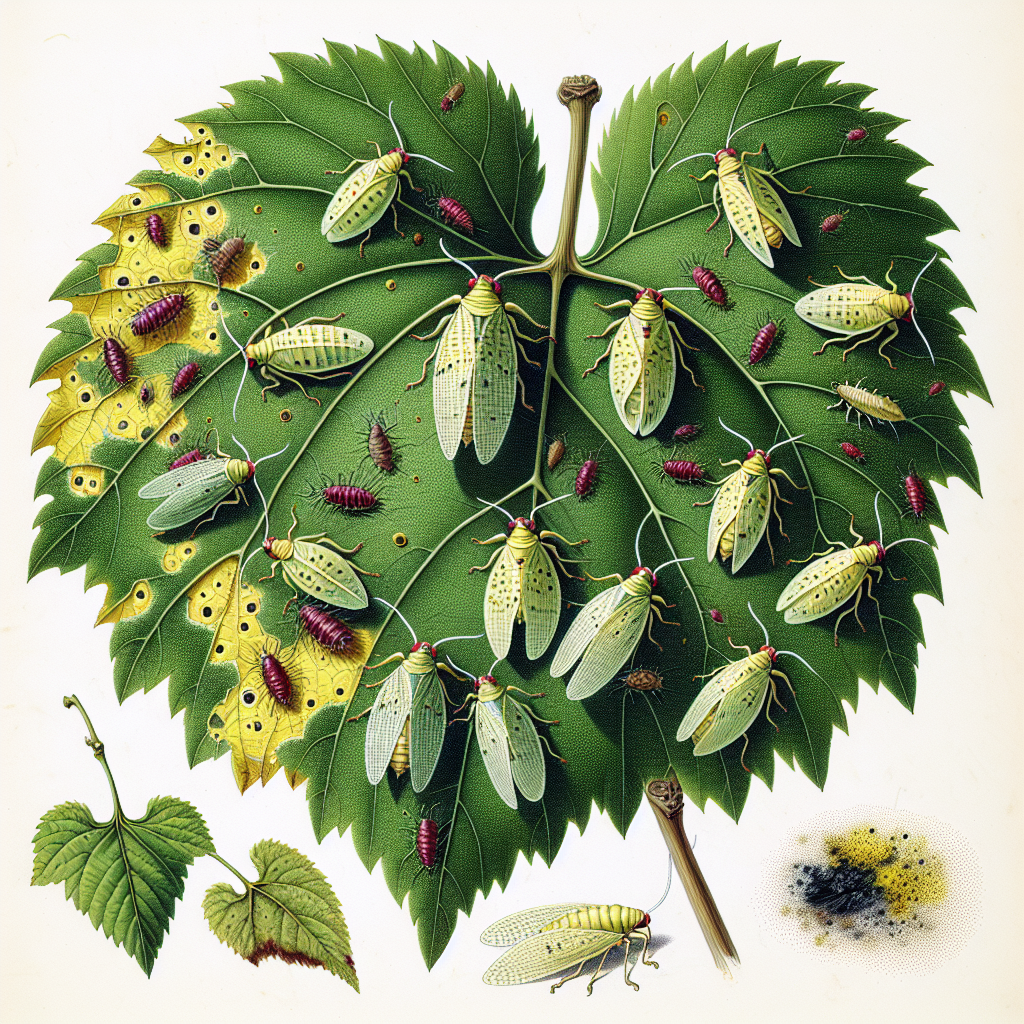
Introduction to Grape leafhoppers
Grape leafhoppers (Erythroneura spp.) represent one of the most pervasive pests in viticulture, particularly in warm, arid regions like California, Australia, and parts of the Mediterranean. These tiny insects, often overlooked due to their size (about 3 mm long), can devastate Grapes crops by sucking sap from leaf tissues, leading to chlorosis, defoliation, and compromised fruit quality. Adult leafhoppers are pale yellow to greenish with red markings, while nymphs are smaller, crawler-like stages that excrete honeydew, fostering sooty mold growth.
Understanding grape leafhoppers is crucial for vineyard managers. Populations can explode under favorable conditions, with a single vine hosting hundreds of individuals. Economic thresholds vary, but damage becomes evident when populations exceed 10-20 nymphs per leaf. This guide draws from entomological research and field trials to deliver actionable diagnostics and management. For broader context on similar pests, see our detailed entry on leafhoppers. Early intervention is key, as unchecked infestations reduce photosynthetic capacity by up to 50%, directly impacting berry size, sugar content, and wine quality.
Identifying Symptoms & Damage
Diagnosing grape leafhopper damage requires keen observation during the growing season. Initial signs appear on the undersides of older leaves near the base of shoots. Nymphs feed by piercing leaf cells and extracting contents, causing stippling—tiny white or yellow dots that coalesce into bronze or reddish patches. Heavily infested leaves turn crispy, curl upward, and drop prematurely, exposing clusters to sunburn.
Key symptoms include:
- Yellowing and stippling: Starts at leaf margins, progressing inward. Use a 10x hand lens to spot nymphs and cast skins (exuviae).
- Honeydew and sooty mold: Sticky droplets attract ants and promote black fungal growth, reducing leaf efficiency.
- Reduced vigor: Vines show stunted shoots, smaller berries, and delayed ripening. In severe cases, yields drop 20-30%.
Differentiate from mites (webbing, finer stipple) or powdery mildew (white powder). Scrape leaf undersides over white paper; active nymphs will move. Monitor weekly from bud break using a beat sheet: tap leaves over a tray and count dislodged insects. Thresholds: 5-10 nymphs/leaf for table grapes, higher for wine varieties. For more on scouting, check our Spring Pest Patrol blog.
Lifecycle and Progression of Grape leafhoppers
Grape leafhoppers complete 4-8 generations per year in warm climates, aligning with vine phenology. Eggs are laid in spring (March-May) in leaf veins, hatching into nymphs within 7-10 days. Nymphs (5 instars) feed voraciously for 2-4 weeks, molting and leaving behind shed skins. Adults emerge by June, winged and highly mobile, migrating to new vines.
Lifecycle stages:
- Eggs: Tiny, inserted into tissue; invisible without magnification.
- Nymphs: Pale, wingless; crawl rapidly, most damaging phase.
- Adults: 3 mm, wedge-shaped; females lay 2-3 eggs/day for 30-40 days.
Overwinter as adults in leaf litter, bark cracks, or ground cover. Peak activity coincides with bloom and veraison. In cooler areas, 2-3 generations; hotter regions see continuous overlap. Disruption at nymph stage prevents population booms. Natural enemies like Anagrus wasps parasitize eggs, reducing subsequent generations by 70%.
Environmental Triggers & Risk Factors
Grape leafhoppers flourish in hot, dry conditions (above 24°C/75°F), low humidity (<50%), and sandy soils. Risk spikes in vineyards with dense canopies, excessive nitrogen, or nearby alternate hosts like blackberry or fig. Weed strips harboring grasshoppers can serve as reservoirs.
Triggers include:
- Climate: Drought stress weakens vines, making them susceptible.
- Cultural practices: Late pruning or poor airflow promotes humidity pockets.
- Previous infestations: Overwintering sites in debris.
High-risk zones: Central Valley (CA), Riverland (Australia). Monitor weather data; populations surge post-irrigation. Avoid over-fertilizing, as lush growth attracts females for oviposition.
Organic Control & Treatment Plans
Organic management emphasizes IPM: monitoring, biologicals, and targeted organics. Avoid broad-spectrum sprays to preserve predators.
Step-by-step plan:
- Cultural: Prune for open canopy; disk under leaf litter in winter. Use cover crops like clover to host parasitoids.
- Biological: Release Anagrus epos wasps (egg parasitoids); encourage spiders, lacewings. Kaolin clay (Surround) coats leaves, deterring feeding.
- Organic sprays: Neem oil or insecticidal soap at nymph stage (pre-bloom). Sulfur burns mites but repels leafhoppers. Apply evenings to spare bees.
- Threshold-based: Treat at 10 nymphs/leaf; recheck 7 days.
Treatment timeline:
| Stage | Action | Product |
|---|---|---|
| Dormant | Sanitation | None |
| Bud break | Monitor | Sticky traps |
| Nymphs | Spray | Neem/soap |
| Adults | Kaolin | Surround |
Efficacy: 80-90% with consistent scouting. Rotate modes to prevent resistance.
Preventing Grape leafhoppers in the Future
Long-term prevention builds resilient vineyards. Select resistant rootstocks like 1103P. Plant windbreaks to disrupt adult flight. Maintain ground covers fostering predators (yarrow, nasturtium).
Annual IPM cycle:
- Winter: Destroy debris, till rows.
- Spring: Trap crops, release parasitoids.
- Summer: Scout, spot-treat.
- Fall: Monitor migration.
Resistant varieties: Flame Seedless show tolerance. Integrate with aphids management, as they indicate imbalance. Track via apps for hyper-local forecasts.
Crops Most Affected by Grape leafhoppers
Primarily Thompson Seedless Grapes, Concord Grapes, and wine varieties like Cabernet Sauvignon Grapes. Table grapes suffer cosmetic damage; raisin types lose tonnage. Secondary hosts: apple, peach, almond. In mixed plantings, proximity to olive amplifies risk. Global impact: $100M+ annual losses in CA alone.