Introduction to Fusarium Dry Rot
Fusarium Dry Rot, caused by various species of the fungus Fusarium (most commonly Fusarium solani var. coeruleum and Fusarium graminearum), is one of the most economically damaging post-harvest diseases in potato production worldwide. This disease strikes tubers after harvest, leading to dry, shriveled rot that renders potatoes unmarketable and causes losses up to 20-80% in severe cases. While potatoes are the primary host, Fusarium Dry Rot can also impact other crops like onion, sweet potato, and cassava, making it a critical concern for small farms and commercial growers alike.
The pathogen enters through wounds created during harvest, handling, or mechanical damage, producing characteristic sunken lesions filled with fungal mycelium. Unlike wet rots, Fusarium Dry Rot progresses slowly, resulting in mummified tubers that produce abundant spores, contaminating storage facilities and subsequent plantings. Early identification and integrated management are essential for minimizing losses, especially in organic systems where chemical fungicides are avoided. This guide provides professional-grade diagnostic tools, lifecycle insights, organic control strategies, and prevention tactics optimized for sustainable agriculture. For more on related Fusarium issues, see our detailed entry on Fusarium.
Understanding Fusarium Dry Rot's biology empowers growers to implement targeted interventions. The disease is exacerbated by poor ventilation in storage, high temperatures (optimal at 20-25°C or 68-77°F), and mechanical injury, common pitfalls in high-volume potato operations. By focusing on seed quality, storage hygiene, and environmental controls, farmers can reduce incidence by over 70%. This comprehensive resource draws from decades of agronomic research to deliver actionable advice for potatoes and susceptible crops.
Identifying Symptoms & Damage
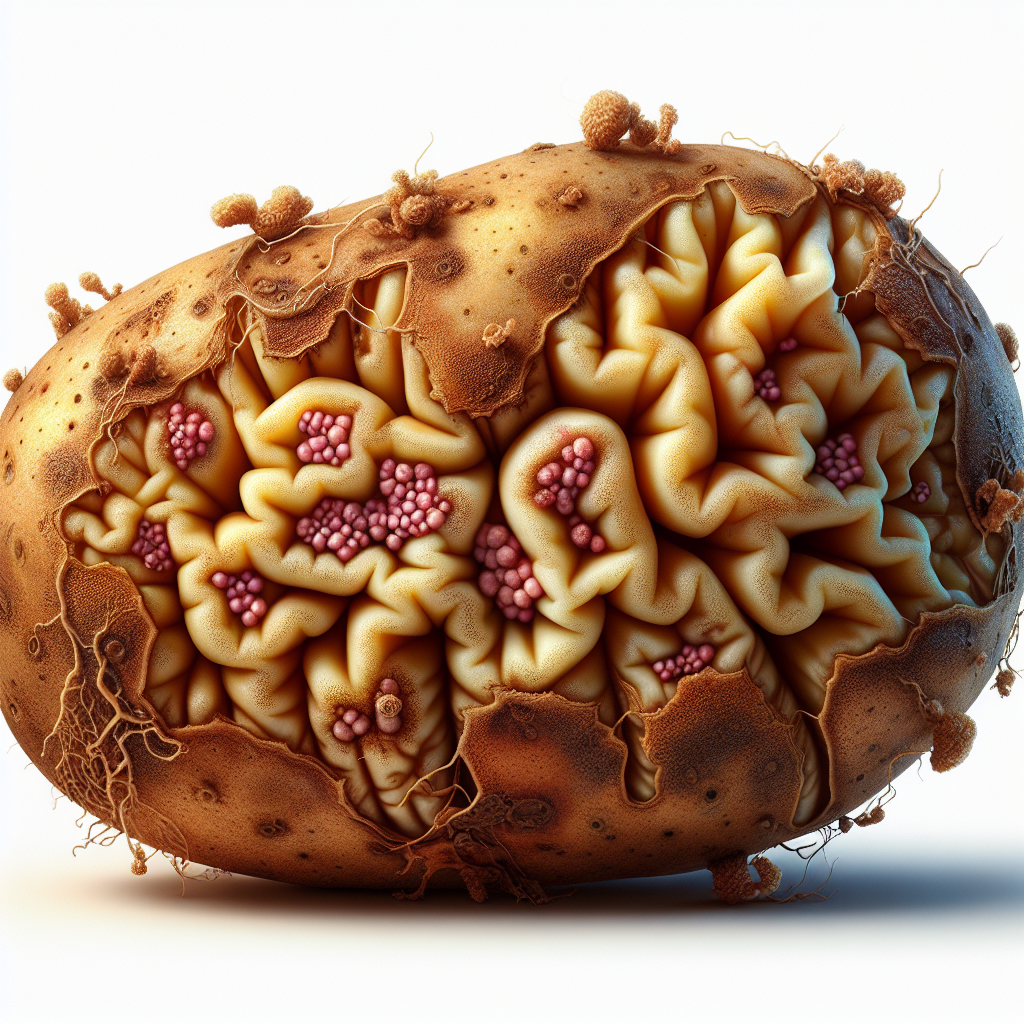
Accurate diagnosis of Fusarium Dry Rot begins with recognizing its distinct symptoms, which differ from similar rots like soft rots or Rhizoctonia. Initial signs appear 2-4 weeks post-harvest as small, sunken, brown lesions on tuber skin, often at wound sites from harvest cuts or bruises. These lesions expand irregularly, developing a characteristic wrinkled, corky texture with exposed dry rot tissue underneath.
Affected areas turn dark brown to black, with internal tissue appearing shriveled and dry, lacking the watery ooze of bacterial rots. A key diagnostic feature is the production of pink to violet spore masses (sporodochia) on lesion surfaces under humid conditions, confirming Fusarium infection. Secondary symptoms include hollowing of the tuber center, longitudinal cracking, and a musty odor. In advanced stages, tubers mummify, becoming lightweight and unsuitable for consumption or replanting.
Damage extends beyond aesthetics: infected tubers lose market value, with shriveling reducing weight by 30-50%. In storage, one infected tuber can produce millions of spores, spreading to healthy ones via air currents or contact. Yield impacts are indirect but severe; poor seed tubers lead to weak stands and reduced harvests. Differentiate from early blight by the dry texture and spore color—Fusarium lacks the concentric rings of Alternaria. For field infections, look for stem cankers at soil line, though post-harvest is predominant.
Lab confirmation involves plating symptomatic tissue on selective media, where Fusarium grows as white to pink colonies. Visual scouting during storage grading is crucial: inspect 10% of each lot, discarding any with lesions >1 cm. Economic thresholds: cull tubers with >5% surface coverage to prevent epidemic spread. In Russet Burbank potato varieties, skin cracking exacerbates entry points, amplifying damage.
Lifecycle and Progression of Fusarium Dry Rot
Fusarium Dry Rot follows a soil- and tuber-borne lifecycle, with chlamydospores surviving in soil for 5-10 years. Infection initiates via macroconidia or microconidia entering wounds, germinating in 24-48 hours under favorable moisture. Mycelium colonizes vascular tissues, producing enzymes that degrade cell walls without liquefying tissue—hence the 'dry' rot.
Progression is temperature-dependent: rapid at 20-25°C, slowing below 10°C or above 30°C. In storage, latent infections activate with humidity >85%, sporulating in 7-14 days. Spores disperse via wind, tools, or airflow, creating secondary cycles. Overwintering occurs as dormant mycelium in seed tubers or soil debris.
The disease peaks 1-3 months post-harvest, with 80% of losses in poorly ventilated bins. In fields, it causes seed piece decay and stem rots, reducing emergence by 15-30%. Learn more about Fusarium root rot, a related field issue. Full lifecycle: spore germination → mycelial growth → sporodochia formation → spore dispersal → new infections. Breaking this cycle requires sanitation and resistant varieties.
Environmental Triggers & Risk Factors
Fusarium Dry Rot thrives in warm (20-25°C), humid (>85% RH) environments with poor airflow, common in unventilated storage. Mechanical injury from harvest machinery doubles infection rates. Soil temperatures >18°C during planting favor seed decay.
Risk factors include: contaminated seed tubers (up to 50% carry latent infections), compacted soils limiting drainage, excessive nitrogen promoting soft tissues, and late harvests exposing tubers to bruises. Regions with mild winters, like the Pacific Northwest or Andean highlands, see higher incidence due to prolonged spore viability. Potato cyst nematodes exacerbate by wounding roots, creating entry points.
Climate change intensifies risks with warmer storage nights. High-risk crops like Yukon Gold potato have thin skins prone to cracking. Monitor with data loggers for temp/RH; act if >20°C/>90% RH.
Organic Control & Treatment Plans
Organic management emphasizes cultural, biological, and physical controls. Seed Treatment: Hot water dip tubers at 47°C for 20 min, reducing inoculum by 90% without residues. Biofungicides like Trichoderma viride or Bacillus subtilis suppress Fusarium via antagonism.
Storage Protocols: Cure tubers at 12-15°C/95% RH for 2 weeks to heal wounds, then store at 4-10°C/<95% RH with ventilation. Remove infected tubers weekly. Check out Soil Health Mastery: 5 Proven Strategies for Small Farms to Build Fertile Ground Without Breaking the Bank for broader organic tips.
Field Controls: Rotate with non-hosts like clover for 3 years. Use certified seed. Apply compost teas with Streptomyces spp. Biologicals reduce soil inoculum by 60%. Wound protectants like calcium chloride sprays pre-harvest. Integrated plan: sanitation (80% control), bioagents (15%), monitoring (5%). For sweet potato, solarization kills soil spores.
Treatment Timeline: Pre-plant: treat seed. Harvest: minimize bruises. Storage: cure and ventilate. Efficacy: 85% reduction possible.
Preventing Fusarium Dry Rot in the Future
Prevention hinges on exclusion and hygiene. Source certified, disease-free seed from low-Fusarium fields. Implement 3-year rotations avoiding potato, tomato, and solanaceous crops. Improve harvest with padded equipment to cut wounds 50%.
Storage best practices: use slatted bins for airflow, maintain <10°C, apply forced air ventilation. Disinfest facilities with steam or bleach (1:10). Scout fields for root rot early. Resistant varieties like 'Defender' or 'Mountain Gem' offer partial immunity. Soil solarization in off-season kills 70% chlamydospores. Monitor with traps for spore levels. Long-term: enhance soil biology with mycorrhizae to outcompete Fusarium.
Farm-wide IPM: track via logs, train workers on hygiene. Annual audits prevent recurrence.
Crops Most Affected by Fusarium Dry Rot
Primarily potato (all varieties, e.g., Russet Burbank potato, Yukon Gold potato), with 10-60% losses. Also hits sweet potato, onion, garlic, cassava, and yam. Less common in carrot and beet. Solanaceae family most vulnerable due to susceptibility.