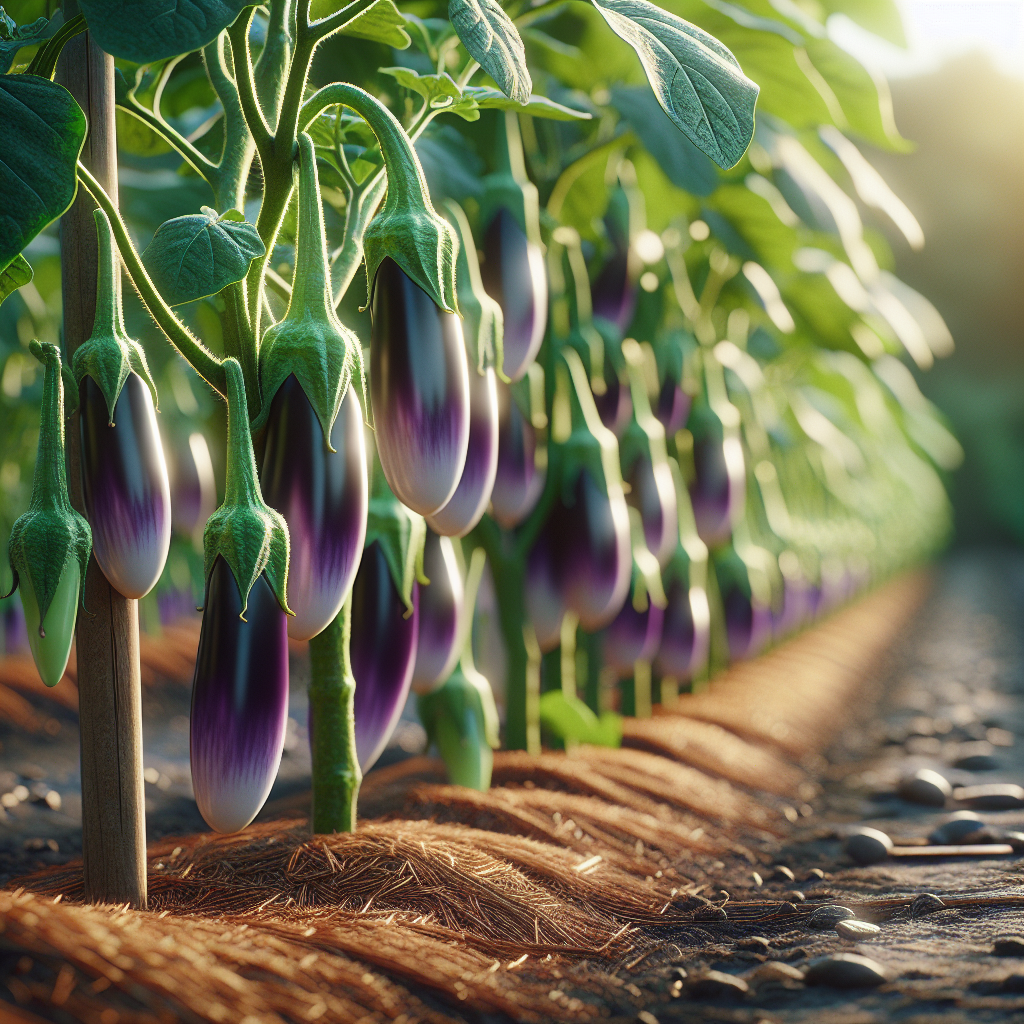
Introduction to Eggplant (Ping Tung Long)
Originally developed in Taiwan, this cultivar has become one of the most respected Asian eggplants for home gardens, market gardens, and warm-season production because it combines ornamental elegance with serious productivity. The fruits are typically 12-18 inches long, slim rather than bulbous, and borne on sturdy plants that can keep flowering and fruiting for months when temperatures remain favorable.
What makes this selection distinct is its texture and culinary behavior. The flesh is tender, relatively low in bitterness compared with many globe types, and usually contains fewer developed seeds when harvested at the ideal stage. That lower seediness is directly tied to harvest timing and plant vigor: plants that are heat-stressed, under-watered, or left too long on the stem tend to produce tougher fruit with more prominent seeds.
Ping Tung Long is not merely a novelty shape. Its elongated fruit habit often makes harvest easier to judge, its thin skin cooks quickly, and its continuous fruiting pattern allows frequent picking rather than one large flush. Growers familiar with standard globe varieties often find that this type behaves more like a long-season, high-turnover harvest crop. For comparison with broader crop behavior, see our Eggplant guide.
As a member of the nightshade family, it shares cultural needs with peppers and tomatoes, but it is generally even more warmth-loving and less tolerant of cool soils. In many climates, poor results with eggplant trace back not to grower skill but to transplanting too early, feeding too much nitrogen, or allowing uneven moisture during flowering and fruit fill.
Botanical Profile of Eggplant (Ping Tung Long)
This cultivar belongs to Solanum melongena, a frost-sensitive perennial grown as an annual in most temperate systems. Like other eggplants, it develops a branching, semi-woody stem with broad, slightly fuzzy leaves. Mature plants commonly reach 3-4 feet tall and 2-3 feet wide under good fertility, though in long hot seasons and fertile soil they may exceed that.
The flowers are typically lavender to pale violet with bright yellow fused anthers, borne singly or in small clusters at branch nodes. The species is largely self-pollinating, but flower set improves when plants are actively growing and daytime temperatures sit in the warm range. Persistent cool nights, extreme heat, or moisture stress can all cause blossom drop.
Ping Tung Long differs from round-fruited types in several key ways:
- fruits are long and narrow, often gently curved
- skin is bright, glossy purple rather than nearly black
- calyx spines are usually less problematic than in some traditional types, though gloves are still helpful at scale
- flesh tends to be finer textured and less bitter
- the plant often sets a greater number of medium-weight fruits rather than fewer heavy ones
Because the fruits are long, they can bend or deform if they contact dense foliage, weeds, or the ground. This is one reason staking is more useful for this cultivar than many beginners expect. Vertical support improves fruit shape, airflow, harvest access, and disease prevention.
Physiologically, eggplant is highly responsive to root-zone temperature. Below roughly 60°F (16°C), root uptake slows, leaves may develop a dull cast, and growth becomes static even if plants remain alive. Once soils warm into the mid-60s to upper-70s°F (18-26°C), Ping Tung Long often accelerates quickly and begins producing the strong vegetative framework needed for sustained cropping.
Soil, pH, and Climate Requirements for Eggplant (Ping Tung Long)
This variety performs best in deep, friable, well-drained loam rich in stable organic matter. Ideal soil texture is one that holds moisture consistently but never stays waterlogged for more than a day after irrigation or rain. A target of 4-6% organic matter is excellent for field or garden production, provided drainage remains good.
The optimal pH range is about 5.8-6.8, with a sweet spot near 6.2-6.5. In more acidic soils below 5.5, nutrient availability becomes imbalanced, especially for calcium and magnesium, and root vigor can suffer. In alkaline soils above 7.2, iron and manganese deficiencies become more likely, often showing as interveinal chlorosis on young leaves.
Eggplant is far less forgiving of cold than many summer vegetables. Ping Tung Long is best grown where daytime temperatures remain around 75-90°F (24-32°C). It can continue functioning above that if soil moisture is stable and pollen viability remains adequate, but fruit set may dip when daytime highs push beyond 95°F (35°C), especially if nights remain hot. Night temperatures of 65-75°F (18-24°C) are ideal for steady growth.
Frost is lethal, and prolonged exposure below 50°F (10°C) causes serious stress. Plants exposed to chilling often become stunted, purple-veined, and slow to recover. For that reason, transplant only after soil has genuinely warmed and the weather pattern is stable.
A pre-plant bed should be loosened 10-12 inches deep. Incorporate well-finished compost rather than raw manure, which can drive excessive nitrogen and lush vegetative growth at the expense of flowering. If using a soil test, a moderate to high potassium level supports fruit quality and firmness. Calcium should be adequate but not pushed excessively; the more important factor is steady moisture that allows calcium transport to developing tissues.
Raised beds are particularly helpful in heavy soils because they increase early-season warmth and reduce transient saturation. Black plastic or biodegradable dark mulch can improve establishment in cooler climates by warming the root zone and reducing weed competition. For broader bed-building and fertility principles, the article on soil health is useful background reading.
Step-by-Step Planting & Propagation
Start from seed indoors 8-10 weeks before the anticipated outdoor transplant window. Seeds germinate best at 80-90°F (27-32°C). At these temperatures, emergence is often seen in 7-14 days; cooler conditions can delay or reduce germination substantially.
Use a sterile, fine-textured seed-starting medium with high porosity. Sow seed about 1/4 inch deep and keep the medium evenly moist, not saturated. A useful rule is that the tray should feel moist and cool but never heavy and waterlogged. Overly wet propagation media encourage damping-off and oxygen deprivation around the emerging radicle.
Once seedlings emerge, provide strong light immediately. Aim for 14-16 hours of intense supplemental light if natural light is weak. Leggy seedlings are common when warmth is high but light is insufficient. After the first true leaves form, reduce air temperature slightly to around 70-75°F (21-24°C) by day and a bit cooler at night to build sturdy stems.
Pot up when roots hold the plug together but are not circling densely. A 3-4 inch pot is usually adequate before field transplanting. Feed lightly with a balanced, dilute fertilizer once true leaves are established. Excess early nitrogen creates soft, transplant-shocked seedlings.
Harden plants gradually over 7-10 days. Expose them first to protected outdoor shade, then increasing sun and wind, but do not harden off into cold conditions. Eggplant hardening is about acclimation, not toughening through stress. Chilling during hardening can set plants back for weeks.
Transplant spacing:
- 18-24 inches between plants for intensive garden culture
- 24-30 inches between plants for larger field-grown specimens
- 3-4 feet between rows to allow airflow and harvest access
At transplanting, set plants at the same depth they grew in the pot or just slightly deeper if stems are sturdy. Unlike tomatoes, eggplants do not usually benefit from deep stem burial. Water in thoroughly to settle soil around roots.
Direct seeding is possible only in very long, hot climates with warm spring soils, but it is rarely preferred because the crop is slow to establish and vulnerable to early competition. Commercial and serious home production almost always rely on transplants.
In containers, use at least a 5-gallon vessel, though 7-10 gallons is far better for yield stability. Choose a high-quality mix with excellent drainage and frequent fertility support, as container-grown Ping Tung Long is a heavy feeder and dries quickly in peak summer.
Care & Maintenance regimes for Eggplant (Ping Tung Long)
Water management is the single most important cultural factor after temperature. The goal is consistently moist soil in the active root zone, roughly the top 8-10 inches, without repeated saturation. As a practical field indicator, soil should hold together when squeezed at root depth but break apart with a light touch; it should not smear like clay paste or crumble bone-dry.
Young transplants need frequent but moderate irrigation until roots expand. Once established, most in-ground plants perform well with about 1-1.5 inches of water per week, rising to 2 inches or more during hot, windy fruiting weather in sandy soils. Rather than shallow daily watering, apply deeper irrigation so moisture penetrates the full root zone.
Signs of underwatering include:
- midday wilt that persists into evening
- dull, slightly gray-green leaves
- flower drop
- narrow or misshapen fruits
- tougher skin and more seeds in harvested fruit
Signs of overwatering include:
- constant droop despite wet soil
- yellowing lower leaves
- slowed growth despite adequate fertility
- edema-like blistering in humid protected culture
- root browning or sour-smelling soil
Mulching with straw, shredded leaves, or plastic helps stabilize moisture swings that otherwise lead to blossom drop and inconsistent fruit texture. Keep organic mulch a few inches away from the stem base to reduce crown disease pressure.
Fertility should favor balanced growth. Too much nitrogen creates large leafy plants with delayed flowering and softer tissues attractive to Aphids. A practical approach is to incorporate compost pre-plant, then side-dress when first flowering begins and again after the first substantial harvest. Organic growers often use a balanced amendment plus a potassium-forward supplement if leaf growth is strong but fruiting lags.
If leaves are huge, lush, and dark green with few flowers, reduce nitrogen. If older leaves pale prematurely and growth is slow, a modest supplemental feeding may be warranted. Calcium deficiency symptoms in fruit are often really irregular water uptake, so correct irrigation first.
Because fruits are long and numerous, support matters. Install a stake or cage at transplant time. A single strong stake with soft ties every 8-10 inches of stem works well. In small-scale field systems, a Florida weave-style support can also be adapted. Staking prevents branch breakage and keeps fruit clean and straight.
Pruning is optional but helpful. Remove the first weak lateral shoots near the base once the plant is established, and consider opening the center lightly to improve airflow. Do not over-prune in hot climates, as fruits can sunscald if stripped of protective foliage.
Pollination is usually adequate outdoors, but in protected tunnels a gentle shake of flowering branches can improve fruit set. Maintain strong bee activity nearby with flowering margins if possible.
Pests, Diseases & Organic Management
Flea beetles are among the most damaging early pests. They create many tiny shot-holes in leaves, and severe pressure can stall young transplants completely. Use floating row cover immediately after transplanting in areas with chronic infestations, removing it once plants are large and flowering begins. Vigorous transplants tolerate feeding far better than weak ones.
Aphids colonize shoot tips and leaf undersides, especially when nitrogen is excessive. They distort new growth and excrete honeydew that supports sooty mold. Control by encouraging natural enemies, washing colonies off with water early, and applying insecticidal soap only when thresholds justify intervention.
Spider mites become serious in hot, dry conditions. Leaves may show fine stippling, bronzing, and webbing. They often flare where plants are drought-stressed or dusty. Raise humidity at canopy level where feasible, avoid water stress, and use horticultural oils or soaps carefully, spraying in cooler parts of the day to prevent phytotoxicity.
Colorado potato beetle and Hornworms may also feed on eggplant in some regions, particularly near solanaceous crops such as Tomato. Hand removal, row covers during establishment, and close scouting of leaf undersides for eggs are effective on smaller plantings.
Common diseases include Verticillium wilt, Bacterial wilt in warm humid regions, Early blight, Phomopsis blight and fruit rot, and various Root rots in poorly drained soil. The best organic management is preventive:
- rotate away from solanaceous crops for 3-4 years when disease pressure is known
- avoid low, waterlogged ground
- irrigate at the base rather than wetting foliage late in the day
- remove cull fruit and diseased debris promptly
- sanitize stakes and tools if blights were present
Verticillium often shows as one-sided yellowing, wilting, and vascular browning. There is no curative treatment in-season. Remove severely affected plants and improve rotation. Bacterial wilt causes rapid collapse in hot weather, often while leaves remain green initially; infected plants should be removed and destroyed.
Sunscald and abiotic stress can be mistaken for disease. Bleached, papery areas on exposed fruit are usually sun injury. Corky skin, bitterness, or seedy flesh usually indicates delayed harvest or stress rather than infection.
Integrated management for Ping Tung Long is most successful when scouting is done twice weekly. Long-fruited cultivars hide damage under the canopy, so lift branches and inspect fruit stems, leaf undersides, and new growth regularly.
Harvesting, Curing & Optimal Storage
Harvest when fruits are glossy, richly colored, and still feel springy rather than hard. For Ping Tung Long, ideal fruit length is often 10-16 inches depending on market preference, but shininess is a better indicator than absolute size. Once the skin loses gloss and becomes dull, the fruit is moving past peak tenderness and seeds are maturing.
Use pruners or a sharp knife rather than twisting fruits off. The stems can be tough, and rough harvest damages branches. Leave a short stem attached to reduce postharvest bruising at the cap.
Frequent harvest is essential. Pick every 2-4 days in peak season. Removing fruits promptly stimulates continued flowering and prevents the plant from diverting energy into seed maturation. Oversized fruits suppress further yield more than many growers realize.
Unlike storage onions or winter squash, eggplant is not cured in the traditional dry-down sense. Instead, handle it as a tender warm-season vegetable with minimal delay between harvest and cooling. Do not expose harvested fruit to direct sun in the field; move it quickly to shade.
The ideal storage temperature is around 50-54°F (10-12°C) with high relative humidity, roughly 90-95%. This is warmer than many refrigerators. Below about 45-50°F (7-10°C), chilling injury can develop, appearing as pitting, browning, dull skin, and rapid decay after removal from storage. At room temperature, fruit softens quickly.
Under proper conditions, expect about 7-10 days of marketable storage, sometimes slightly longer with excellent handling. Store away from ethylene-heavy fruits when possible, and avoid stacking that bends or compresses the long fruits.
Quality indicators at harvest and storage:
- glossy skin = young, tender, best eating quality
- slight resilience when pressed = ideal maturity
- dull skin, hard seeds, spongy flesh = overmature
- shriveling = low humidity or excessive storage time
- bronzing or pitting = chilling injury or rough handling
Companion Planting for Eggplant (Ping Tung Long)
The most useful companions are those that either improve pest balance, occupy different root zones, or help make efficient use of bed space without competing aggressively during summer heat. Thai Basil is particularly valuable near eggplant because it attracts pollinators and beneficial insects while fitting neatly into the warm, sunny conditions the crop prefers.
Onion and Garlic are classic allium companions that can help diversify the planting and may reduce pest pressure through strong scent masking, although they should not be viewed as a standalone control method. Their upright habit also means they compete less for light than sprawling intercrops.
Nasturtium works well as a trap and support plant in mixed plantings, drawing Aphids and helping increase beneficial insect presence. It also covers soil lightly without creating the dense, humid canopy that can worsen disease the way some larger companion species do.
Avoid planting eggplant immediately adjacent to crops that create heavy shade or share the same major disease cycles without careful rotation planning. Other solanaceous plants can coexist in a diverse garden, but grouping too many together year after year concentrates Flea beetles, wilt pathogens, and blights.
A strong companion strategy for this cultivar is functional rather than folkloric: combine one aromatic insect-confusing herb, one upright allium, and one flowering insectary plant. Keep companions far enough away that airflow around the eggplant canopy remains open, especially once Ping Tung Long reaches full summer size.