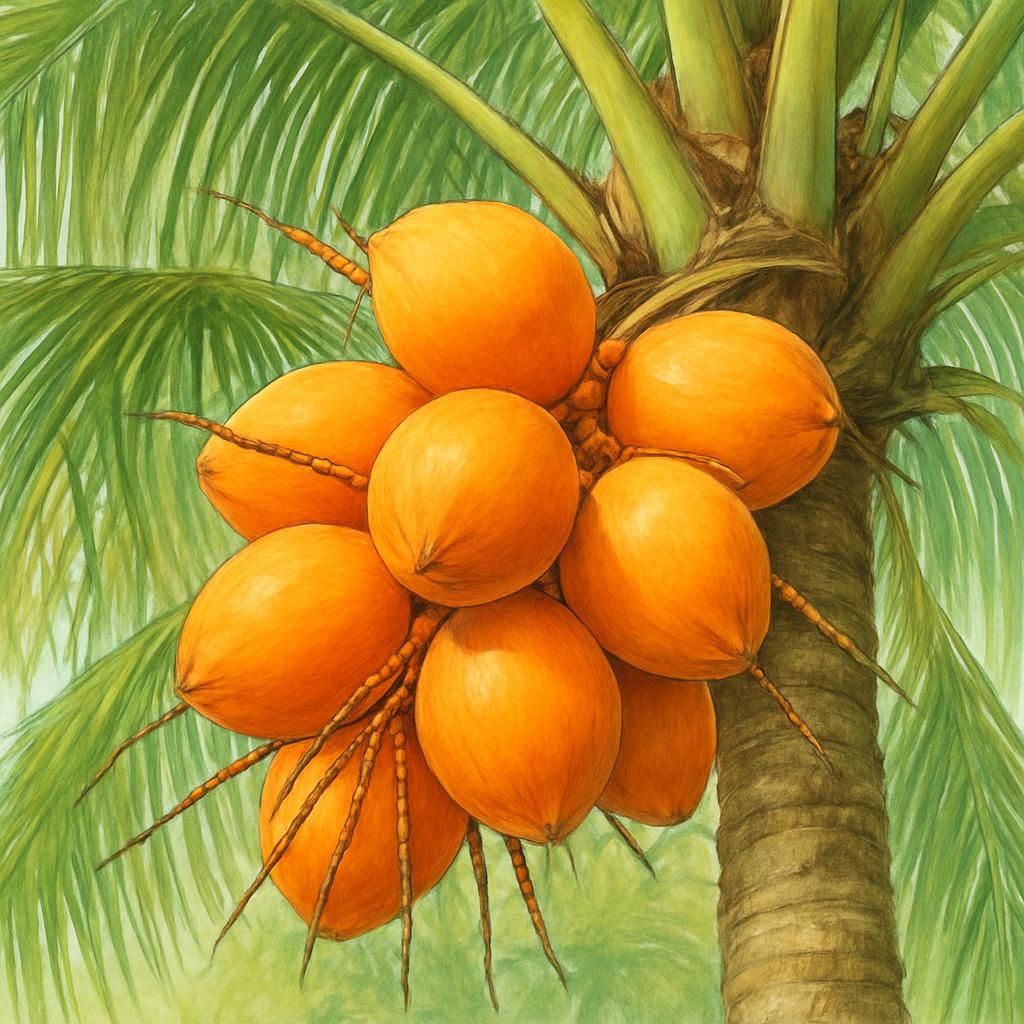
Introduction to Coconut (King Coconut)
King Coconut, a distinctive tall variety of Coconut (crop), is renowned across tropical regions for its vibrant orange husk and exceptionally sweet, aromatic water. Grown primarily in Sri Lanka and parts of South India, this palm produces medium-sized nuts with a thin kernel and high volumes of naturally sweet endosperm liquid. Commercial and smallholder growers value King Coconut for both fresh tender-nut sales and value-added coconut water products.
Successful cultivation requires understanding the palm’s long-term nature; productive trees can remain in the landscape for 60–80 years. Site selection, drainage, and consistent nutrition are critical because coconut palms have shallow, fibrous root systems that respond quickly to both water stress and nutrient imbalances. This guide delivers professional-grade, field-tested recommendations for establishing and maintaining high-yielding King Coconut plantations.
Botanical Profile of Coconut (King Coconut)
King Coconut belongs to the Arecaceae family and exhibits the classic morphology of tall coconuts: a single unbranched trunk reaching 20–30 m, a terminal crown of 30–40 pinnate fronds, and inflorescences that emerge from leaf axils. The variety is distinguished by its bright orange to reddish-brown husk at the immature stage and a higher sugar content in the nut water compared with green-husked tall types.
The root system is adventitious, spreading laterally up to 5–7 m and rarely deeper than 1 m. Flowering begins 4–6 years after planting from seed; each spadix carries both male and female flowers, enabling wind and insect pollination. Nuts reach full size in 10–12 months and are harvested at the tender stage (7–8 months) for drinking or allowed to mature fully for copra or seed purposes.
Soil, pH, and Climate Requirements for Coconut (King Coconut)
King Coconut thrives in deep, well-drained sandy loam to loamy sand soils with good organic matter. The palm tolerates coastal saline conditions but performs best away from prolonged waterlogging. The following table summarizes ideal conditions:
| Parameter | Ideal Range | Notes |
|---|---|---|
| Soil Type | Sandy loam to loamy sand | Avoid heavy clay without raised beds |
| Soil pH | 5.5–7.5 | Slightly acidic to neutral preferred |
| Temperature | 24–32 °C (day); >18 °C (night) | Sensitive to frost below 10 °C |
| Annual Rainfall | 1500–2500 mm, evenly distributed | Supplemental irrigation in dry spells |
| Relative Humidity | 70–85 % | High humidity favors pollination |
| Elevation | 0–600 m a.s.l. | Growth slows above 800 m |
| Spacing (Tall palms) | 8 m × 8 m (triangular) | 150–160 palms/ha |
Step-by-Step Planting & Propagation
- Seed selection: Choose fully mature, orange-husked nuts from high-yielding mother palms free of Rhinoceros beetle damage.
- Nursery preparation: Soak selected nuts in water for 24 hours, then lay horizontally in sand beds under 50 % shade. Germination occurs in 60–90 days.
- Seedling care: Transplant 4–6-month-old seedlings with 4–5 leaves into polybags containing a 2:1:1 mix of topsoil, sand, and compost. Maintain consistent moisture.
- Field layout: Mark 8 m triangular spacing on contour; dig 1 m × 1 m × 1 m pits 3–4 months before planting. Refill with topsoil mixed with 20 kg well-rotted manure and 500 g rock phosphate.
- Planting: Set seedlings so the collar is level with the soil surface. Firm soil and water immediately. Provide temporary shade for the first 4–6 weeks.
- Initial irrigation: Apply 20–30 L per palm every 3–4 days until the monsoon establishes.
Care & Maintenance regimes for Coconut (King Coconut)
Regular attention to water, nutrition, and canopy management maximizes both nut count and water quality. The table below outlines a practical annual schedule:
| Month Range | Watering (per palm) | Fertilizer Application | Pruning & Other Operations |
|---|---|---|---|
| Jan–Feb (dry) | 40–50 L every 4 days | 1.5 kg urea + 1 kg MOP + 2 kg SSP split dose | Remove dead fronds; basin cleaning |
| Mar–Apr | 30 L every 5 days | 500 g MgSO₄ + 50 g borax | Mulch with 10 cm coconut frond chips |
| May–Jun (monsoon) | Rainfed; irrigate only if dry spell | 1 kg neem cake + 10 kg FYM | Intercrop planting; basin weeding |
| Jul–Aug | 30 L every 5 days | Second split of NPK | Monitor for Rhinoceros beetle |
| Sep–Oct | 40 L every 4 days | 500 g MgSO₄ | Harvest tender nuts; leaf axil cleaning |
| Nov–Dec | Reduce to 20 L every 7 days | Apply 5 kg wood ash around basin | Remove persistent spathes; winter mulch |
Micronutrient sprays (zinc, boron, manganese) at 0.2 % every 4 months correct hidden hunger common in sandy soils.
Pests, Diseases & Organic Management
Major insect threats include Rhinoceros beetle, Red palm weevil, and Black-headed caterpillar. Regular inspection of leaf axils and crown, coupled with pheromone traps and neem-based sprays, keeps populations below economic thresholds. The fungal disease Bud rot caused by Phytophthora palmivora is managed by cutting out infected tissue and applying copper-based Bordeaux paste. Stem bleeding is prevented through proper drainage and application of 5 kg neem cake per palm twice yearly.
Organic management emphasizes cultural practices: maintaining 10–15 cm mulch depth, avoiding wounds during harvest, and intercropping with Gliricidia for natural pest deterrence. Release of predatory beetles (Oryctes rhinoceros) and weekly pheromone trapping reduce rhinoceros beetle damage by 60–70 % without synthetic insecticides.
Harvesting, Curing & Optimal Storage
Tender King Coconut nuts are harvested at 7–8 months when the husk turns bright orange and water volume peaks. Skilled climbers or mechanical harvesters cut the bunch stalk; nuts are lowered carefully to avoid cracking. Fresh nuts maintain quality for 7–10 days at ambient temperature; refrigeration at 10–12 °C extends shelf life to 3–4 weeks.
Mature nuts (11–12 months) intended for seed or copra are allowed to fall naturally or are pole-harvested. After de-husking, nuts are dried in the sun for 3–5 days or in forced-air dryers at 60 °C until copra moisture reaches 6 %. Store copra in breathable jute sacks at <65 % RH to prevent storage beetles and mold.
Companion Planting for Coconut (King Coconut)
Intercropping maximizes land-use efficiency during the first 4–5 years while palms are establishing. Compatible companions include Banana (crop), Pineapple (crop), and Cocoa (crop). Leguminous cover crops such as Pigeon pea and Gliricidia improve soil nitrogen and provide mulch. Aromatic herbs like Thai Basil and Rosemary deter aphids and whiteflies. Avoid shallow-rooted vegetables directly under the drip line once palms exceed 4 m height to prevent root competition.
For sustainable systems, rotate annual intercrops every two seasons and return all crop residues to the palm basins. This closed-loop approach builds soil organic carbon and reduces external fertilizer needs by 20–30 % over a decade.