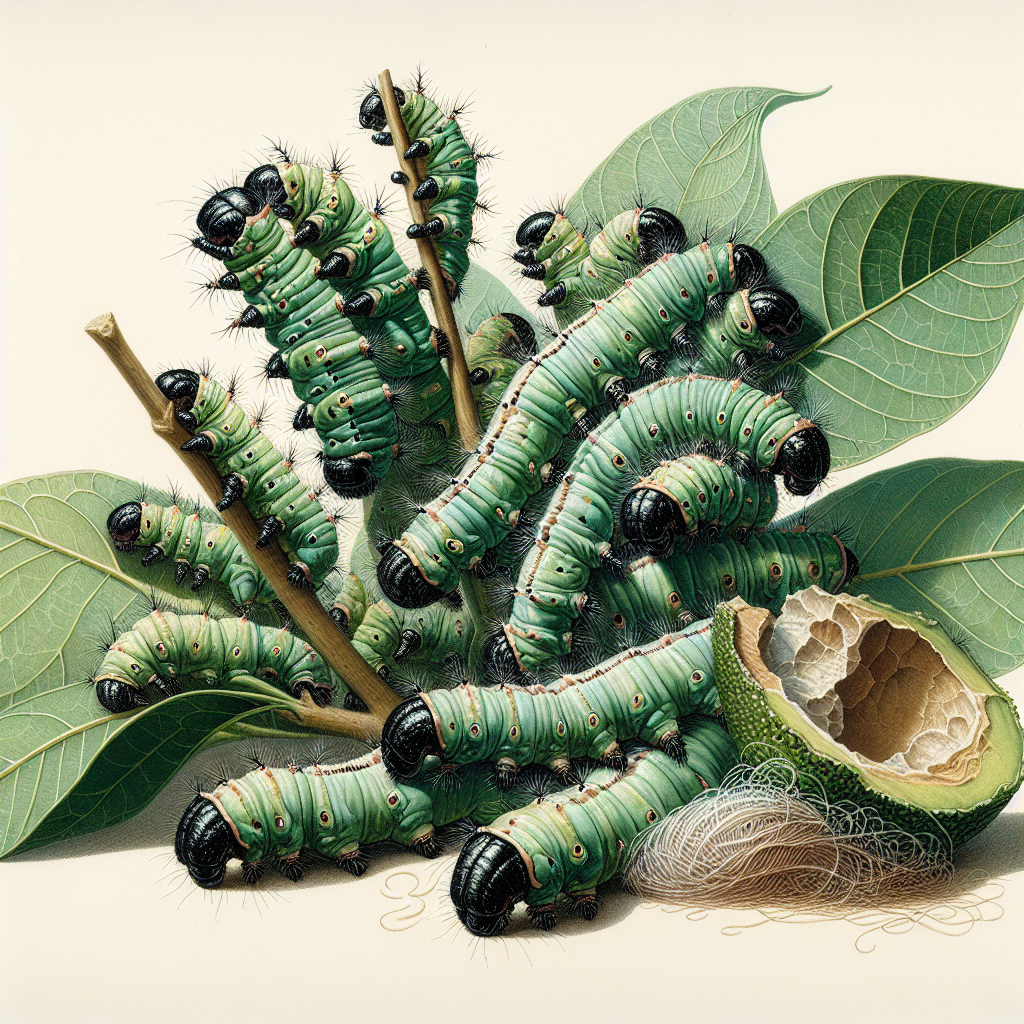
Introduction to Black-headed caterpillar
The Black-headed caterpillar, scientifically known as Dalaca cloanthes, represents one of the most formidable pests in tropical and subtropical agriculture, particularly notorious for devastating Hass Avocado orchards and other high-value crops. Native to regions like Central and South America, this moth larva has earned its name from the distinctive shiny black head contrasting with its pale green to yellowish body. Farmers often first notice the pest through sudden, severe defoliation, where entire branches are skeletonized by hordes of synchronized feeding caterpillars.
Understanding this pest is crucial for avocado growers and those cultivating similar crops, as uncontrolled infestations can lead to 50-100% foliage loss, stunting tree growth, reducing fruit set, and compromising long-term orchard productivity. Unlike sporadic pests, Black-headed caterpillars feed gregariously, forming large colonies that amplify damage rapidly. This guide draws from entomological research and field-tested agricultural practices to equip you with diagnostic tools, lifecycle knowledge, and organic management protocols. By integrating monitoring, biological controls, and cultural practices, growers can mitigate losses effectively. For broader pest management insights, check this Spring Pest Patrol blog on organic strategies.
Identifying Symptoms & Damage
Early identification is key to curbing Black-headed caterpillar outbreaks. Scout for clusters of 1-2 inch larvae with jet-black heads and translucent green bodies, often covered in a silken mat or frass. They congregate on leaf undersides or branch crotches, creating webbed shelters. Initial symptoms include pinhole feeding on young leaves, progressing to complete skeletonization where only veins remain.
Damage manifests as rapid defoliation, starting from the upper canopy and moving downward. Affected leaves turn brown, curl, and drop prematurely, exposing branches to sunburn. In severe cases, trees appear bare, with sooty mold developing on honeydew excretions, attracting ants. Differentiate from other caterpillars by the black head and gregarious behavior—unlike solitary hornworms or armyworms.
Inspect during dawn or dusk when larvae are active. Use a hand lens to confirm: bodies are smooth, with prolegs and a dark thoracic shield. Economic thresholds: 5-10 larvae per branch warrant action. Secondary signs include moth adults—medium-sized, brown with wingspans up to 1.5 inches—fluttering at night. Document damage with photos for IPM tracking, noting proximity to wild hosts like guava or native trees.
Lifecycle and Progression of Black-headed caterpillar
Dalaca cloanthes completes 3-5 generations annually in warm climates (25-30°C), with lifecycle spanning 40-60 days. Eggs are laid in clusters of 50-200 on leaf undersides, hatching in 7-10 days into tiny black-headed larvae. The larval stage, most destructive, lasts 20-30 days across five instars: early instars rasp leaf surfaces, while later ones voraciously devour foliage.
Mature larvae (up to 40mm) descend trees via silken threads to pupate in soil, forming reddish-brown pupae 15-20mm long. Pupation takes 10-15 days, emerging as nocturnal moths. Adults live 5-10 days, focusing on reproduction. Overwintering occurs as diapausing pupae in dry seasons.
Progression ties to host phenology: peak activity aligns with new flush growth in avocados. Monitor with pheromone traps for adults and branch beating for larvae. Understanding this cycle enables timed interventions, like targeting young larvae when vulnerable. Compared to armyworms, Black-headed caterpillars are more stationary but equally devastating in colonies.
Environmental Triggers & Risk Factors
Black-headed caterpillar thrives in humid tropics (70-90% RH, 24-32°C), with outbreaks triggered by prolonged wet seasons promoting egg survival and fungal suppression of natural enemies. Risk escalates in young orchards (<5 years) with dense canopies and excessive nitrogen, fostering tender flush attractive to ovipositing moths.
Poor sanitation—unremoved fallen leaves harboring pupae—increases reinfestation. Proximity to wild hosts like guava or native Myrtaceae serves as reservoirs. Monoculture planting and irrigation runoff create microclimates ideal for larval survival. Drought stress weakens trees, making them susceptible, while hurricane-damaged foliage spikes populations.
Soil type matters: well-drained loams allow pupal survival better than heavy clays. Scout high-risk zones: orchard edges, windbreaks. Climate change extends generations, per studies in Mexico and Peru. Mitigate by diversifying crops and enhancing biodiversity to disrupt cycles.
Organic Control & Treatment Plans
Organic management emphasizes IPM: prevention first, then biological and mechanical controls. Monitoring: Weekly scouts using sticky traps and beating sheets; treat at 2-5 larvae/10 branches.
Biological Controls: Introduce Bacillus thuringiensis (Bt) var. kurstaki at 1-2g/L, applied evenings to young larvae (1st-3rd instar). Efficacy >90% with 3 applications 7 days apart. Release Trichogramma wasps (500-1000/ha/week) for egg parasitism. Encourage native predators: birds, spiders, ants via flowering borders.
Mechanical: Hand-pick clusters into soapy water; prune infested branches and destroy. High-pressure water blasts dislodge larvae. Botanicals: Neem oil (0.5-1%) or spinosad (organic-approved) at label rates; rotate to prevent resistance. For outbreaks, cover trees with fine mesh (BTM).
Soil Treatment: Tillage exposes pupae to predators/sun. Integrate with caterpillar pests strategies. Success stories from Peruvian avocado farms show 80% reduction via Bt + parasitoids.
Preventing Black-headed caterpillar in the Future
Prevention builds resilient systems. Plant resistant avocado rootstocks and diversify with intercropping thai-basil or marigolds as repellents. Maintain 40-50% canopy closure via pruning for airflow, reducing humidity.
Sanitation: Rake/mulch fallen debris; solarize soil pre-planting. Use reflective mulches to deter moths. Scout year-round, especially post-rain. Encourage beneficials with hedgerows of yarrow or nasturtium. Rotate insecticides; monitor resistance.
Long-term: Breed tolerant varieties; use trap crops like nearby guava. Calendar-based sprays timed to moth flights via degree-day models. Farm hygiene and biodiversity slash risks by 70%, per extension data.
Crops Most Affected by Black-headed caterpillar
Primarily avocado, especially Hass and Fuerte varieties, with Fuerte Avocado highly susceptible due to tender leaves. Secondary hosts: guava, mango (kulfi-mango), mango, citrus, and ornamentals. Rare on banana or dragon-fruit. Tropical/subtropical focus; minimal in temperate zones.