Introduction to Burr rots
Burr rots represent a critical fungal disease complex primarily caused by pathogens like Phytophthora species and Sclerotinia sclerotiorum, targeting crops with burr-enclosed fruits or seed pods. The name 'burr rots' derives from the distinctive white, fuzzy mycelial growth resembling burrs that emerge from rotted tissues under humid conditions. This disease can devastate yields by 50-90% in severe outbreaks, particularly in high-value burr crops during prolonged wet periods.
First identified in subtropical orchards in the 1980s, burr rots has spread globally due to international trade and climate shifts favoring its pathogens. It compromises fruit quality, leading to post-harvest losses and market rejection. Early detection is vital, as the disease progresses rapidly from initial lesions to complete tissue breakdown. Farmers must integrate cultural, biological, and organic chemical controls for effective management. For more on related pathogens, see Phytophthora.
Understanding burr rots requires knowledge of its dual-phase infection: primary via soil splash and secondary via airborne spores. Affected burrs become lightweight, discolored, and drop prematurely, signaling economic loss. This guide equips growers with professional-grade diagnostics and strategies to safeguard harvests. Regular scouting and soil health practices are foundational to resilience against this pervasive threat.
Identifying Symptoms & Damage
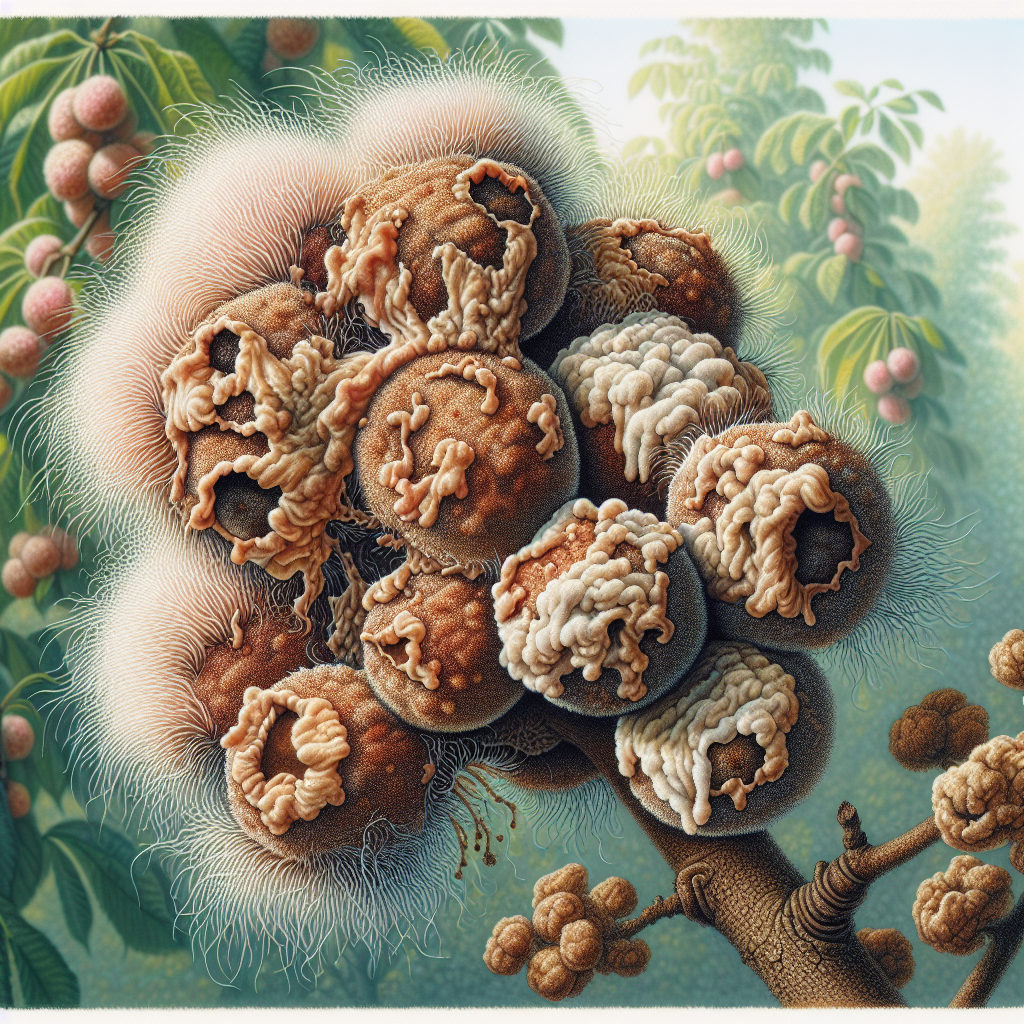
Burr rots manifests through distinct visual cues, enabling prompt diagnosis. Initial symptoms appear as water-soaked lesions on burr exteriors, often at the stem attachment point. These lesions expand rapidly, turning dark brown to black with a soft, mushy texture. Within 48-72 hours under high humidity (>85%), characteristic white, cottony mycelial 'burrs' erupt from the rotting tissue, giving the disease its name.
Advanced stages show complete burr disintegration, releasing black sclerotia (survival structures) into the soil. Infected fruits inside burrs exhibit internal rot, with off-white to tan flesh and a foul, fermented odor. Foliage near infections yellows and wilts, sometimes with root rots as secondary symptoms. Damage assessment reveals 20-40% yield loss in early detection versus total crop failure if unchecked.
Microscopic confirmation involves observing oospores in Phytophthora cases or sclerotia in Sclerotinia infections. Use a 10x hand lens to spot burr-like mycelia. Differentiate from anthracnose by the absence of concentric rings and from bacterial rots by the firm mycelial growth. Economic impact includes reduced marketability, as even mildly affected burrs fail quality standards. Photograph suspected samples for AI-assisted diagnosis, as in Why Misidentifying Plants Costs Small Farms Thousands.
Yield impacts are profound: burr drop leads to ground contamination, fostering reinfection cycles. In orchards, girdling cankers at the burr base cause branch dieback. Conduct grid scouting (every 10 rows) weekly during wet seasons to map progression. Symptom progression from lesion to full rot takes 5-10 days at 25-30°C.
Lifecycle and Progression of Burr rots
The burr rots lifecycle spans soilborne and aerial phases, with Phytophthora producing zoospores in saturated soils and Sclerotinia forming apothecia from sclerotia. Overwintering sclerotia germinate in spring, releasing ascospores during rain events. Primary infection occurs via splash dispersal onto lower burrs, with incubation of 3-7 days.
Secondary spread via wind-driven conidia accelerates epidemics, with R0 (reproduction number) exceeding 5 in optimal conditions. Disease progression follows a sigmoidal curve: slow initial spread, exponential mid-season, plateauing at canopy closure. Temperature optima: 24-28°C for Phytophthora, 18-24°C for Sclerotinia. Humidity above 90% sustains sporulation for 72+ hours.
Sclerotia persist 2-5 years in soil, triggered by host residues. Lifecycle completes in 14-21 days, with multiple cycles per season. Progression stages: 1) Lesion formation (Day 1-3), 2) Mycelial burr emergence (Day 4-6), 3) Fruit rot and drop (Day 7-10), 4) Sclerotia formation (Day 11+). Monitor using disease models integrating leaf wetness hours. Integrated with root rots, it forms polycyclic epidemics devastating orchards.
Environmental Triggers & Risk Factors
Burr rots thrives in warm (22-30°C), humid environments with >200mm monthly rainfall. Poor drainage and compacted soils retain moisture, elevating Phytophthora activity. High nitrogen fertilization promotes succulent tissues, increasing susceptibility. Overhead irrigation splashes inoculum, mimicking rain events.
Risk factors include dense canopies reducing airflow, wounding from hail or machinery, and nearby weed hosts harboring pathogens. Acidic soils (pH <6.0) favor Sclerotinia. Crop rotation gaps <3 years perpetuate soil inoculum. Climate change extends wet seasons, boosting incidence by 30% in marginal areas.
Susceptibility peaks at burr maturity (80-100 days post-bloom). Monocultures amplify spread; intercropping with marigold suppresses via allelopathy. Assess site risk via soil tests for sclerotia density (>10/g soil = high risk). Prolonged leaf wetness (>12 hours) is the primary trigger.
Organic Control & Treatment Plans
Organic management emphasizes sanitation, biocontrols, and resistance. Remove and destroy infected burrs weekly, burying >30cm deep or composting at 60°C+. Apply Trichoderma harzianum (5kg/ha) pre-planting to outcompete pathogens. Bacillus subtilis sprays (2L/ha, 7-day intervals) inhibit sporulation.
Potassium phosphite drenches (3-5L/ha) boost plant defenses, reducing lesion expansion by 60%. Neem oil (1%) + copper octanoate (OMRI-approved) for curative sprays during early symptoms. Prune for 20% canopy openness to enhance drying. Companion planting with thyme repels vectors.
Biological: Release predatory mites against secondary mites. Treatment timeline: Week 1 - Sanitation + biocontrol; Week 2-4 - Phosphite + Bacillus; Monitor efficacy via lesion counts. Rotate with non-hosts like corn. In outbreaks, rogue 10m buffers around foci. Success rates: 70-85% with integrated plans.
Preventing Burr rots in the Future
Prevention hinges on cultural practices: Select resistant varieties and certified disease-free stock. Improve drainage with raised beds (30cm) and cover crops like clover for soil aeration. Mulch with 10cm coarse material to suppress splash. Avoid overhead watering; use drip irrigation.
Soil solarization (6 weeks summer) kills 90% sclerotia. Annual lime to pH 6.5-7.0. Scout biweekly with sticky traps for early spores. Rotate 4 years with brassicas or grains. Boost immunity via balanced NPK (100:50:100 kg/ha) and silicon supplements (50ppm). Quarantine new plantings 2 years.
Long-term: Grafted rootstocks resistant to root rots. Weather-based alerts for sprays. Farm-wide IPM reduces incidence 80%. Record-keeping tracks progress; adjust annually.
Crops Most Affected by Burr rots
Primary hosts: Chestnut (/wiki/chestnut), hazelnut (burr-like husks), pecan, and filbert crops where husks mimic burrs. Secondary: walnut, almond with hull rots resembling burr symptoms. Tropical burr fruits like rambutan (not listed) and native American burr oaks.
Chestnuts suffer 70% loss; pecans show hull rot epidemics. Avoid confusion with pecan scab. Emerging on macadamia. Global hotspots: US Southeast, Australia, Southeast Asia. Yield thresholds: <5% infection tolerable.