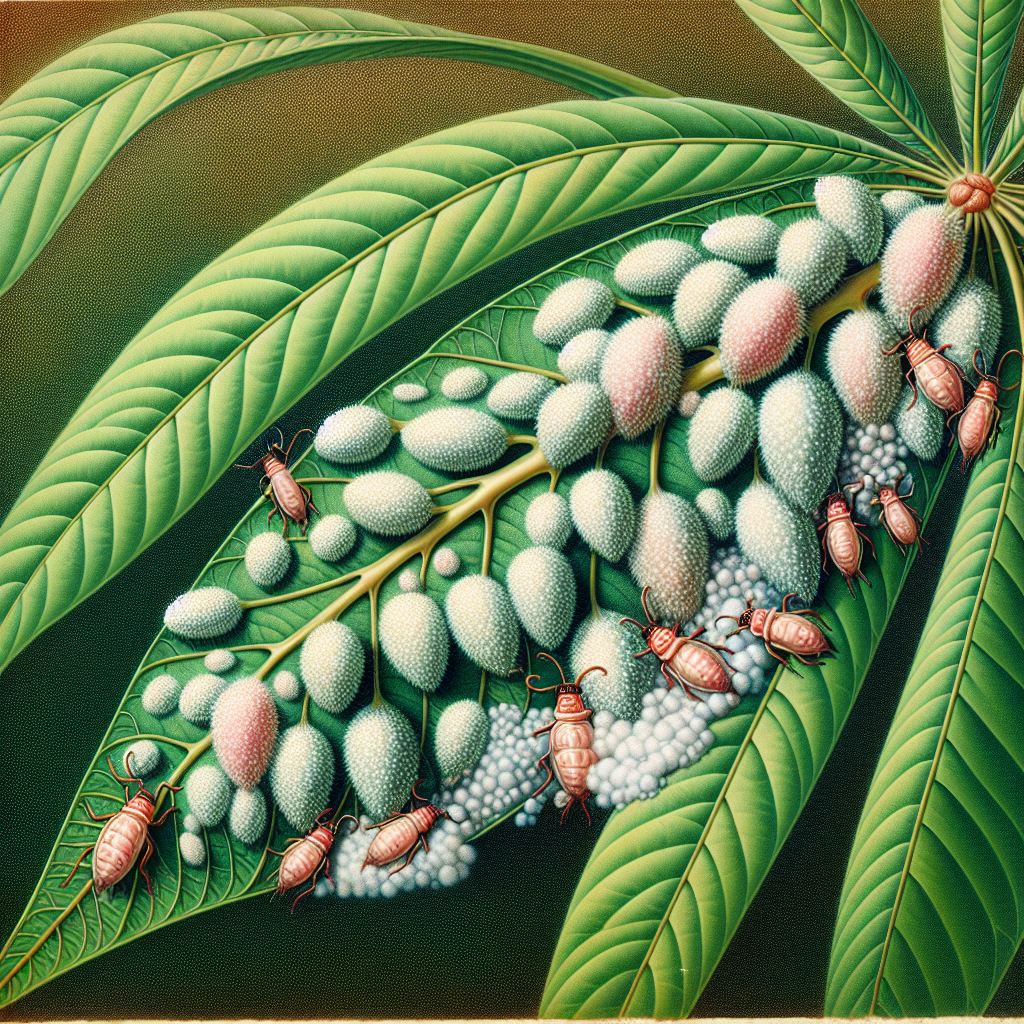
Introduction to Cassava mealybug
The cassava mealybug, scientifically known as Phenacoccus manihoti, represents one of the most destructive pests affecting Cassava production worldwide. First identified in Brazil in the early 20th century, this tiny insect exploded onto the African continent in the 1970s, devastating cassava crops—a staple food for over 800 million people in tropical regions. Infestations can reduce yields by up to 80%, leading to food insecurity and economic losses estimated in billions of dollars. As a member of the Pseudococcidae family, it closely resembles other mealybugs, covered in a white, waxy secretion that protects it from predators and desiccants.
Farmers in sub-Saharan Africa, Southeast Asia, and parts of South America face ongoing challenges from this pest due to its rapid reproduction and ability to develop resistance to some chemical controls. However, success stories abound: classical biological control programs introduced parasitoids like Anagyrus lopezi, which have restored yields in many areas. This definitive guide equips agricultural professionals with diagnostic tools, lifecycle insights, and proven organic management strategies to combat cassava mealybug effectively. Early detection and integrated approaches are key to minimizing damage and sustaining cassava productivity.
Understanding the pest's biology is crucial for timely intervention. Adult females are wingless, oval-shaped (about 1-1.5 mm long), and produce prolific offspring—up to 400 eggs per female in overlapping generations. Males are rare and winged, but reproduction is mostly parthenogenetic, allowing explosive population growth under favorable conditions. For more on small-farm pest strategies, check this Spring Pest Patrol blog.
Identifying Symptoms & Damage
Spotting cassava mealybug early is essential for containment. Look for clusters of white, cottony masses on the undersides of leaves, stems, and growing tips—often resembling tiny tufts of mold. Heavily infested plants exhibit stunted growth, with leaves turning yellow, curling, and dropping prematurely. The most telltale sign is the sooty mold fungus that grows on the honeydew excreted by feeding mealybugs, coating leaves in a black, sticky film that blocks photosynthesis.
Damage progresses rapidly: nymphs (crawlers) insert piercing-sucking mouthparts into phloem tissues, extracting sap and injecting toxins that distort plant architecture. Terminal buds bunch together, mimicking viral symptoms, while roots become underdeveloped, leading to wilting during dry spells. Severe infestations cause 'bunch top' syndrome, where plants produce numerous small, malformed shoots instead of robust storage roots. Yield losses correlate directly with infestation density: light (10-20% yield loss), moderate (40-60%), heavy (80-100%).
Differentiate from similar pests like root mealybugs or scale insects by the waxy filaments trailing from females and the presence of pinkish eggs within ovisacs. Use a hand lens to confirm mobile crawlers (orange-pink, leg-bearing nymphs). Scout weekly in high-risk areas, focusing on field edges and previously infested plots. Associated issues include ant tending (ants farm mealybugs for honeydew) and secondary infections from sooty mold.
Lifecycle and Progression of Cassava mealybug
The cassava mealybug completes its lifecycle in 20-40 days, depending on temperature (optimum 28-30°C). Eggs (0.1-0.2 mm, pinkish) are laid in ovisacs containing 100-400 each, hatching into crawlers within 5-10 days. These mobile nymphs (1st instar) settle on tender tissues, molting three times (2nd/3rd instars) over 15-20 days into wingless adult females. Males develop wings, mate briefly, and die, but parthenogenesis dominates.
Populations build through 10-20 overlapping generations per year in tropics. Crawlers disperse by wind, crawling, or ants. Overwintering occurs as eggs or 3rd instars in protected crevices. Progression: eggs → crawlers (dispersal phase, vulnerable) → settled nymphs (feeding, rapid growth) → adults (reproduction). Peak infestations coincide with flush growth post-rains.
Monitoring lifecycle stages informs control timing: target crawlers with contact sprays, adults with systemic options. Understanding this progression allows predictive modeling for outbreaks.
Environmental Triggers & Risk Factors
Warm, humid tropics (25-32°C, >60% RH) favor explosive outbreaks, with dry spells stressing plants and increasing susceptibility. Poor soil fertility, especially nitrogen deficiency, weakens cassava, making it attractive. Monoculture fields over 1 ha amplify spread; intercropping with banana or sweet potato reduces risk.
Key triggers: introduction via infested cuttings (primary vector), wind-dispersed crawlers, and ants. Drought-stressed plants exude more sap, drawing mealybugs. High planting density (>10,000 plants/ha) and late planting (missing early rains) heighten vulnerability. Regions like Nigeria, Thailand, and Brazil report recurrent epidemics. Climate change may expand range poleward.
Risk assessment: inspect cuttings, rotate fields, avoid susceptible varieties like TMS 30572.
Organic Control & Treatment Plans
Organic management integrates cultural, biological, and mechanical tactics. Biological Control: Deploy parasitoids (Anagyrus lopezi, Acerophagus coccois)—proven 90% effective in Africa. Release 10,000/ha early infestation; predators like ladybugs, lacewings consume crawlers. Neem Oil: 2-5% emulsions smother all stages (apply evenings, 7-10 day intervals). Insecticidal Soaps: Potassium salts disrupt membranes (1-2% solution, target undersides).
Cultural Practices: Prune infested tips, destroy debris. Plant resistant varieties (TMS 60142, NR 8083). Intercrop with marigold (repels via thiophenes). Trapping: Yellow sticky traps for crawlers; ant baits (boric acid + sugar) disrupt mutualism.
Treatment Plan:
- Scout weekly; act at 10% infestation.
- Prune + soap/neem (Week 1).
- Release parasitoids (Week 2).
- Monitor; repeat as needed. Avoid broad-spectrum sprays to preserve predators. Success rates: 70-95% with IPM.
Preventing Cassava mealybug in the Future
Prevention hinges on clean planting material: hot-water treat stem cuttings (49°C, 20 min) or use tissue culture. Rotate with non-hosts like corn or cowpeas every 2 years. Plant early (onset rains), space 1x1m for airflow. Mulch suppresses crawlers; barrier crops (e.g., thai basil) deter spread.
Field sanitation: rogue infested plants, deep plow residues. Monitor borders; apply prophylactic neem pre-rains. Build on-farm parasitoid rearing. Variety selection: resistant cultivars yield 20-50% more. Farmer field schools enhance adoption. Long-term: regional quarantines, GPS scouting.
Crops Most Affected by Cassava mealybug
Primarily cassava, but polyphagous on >80 hosts: sweet potato, yam, taro, mango, papaya, sugarcane, coffee. Worst in cassava (Manihot esculenta), causing root yield drops >70%. Minor damage to soybeans, peanuts, eggplant. Focus protection on staple root crops in tropics.