Introduction to Carrot (Paris Market)
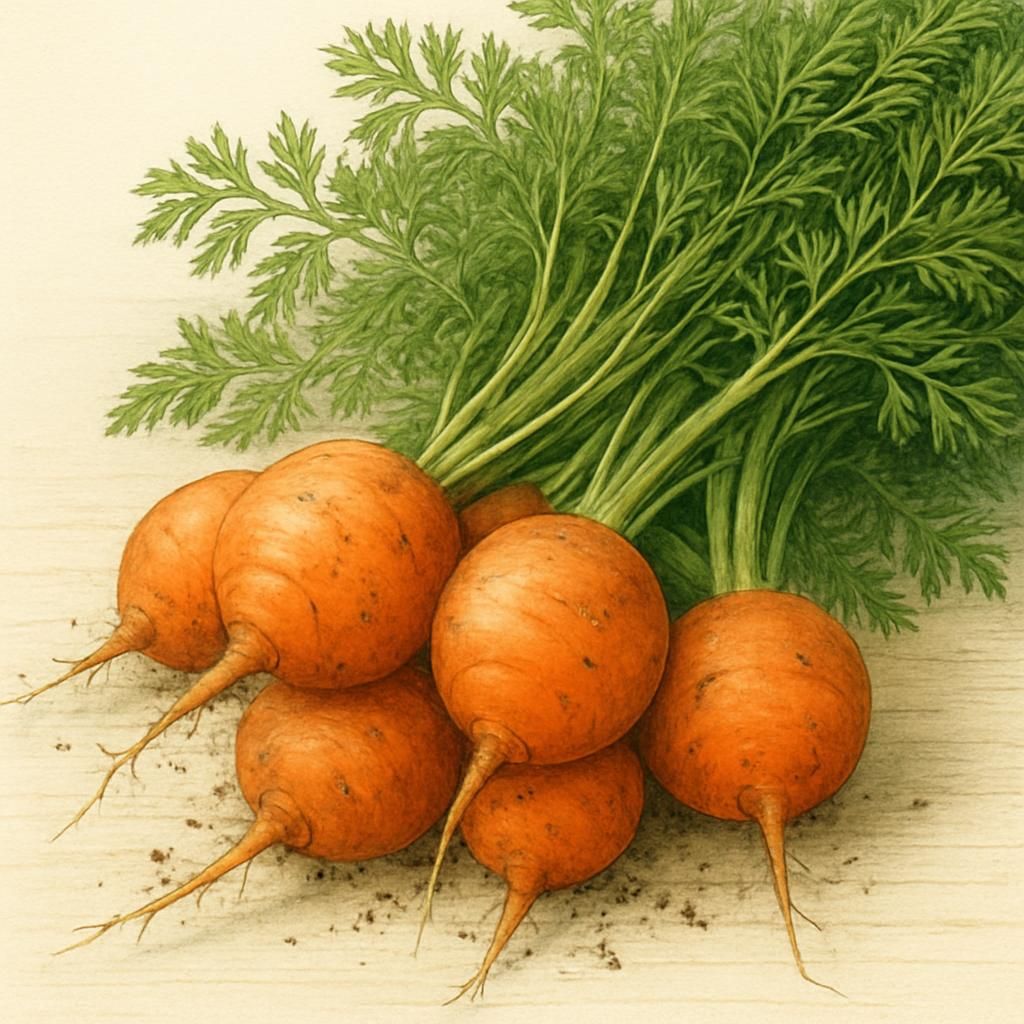
The Carrot (Paris Market) is a compact, spherical heirloom variety that delivers exceptional sweetness and crunch in a petite package. Developed in 19th-century France, this variety thrives where longer carrot types struggle, making it ideal for container growing, raised beds, and heavy clay soils. Its rapid maturity and reliable performance have made it a favorite among both home gardeners and small-scale commercial growers seeking premium baby carrots.
Paris Market carrots typically reach 1.5–2 inches in diameter at maturity, with smooth, bright-orange skins and a tender core. Their small size reduces the risk of forking and allows dense planting, resulting in impressive yields per square foot. Because the roots remain tender even when harvested young, they are popular for fresh market sales, gourmet restaurants, and pickling.
Botanical Profile of Carrot (Paris Market)
Carrot (Paris Market) belongs to the Apiaceae family and shares the same botanical characteristics as other Carrot (crop) cultivars. The plant produces a rosette of finely divided, feathery leaves that emerge from a central crown. The edible portion is a modified taproot that stores carbohydrates and develops its signature orange pigmentation through carotenoid accumulation.
Flowering occurs in the second year if plants are left in the ground over winter. The inflorescence is a compound umbel typical of the carrot family, producing small white flowers that attract beneficial pollinators. Seeds are small, ridged, and brown, requiring careful handling during sowing to achieve even stands.
Soil, pH, and Climate Requirements for Carrot (Paris Market)
Carrot (Paris Market) performs best in loose, well-drained soils free of stones and clumps that could cause forking. The variety tolerates slightly heavier soils than longer types because of its short, round shape, yet still benefits from deep cultivation and organic amendments.
| Parameter | Ideal Range/Value | Notes |
|---|---|---|
| Soil Type | Sandy loam to loam | Avoid compacted or rocky soils |
| Soil pH | 6.0–6.8 | Slightly acidic to neutral; lime if below 5.8 |
| Soil Temperature | 50–75°F (10–24°C) | Optimal germination at 55–65°F |
| Air Temperature | 60–75°F (15–24°C) day / 50–60°F night | Bolting risk above 80°F |
| Spacing | 1–2 inches between plants | Rows 8–12 inches apart |
| Depth | ¼–½ inch seed depth | Keep consistently moist until germination |
| Organic Matter | 2–4% | Incorporate well-rotted compost |
Step-by-Step Planting & Propagation
- Site Selection: Choose a location with at least 6–8 hours of direct sunlight. Raised beds or containers 8–12 inches deep work exceptionally well for Paris Market carrots.
- Soil Preparation: Remove stones and break up any compacted layers to 10–12 inches. Incorporate 2–3 inches of finished compost and rake to a fine, level seedbed.
- Sowing Timing: Direct sow 2–3 weeks before the last spring frost when soil reaches 50°F. Successive sowings every 2–3 weeks extend the harvest window through fall.
- Seeding Technique: Mix tiny seeds with sand or radish seed for even distribution. Sow in shallow drills, cover lightly, and firm the soil. Maintain consistent moisture until seedlings emerge in 7–14 days.
- Thinning: When seedlings reach 2 inches tall, thin to 1–2 inches apart. Crowded plants produce smaller, misshapen roots.
- Transplanting: While direct sowing is preferred, 3-week-old cell-grown seedlings can be transplanted carefully without disturbing the taproot.
Care & Maintenance regimes for Carrot (Paris Market)
Consistent moisture and balanced nutrition are critical for sweet, tender roots. Over-fertilization with nitrogen promotes foliage at the expense of root development, while drought stress leads to bitter flavor and cracking.
| Task | Schedule | Details |
|---|---|---|
| Watering | 1 inch per week; 2–3 shallow sessions | Maintain even moisture; mulch to reduce evaporation |
| Fertilizer | At sowing and 3 weeks after emergence | Side-dress with balanced organic fertilizer (NPK 5-5-5) or compost tea |
| Mulching | After thinning | 1–2 inches of straw or shredded leaves suppress weeds and retain moisture |
| Weeding | Weekly until canopy closes | Hand-weed or shallow hoe; avoid deep cultivation near roots |
| Thinning | Once at 2-inch height | Ensure final spacing of 1–2 inches |
| Pest Scouting | Twice weekly during warm weather | Check leaf undersides for Aphids and flea beetles |
Pests, Diseases & Organic Management
Carrot (Paris Market) faces fewer pest pressures than longer varieties, yet several insects and pathogens can still reduce quality. The most common issues include carrot rust fly larvae, Aphids, and flea beetles. Fungal diseases such as Alternaria leaf spot and powdery mildew may appear during humid periods.
Organic management begins with cultural practices: crop rotation, floating row covers at planting, and removal of crop debris. Beneficial nematodes and Bacillus thuringiensis products target soil-dwelling larvae, while insecticidal soaps and neem oil control aphids and flea beetles. Companion planting with Onion (crop) or Garlic (crop) repels carrot rust flies through volatile compounds.
Harvesting, Curing & Optimal Storage
Paris Market carrots reach baby size in 50–60 days and full size in 70–80 days. Harvest when roots are 1.5–2 inches in diameter by gently loosening soil and pulling. Avoid leaving roots in warm soil after maturity, as they may become woody.
Curing is unnecessary for fresh market sales, but a brief 1–2 hour air-drying period removes field moisture and reduces storage rot. Store unwashed roots at 32–38°F with 95% humidity for up to 4 months. Remove tops to ½ inch to prevent moisture loss. For longer storage, pack in damp sand or sawdust in a root cellar.
Companion Planting for Carrot (Paris Market)
Strategic companions enhance growth and deter pests. Onion (crop), Garlic (crop), and Leek mask carrot scent from rust flies. Lettuce (crop) and Radish (crop) provide quick ground cover and utilize different soil depths. Aromatic herbs such as Rosemary (crop) and Thyme (crop) repel aphids while attracting beneficial insects.
Avoid planting near Dill or Parsley (crop), which can cross-pollinate and reduce seed purity in future generations. Interplanting with Nasturtium (crop) provides a trap crop for aphids. For more ideas on beneficial pairings, see Summer Companion Planting: 10 Organic Pairings to Boost Small Farm Resilience.