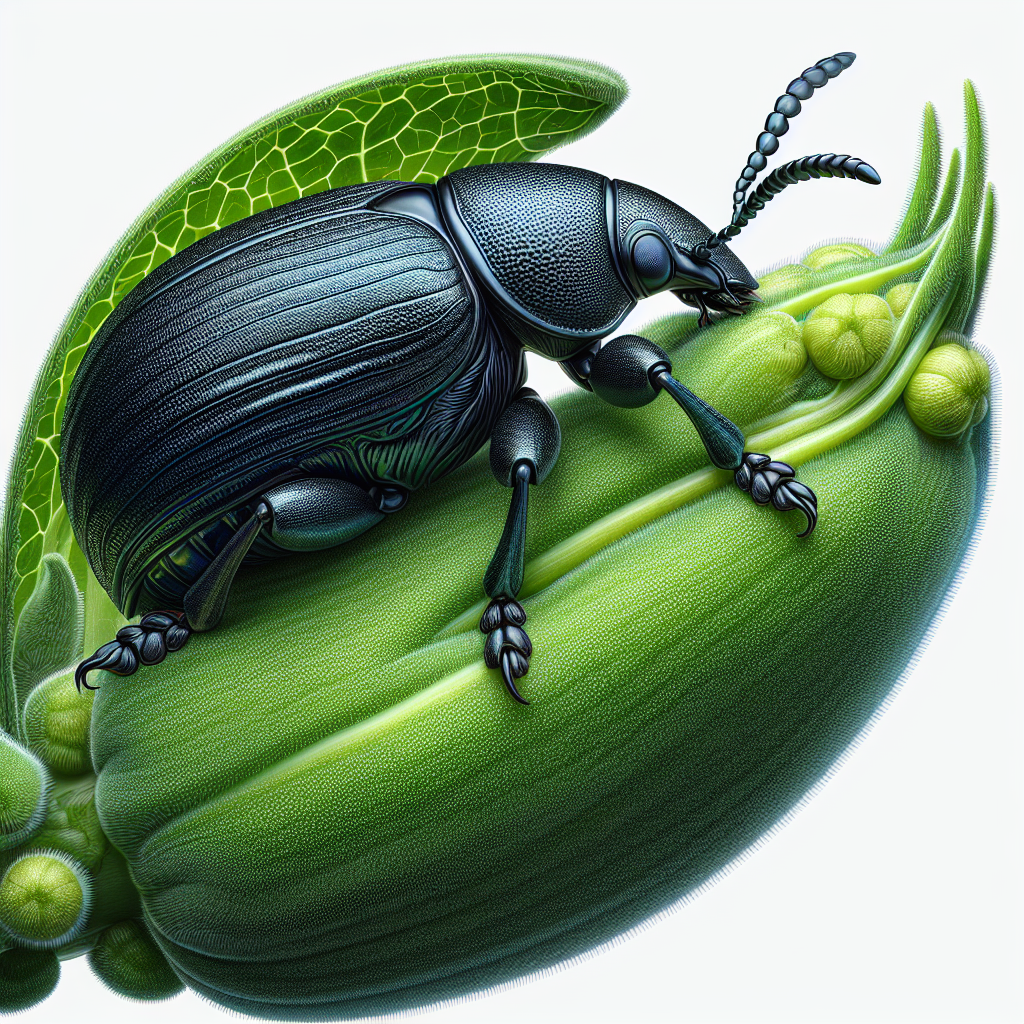
Introduction to Cabbage seedpod weevil
The cabbage seedpod weevil, scientifically known as Ceutorhynchus obstrictus (Marsham), is a notorious pest in brassica crop production worldwide, especially devastating to oilseed rapeseed and canola fields. Native to Europe, this beetle has spread across North America, Australia, and parts of Asia, where it poses a major threat to seed yield by infesting developing pods. Adults are small (2-3 mm long), shiny black beetles with a pronounced snout, earning them the name 'seedpod weevil' due to their preference for ovipositing in pods.
First detected in North America in the 1930s, populations exploded in the 1990s with the expansion of canola acreage. A single female can lay up to 100-200 eggs, and under optimal conditions, one larva can destroy up to 70% of seeds in a pod. Economic thresholds are typically 10-20 weevils per sweep net sample, but damage can reduce yields by 30-50% if unchecked. This guide provides comprehensive diagnostics, lifecycle insights, and organic management strategies tailored for small farms and commercial growers combating this pest. Early detection through field scouting is crucial, as larvae are concealed inside pods, making post-infestation control challenging.
Identifying Symptoms & Damage
Cabbage seedpod weevil damage manifests in distinct stages, making accurate diagnosis essential for timely intervention. Adult feeding creates characteristic round 'shot holes' (1-2 mm diameter) on leaves, stems, and pods, often appearing from late spring to summer. These holes are clean-cut and uniform, distinguishing them from irregular chewing by cabbage worms or flea beetles.
The most damaging phase is larval infestation: females chew a tiny hole in green pods and insert eggs, which hatch into cream-colored, legless larvae (up to 3 mm long) that tunnel inside, feeding on seeds. Infested pods become distorted, shortened, and fail to fill properly, turning yellowish prematurely. Severely damaged pods split open, revealing frass-filled cavities with few viable seeds. Seed yield loss correlates directly with larval numbers; 2-3 larvae per pod can destroy 80% of seeds.
Secondary signs include adult aggregation on flowering brassicas and a slight musty odor from frass. Differentiate from pod midge or pod borers by the neat entry holes and internal seed destruction without webbing. Use a sweep net or beat sheet for adults (grayish dust when crushed confirms identification). For larvae, slice open pods longitudinally—healthy pods have plump seeds; infested ones show hollowed chambers. Monitor pod tips for extruded 'plug' of plant tissue over egg-laying scars. In severe cases, entire racemes shrivel, mimicking drought stress or Alternaria leaf spot.
Lifecycle and Progression of Cabbage seedpod weevil
Understanding the cabbage seedpod weevil's lifecycle is key to disruption timing. This univoltine (one generation per year) pest overwinters as diapausing adults in soil, leaf litter, or field margins, emerging in early spring (April-May in temperate zones) when brassicas bolt. Adults feed on leaves and pollen for 20-30 days, gaining weight before seeking buds and flowers.
Oviposition peaks during flowering (May-June), with females laying 1-5 eggs per pod over 2-4 weeks. Eggs hatch in 5-10 days into larvae that feed for 20-30 days, passing through three instars. Mature larvae (curved, C-shaped) bore out of pods, drop to soil, and pupate 5-10 cm deep, forming pupal cells. Adults emerge in 10-15 days (July-August) but re-enter diapause until fall, migrating to overwintering sites. Total lifecycle: 45-60 days, influenced by temperature (optimum 20-25°C).
Generational synchrony with crop phenology is critical—damage maximizes when peak egg-laying coincides with 10-20% bloom. In warmer climates, partial second generations occur, extending risk. Track progression with degree-day models (base 6°C, 600-800 DD for adult emergence). Overwinter survival exceeds 90% in undisturbed soil, emphasizing post-harvest sanitation.
Environmental Triggers & Risk Factors
Cabbage seedpod weevil thrives in mild, continental climates with brassica monocultures. Key triggers include warm springs (15-20°C) accelerating adult emergence and flowering synchrony, dry conditions favoring adult dispersal (up to 1 km), and minimum tillage preserving overwintering habitat. High-risk factors: continuous cabbage or rapeseed cropping, volunteer plants serving as bridges, and proximity to infested fields.
Soil type influences pupal survival—loamy soils retain moisture better than sands. Late-maturing varieties extend exposure windows, while windbreaks concentrate weevils. Compounding risks include concurrent aphids vectoring viruses or downy mildew, weakening plants. Climate change models predict range expansion northward, with earlier springs boosting populations 20-50%. Scout high-risk zones: field edges, weedy margins, and south-facing slopes first. Thresholds rise in diverse rotations or irrigated fields due to asynchrony.
Organic Control & Treatment Plans
Organic management of cabbage seedpod weevil emphasizes integrated pest management (IPM) with no broad-spectrum insecticides. Cultural Controls: Rotate brassicas with non-hosts like potato or corn (3-4 years minimum). Destroy volunteers and edge weeds promptly. Deep tillage (15-20 cm) in fall exposes pupae to predators and desiccation, reducing carryover 70-90%.
Biological Controls: Encourage natural enemies—ground beetles, rove beetles, and parasitic wasps (Trichomalimus perfectus) attack larvae (up to 30% mortality). Plant nectar-rich borders with thyme or yarrow to boost parasitoids. Release commercially available Microtonus hyperodae (stem borer parasite) where established.
Physical/Mechanical: Use sweep nets (20-30 sweeps/10 m²) for adults pre-bloom, drowning in soapy water. Vacuum bands on stems target egg-laying. Trap crops like early mustard lure adults away. For seeds, hot water treatment (48°C, 10 min) kills internal larvae without residues.
Treatment Timeline: Scout weekly from bud stage (threshold: 2-5 adults/sweep). Apply organic-approved options like Beauveria bassiana (entomopathogenic fungus) or neem oil at 10% bloom, targeting adults (2 applications, 7-day interval). Pyrethrum or spinosad for outbreaks, but rotate to avoid resistance. Post-harvest, flail-mow residues and disk incorporate. Monitor efficacy with pod dissections (goal: <1 larva/10 pods). See our Spring Pest Patrol blog for AI-enhanced scouting tips.
Preventing Cabbage seedpod weevil in the Future
Long-term prevention hinges on breaking the lifecycle and reducing inoculum. Implement 4-year rotations excluding all brassicas (Brassica napus, B. rapa, mustards). Use resistant varieties like 'Echo' or 'Viola' with tight pod sutures. Plant early-maturing cultivars to escape peak oviposition.
Sanitation is paramount: harvest promptly, bale and remove residues, then till deeply. Maintain 1 km buffers from commercial brassicas. Cover crops like clover suppress emergence via allelopathy. Perimeter traps (blue sticky cards + bucket traps with allyl isothiocyanate lures) intercept 20-40% migrants.
Enhance biodiversity with hedgerows of native plants fostering predators. Soil health via cover cropping reduces weevil burrowing success. Scout with degree-day apps; act at 400 DD post-bloom. Certify seed free of weevils. Annual risk assessments via sweep nets predict outbreaks. Consistent IPM yields 80-95% control without synthetics, safeguarding yields sustainably.
Crops Most Affected by Cabbage seedpod weevil
Primarily attacks oilseed brassicas: canola (Brassica napus), rapeseed (B. napus), turnip rape (B. rapa), and mustards (Sinapis alba, B. juncea). Yield losses hit 40-100% in seed crops; forage brassicas suffer less due to early harvest.
Secondary hosts include broccoli, cauliflower, kale, and Chinese cabbage, mainly adult feeding damage. Rarely infests podless crops like leafy greens. Economic impact greatest in Canada (Prairies) and Europe, costing millions annually. Diversify rotations with peas or wheat to mitigate.
(Word count: 1452)