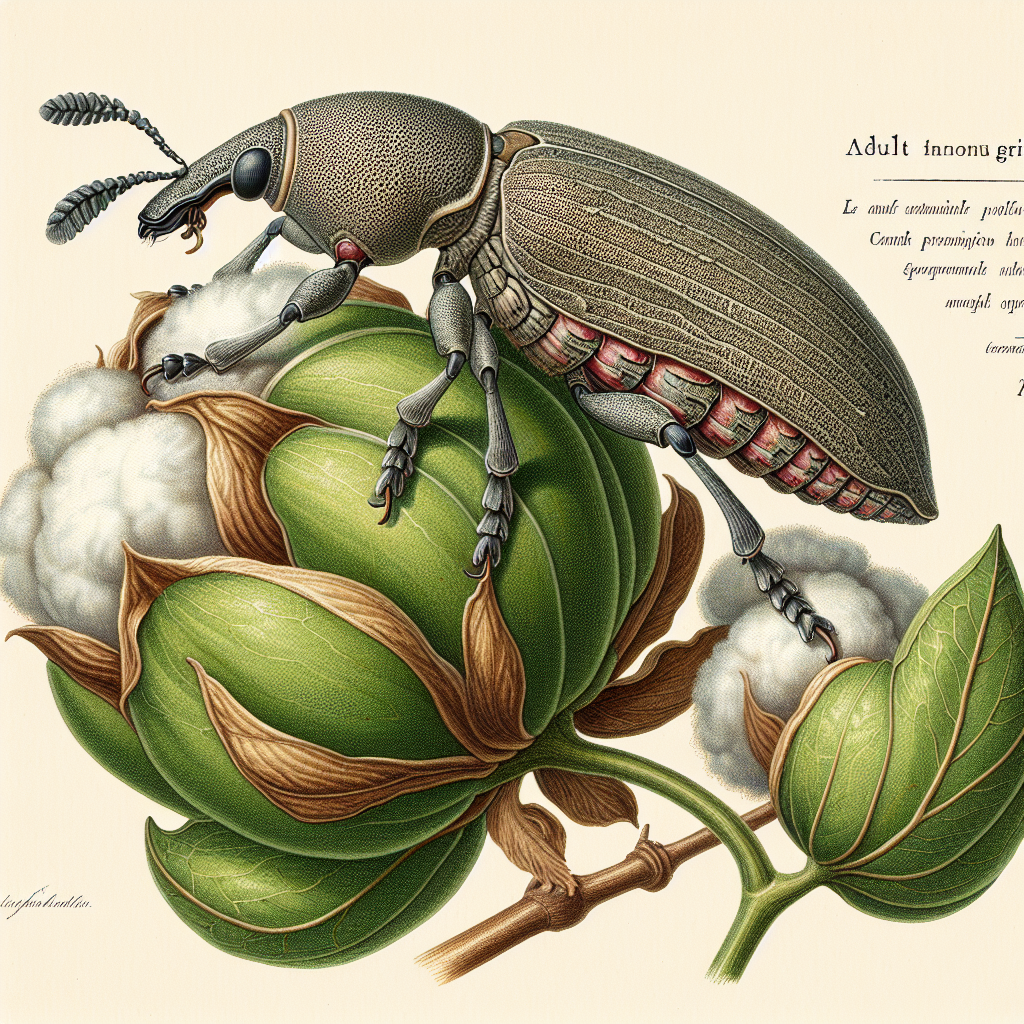
Introduction to Boll weevils
Boll weevils (Anthonomus grandis) represent one of the most infamous pests in agricultural history, particularly devastating to cotton production across the Americas. First identified in Mexico and spreading to the United States in the late 19th century, these small beetles have caused billions in crop losses, prompting innovations like the boll weevil eradication programs that transformed Southern U.S. farming. Adults are grayish-brown, about 1/4 inch long, with distinctive elongated snouts and reddish-orange markings on their wings. Females lay eggs inside cotton squares (flower buds) and bolls, where larvae feed voraciously, ruining fiber quality and yield. Beyond cotton, they occasionally attack other crops like okra, but cotton remains their primary target. Understanding boll weevils is crucial for growers in warm, humid regions, as unchecked infestations can wipe out 50-100% of bolls in a field. Early detection and integrated pest management (IPM) are key to protecting yields. This guide equips farmers with diagnostic tools, lifecycle knowledge, organic controls, and prevention strategies to combat this pest effectively. For small farms, timely intervention can preserve profitability amid rising input costs. Spring Pest Patrol: Organic AI Strategies to Shield Your Crops from Common Invaders
Identifying Symptoms & Damage
Spotting boll weevil damage early is essential for containment. Look for tiny entry holes (1/16 inch) on cotton squares and bolls, often surrounded by lint or frass (insect waste). Affected squares shed prematurely, appearing wilted or brown, while infested bolls show flaky white fibers protruding from punctures, with internal larvae creating galleries. Young bolls may abort entirely, leading to sparse fruit set. Heavy infestations cause 'shedding' where 20-50% of bolls drop, drastically reducing harvestable yield. Adult weevils are active during the day, dropping from plants when disturbed—shake branches over a white sheet to check. Larvae are white, legless, C-shaped grubs inside bolls, invisible externally but detectable by squeezing (healthy bolls exude milky sap; infested ones yield watery liquid and frass). Secondary signs include sooty mold on shed lint from honeydew-like secretions, though less common than in aphids. Differentiate from similar pests like beetles or corn earworm by the snout and specific boll damage. Scout weekly from bloom through boll set, using pheromone traps for adults. Thresholds: 1 weevil per 100 plants or 5-10% infested squares warrants action. Document patterns to refine future monitoring.
Lifecycle and Progression of Boll weevils
Boll weevils complete 3-6 generations per season in subtropical climates, aligning with cotton phenology. Adults overwinter in diapause under plant debris, leaf litter, or soil, emerging in spring (March-May) when temperatures exceed 60°F (15°C). Females lay 100-300 eggs singly in squares or small bolls, puncturing with ovipositor and marking with a 'rostrum' spot. Eggs hatch in 3-4 days into larvae that feed for 7-10 days, pupating inside the boll for another 4-5 days. New adults emerge 2-3 weeks after egg-laying, feeding on pollen and laying more eggs. Peak activity coincides with first bloom (June-July), with later generations targeting maturing bolls. Full cycle: 21-30 days at 80°F (27°C), slowing in cooler weather. Overwintering survival exceeds 50% in mild winters, fueling spring infestations. Males produce aggregation pheromones, drawing swarms to fields. Understanding this progression allows timed interventions: trap adults pre-bloom, destroy shed squares mid-season. In eradication zones, sterile insect technique disrupts mating. Monitor degree-days (base 60°F) for precise predictions—450-500 DD from overwintering to first flight.
Environmental Triggers & Risk Factors
Boll weevils thrive in warm, humid conditions optimal for cotton: temperatures 75-90°F (24-32°C), rainfall 20-40 inches annually. Proximity to overwintering sites like woods, fencerows, or volunteer cotton heightens risk—adults fly 1-10 miles seeking hosts. Poor field sanitation, such as undecomposed gin trash or late-maturing varieties, sustains populations. Monoculture cotton fields without refuges amplify outbreaks, as do drought-stressed plants (weevils prefer succulent tissue). High nitrogen fertilization boosts square production, inadvertently increasing oviposition sites. Adjacent crops like peanuts or sorghum serve as bridges. Climate change extends seasons, potentially adding generations northward. Soil types matter: sandy loams retain weevils better than clays. Risk assessment: fields near infested history score high; use GIS mapping for hotspots. Mitigate by destroying volunteers pre-planting and rotating with non-hosts like wheat or corn. Hyper-local weather monitoring prevents surprises from unseasonal warmth.
Organic Control & Treatment Plans
Organic management emphasizes IPM over chemicals. Start with cultural controls: plow under crop residue post-harvest to expose pupae to predators and desiccation—achieves 70-90% overwintering mortality. Plant early-maturing cotton varieties resistant to weevil pressure. Scout rigorously with grandlure pheromone traps (1-2 per 10 acres), removing trapped weevils weekly. Hand-pick and destroy infested squares/bolls daily in small fields (<5 acres). Introduce biological agents: parasitic wasps (Catolaccus grandis) release 3,000/acre at bloom, targeting 50% larvae; lady beetles and big-eyed bugs prey on eggs/adults. Neem oil (azadirachtin) sprays (1-2% solution) deter feeding/oviposition when applied at pinhead square stage, weekly through bloom—safe for pollinators if evening-applied. Kaolin clay (Surround WP) creates physical barriers, reducing oviposition by 60%. Spinosad (organic-approved) targets larvae inside bolls at 0.02 lb AI/acre, 7-day intervals. Trap crops: early-planted okra borders lure weevils away. Mulch with straw to disrupt soil pupation. Integrated plan: monitor (traps), cultural (sanitation), bio (predators), minimal sprays. Rotate annually; track efficacy via boll samples. For outbreaks, flare crops (early destroy edge plants) confines weevils. Yields recover 20-40% with diligent IPM.
Preventing Boll weevils in the Future
Prevention hinges on breaking the lifecycle chain. Implement mandatory fall plowing to bury/ expose residues, timed before winter rains. Eradicate volunteer cotton within 100 yards of fields. Use Bt cotton varieties (organic hybrids available) expressing lepidopteran toxins that indirectly suppress weevils via healthier plants. Border traps with kill strips (insecticide-coated) intercept migrants. Maintain field buffers of non-hosts like clover or marigold to deter influx. Scout pre-plant for overwintering sites, disk harrowing woods edges. Area-wide management: coordinate with neighbors for synchronized planting/destruction. Resistant varieties like DP 393 or PHY 485WRF show 30% less damage. Monitor via apps for pheromone trap data. Long-term: diversify into intercropping with thyme or yarrow, natural repellents. Clean equipment to avoid transport. Annual risk audits prevent reinfestation. Successful programs, like U.S. Boll Weevil Eradication (99% elimination in 15 states), prove vigilance pays. Commit to zero tolerance for sustainability.
Crops Most Affected by Boll weevils
Boll weevils primarily target upland cotton and pima cotton, boring into squares and bolls, causing up to 100% loss in untreated fields. Okra suffers similar pod damage, though less economically. Rare hosts include hibiscus and kenaf, but cotton dominates. No significant impact on grains like rice or soybeans. Focus protection on Gossypium species.