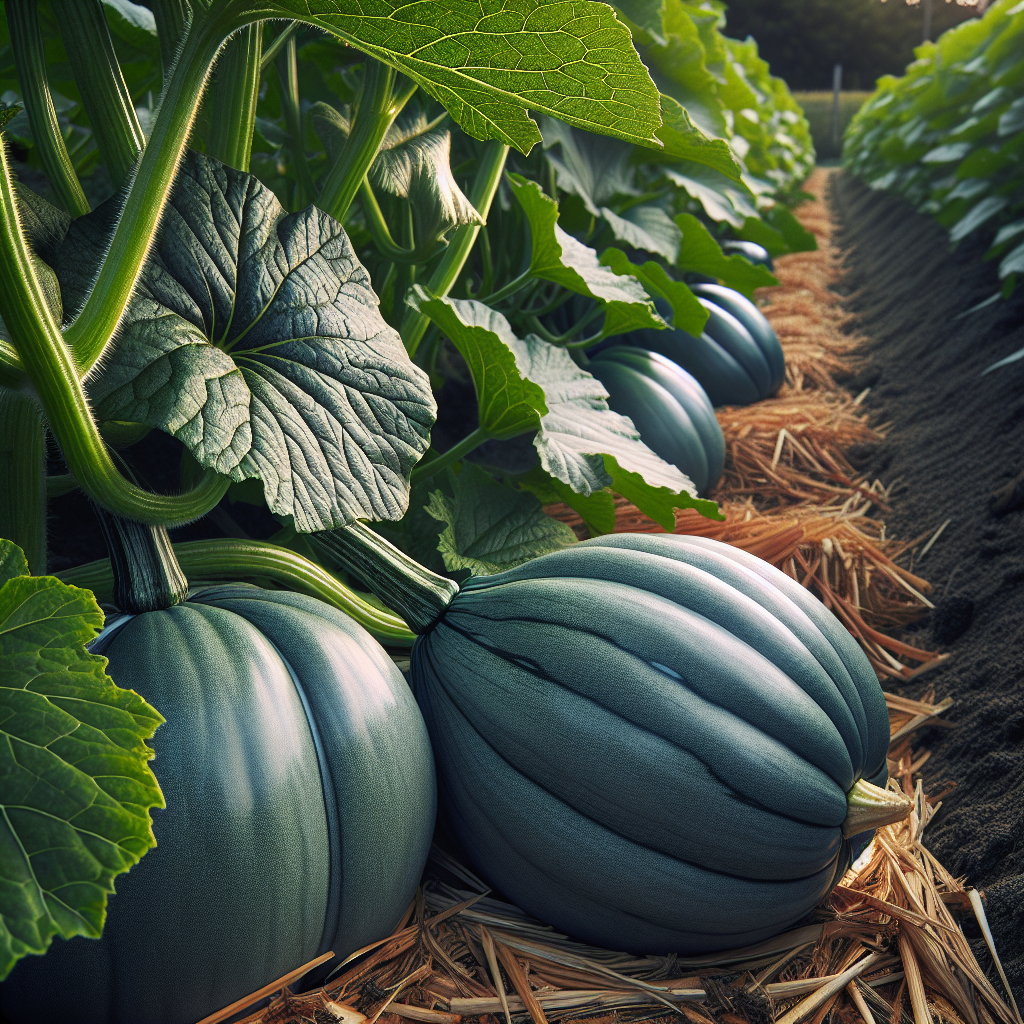
Introduction to Blue Hubbard Squash
An old New England heirloom with a reputation for size, storage quality, and rich flavor, this winter squash belongs to the Hubbard group and is widely recognized by its hard blue-gray skin and teardrop-shaped fruits. Mature fruits commonly weigh 10-20 pounds, though larger specimens are possible under ideal fertility and irrigation. The flesh is thick, fine-grained, and deep orange, becoming sweeter and drier after curing and a few weeks of storage.
Blue Hubbard is a long-season crop best suited to growers who can provide 100-120 frost-free days, ample rooting space, and strong soil fertility. Unlike tender summer squash, it is harvested fully mature and intended for curing and storage. In traditional kitchen gardens, Hubbard types were valued as staple winter food because they store for months and hold quality well. If you want a dense, flavorful squash for roasting, baking, puree, and livestock feed supplementation, this is one of the most dependable old cultivars to grow.
Because it is a form of Hubbard Squash, Blue Hubbard shares the species-level vigor typical of many C. maxima types: sprawling vines, large leaves, and heavy nutrient demand. For broader planning on building fertility before planting, see soil health strategies.
Botanical Profile of Blue Hubbard Squash
This cultivar belongs to Cucurbita maxima, a species that includes many large-fruited winter squashes known for sweet, dry flesh and relatively soft stems compared with Cucurbita pepo. Blue Hubbard plants produce long trailing vines that may extend 10-15 feet or more, with broad, slightly lobed leaves and coarse petioles. The vine habit is aggressive, and lateral branching can quickly cover a large bed.
The fruit is typically oblong to bulbous with a tapered neck and blunt blossom end. Its rind matures from greenish juvenile tones into a powdery blue-gray to slate-blue finish. This glaucous coloration is one of its defining visual traits. Rinds are thick and hard at maturity, which contributes to the cultivar's excellent storage performance. Flesh color is a saturated orange, indicating strong carotenoid content.
As a monoecious plant, it bears separate male and female flowers on the same vine. Male blossoms appear first and are more numerous; female flowers can be recognized by the swollen ovary behind the petals, which resembles a miniature squash. Pollination is usually carried out by bees, especially squash bees and honeybees active in early morning. Poor pollination leads to misshapen fruit, fruit abortion, or low fruit set.
Blue Hubbard tends to produce fewer but larger fruits than compact winter squash varieties. Commercially, this is useful where high per-fruit weight is preferred. Botanically, C. maxima generally performs best in warm soil and can be somewhat more tolerant of cool night conditions than some tropical cucurbits, but it still suffers under frost, waterlogging, and severe heat stress during flowering.
Soil, pH, and Climate Requirements for Blue Hubbard Squash
This crop performs best in deep, fertile, well-drained loam or sandy loam with high organic matter and strong water-holding capacity. The ideal pH range is 6.0-6.8, though plants can still grow reasonably well from about 5.8 to 7.2 if nutrient availability is managed carefully. Below pH 5.8, calcium, magnesium, and phosphorus availability may decline while manganese and aluminum can become more problematic. Above pH 7.2, micronutrients such as iron and manganese may become less available, sometimes causing pale new growth.
Blue Hubbard is a heavy feeder. Before planting, target soil with moderate to high organic matter, ideally above 4%, and good cation exchange capacity if possible. A pre-plant incorporation of fully finished compost improves structure, moisture retention, and microbial activity. Avoid raw manure immediately before planting, as it can encourage excessive vegetative growth, create food safety concerns, and contribute to nutrient imbalance.
Drainage is critical. Squash roots need oxygen, and soils that stay saturated after rain can lead to root stress, stunting, and increased risk of Phytophthora and other rots. If water remains pooled for more than 24 hours after a soaking rain, install raised beds or hills. In heavier clay soils, mounded rows 8-12 inches high can dramatically improve performance.
The crop prefers full sun with a minimum of 8 hours of direct light daily; 10 or more is better for maximum sugar accumulation and fruit sizing. The optimum temperature range for vigorous growth is roughly 70-85°F (21-29°C). Germination is strongest when soil temperatures are 70-95°F (21-35°C), with the fastest emergence often around 85-90°F. Seeds planted into cool soil below 60°F often rot or emerge weakly.
A long frost-free season is essential. Blue Hubbard usually needs about 100-120 days from sowing to harvest, depending on climate and strain. It does best in temperate regions with warm summers and low frost risk into early autumn. In very hot climates above 95°F (35°C), pollen viability and fruit set can drop, especially when nights remain hot. In humid regions, airflow and disease prevention become especially important.
Step-by-Step Planting & Propagation
Direct sowing is the standard method because cucurbits dislike root disturbance. Start only after all danger of frost has passed and soil has warmed to at least 65°F (18°C), preferably 70°F (21°C) or higher. In short-season regions, seeds may be started indoors 2-3 weeks before transplanting, but use large biodegradable pots or deep cell trays and disturb roots as little as possible.
Select the site. Choose a full-sun area with enough room for sprawling vines. Do not plant where other cucurbits grew in the previous 2-3 years if disease or vine borer pressure was high.
Prepare the bed. Work compost into the top 6-10 inches of soil. If soil testing is available, adjust phosphorus and potassium before planting rather than relying entirely on side-dressing later. Squash responds strongly to adequate potassium for fruit quality and storage life.
Form hills or wide rows. Traditional hills should be 18-24 inches across and slightly raised. Space hills 6-8 feet apart in all directions. In rows, space plants 4-6 feet apart with 8-10 feet between rows. Blue Hubbard is not a compact type; crowding reduces airflow and increases disease pressure.
Sow seed. Plant 1-1.5 inches deep. Sow 3-4 seeds per hill, then thin to the strongest 1-2 plants once true leaves develop. If using rows, place seeds 2-3 per station and thin similarly.
Transplant carefully if needed. Harden seedlings off over 5-7 days. Transplant only when they have 1-2 true leaves and roots have not begun circling heavily. Plant at the same depth they were growing in containers, water immediately, and protect from wind.
Mulch after establishment. Wait until soil is fully warm, then apply straw or leaf mulch to suppress weeds and reduce soil splash. Keep mulch a few inches away from the crown to prevent rot.
For germination, expect emergence in 5-10 days in warm soil. If stands are patchy, check for seedcorn maggot, cold soil injury, or damping conditions. Re-sow quickly if the season allows.
Care & Maintenance regimes for Blue Hubbard Squash
Once established, this crop benefits from steady, even growth without swings between drought and saturation. Aim to supply roughly 1-1.5 inches of water per week from rainfall or irrigation during vegetative growth, increasing to as much as 2 inches weekly during peak flowering and fruit enlargement on sandy soils or in hot weather. Deep, infrequent watering is superior to shallow daily sprinkling because roots will explore deeper soil and plants become more resilient.
A practical soil-moisture target is to keep the root zone moist to a depth of 6-8 inches without becoming waterlogged. If you squeeze a handful of soil from that depth, it should feel cool and hold together loosely, not drip water or crumble to dust. Overwatered plants often show yellow lower leaves, slow growth despite wet soil, and a sour smell in poorly drained beds. Severely waterlogged roots may cause midday wilt that does not recover at night, which can be mistaken for drought. Underwatered plants wilt during heat and may recover by evening at first, but prolonged stress leads to dull leaf color, blossom drop, poor fruit fill, and hard, underdeveloped squash.
Drip irrigation or soaker lines are strongly recommended. Wet foliage from overhead irrigation raises disease pressure, especially Powdery mildew and leaf blights. Irrigate early in the day if overhead watering is unavoidable.
Nutrient management should balance vine growth with fruit development. Excess nitrogen produces lush vines at the expense of fruit set and may delay maturity. A common approach is to incorporate compost pre-plant, apply a balanced organic fertilizer at planting, then side-dress when vines begin to run and again just after fruit set if growth is slowing. Watch the plants: pale leaves and weak vine extension suggest nutrient shortage, while dark, oversized foliage with few fruits suggests too much nitrogen.
Weed control matters most in the first 4-6 weeks. Once vines cover the ground, they outcompete many weeds. Hand-weed shallowly to avoid disturbing roots. Mulch helps conserve moisture and limit weed emergence, but do not pile it against stems.
Pollination is frequently the hidden yield limiter. Encourage bee activity by avoiding insecticide sprays during bloom and by maintaining nearby flowering habitat. If fruit set is poor despite healthy vines, hand-pollination in the morning can improve results. Transfer pollen from a freshly opened male flower to the stigma of an open female flower using the anther directly or a soft brush.
Fruit load management is optional but useful. For very large, high-quality squash, some growers limit each plant to 2-4 fruits by removing late flowers and small fruit after the desired set. This channels carbohydrates into fewer squash and improves uniform maturity.
In cool regions, pinch off new vine tips and flowers 30-40 days before expected frost so the plant directs energy into maturing existing fruit. Place boards, flat stones, or thick straw under developing squash in damp climates to reduce contact rot.
Pests, Diseases & Organic Management
The most common insect threats are Squash bugs, Cucumber beetles, Aphids, and sometimes Squash vine borers, though C. maxima types can show somewhat variable susceptibility depending on local pest pressure. Squash bugs feed by piercing leaves and vines, causing stippling, yellowing, and eventual collapse if populations build. Check leaf undersides for bronze egg clusters and crush them early. Cucumber beetles chew seedlings, scar fruit, and can vector Bacterial wilt. Use floating row covers immediately after planting, then remove at flowering for pollination.
Aphids often colonize leaf undersides during warm weather. Light infestations rarely justify intervention, but heavy populations can distort growth and spread viruses. A strong water spray, insecticidal soap, and encouragement of beneficial insects usually suffice.
Slugs may damage young seedlings in mulched or damp beds. Use traps, hand-picking, and drier surface conditions around young plants.
Powdery mildew is one of the most common late-season diseases. It first appears as white, talc-like patches on upper or lower leaf surfaces. Severe infection reduces photosynthesis and shortens fruit-filling time. Prevention is better than cure: provide wide spacing, keep foliage dry, avoid excess nitrogen, and remove badly affected leaves only if overall canopy remains sufficient. Organic controls such as potassium bicarbonate or labeled sulfur products can slow spread when applied early.
Downy mildew, Angular leaf spot, Anthracnose, and various Bacterial leaf diseases can also occur, especially in humid regions. Leaf spotting that begins after frequent rain or overhead irrigation often reflects splash-dispersed pathogens. Mulch, drip irrigation, crop rotation, and sanitation are foundational controls.
Fruit rots are often linked to wet soil contact, poor airflow, or injury. Hard rinds are protective, but any crack or bruise becomes an infection entry point. Keep fruit off saturated ground and harvest before repeated cold rains.
Viruses such as Zucchini yellow mosaic virus, Watermelon mosaic virus, and Cucumber mosaic virus may cause mottled, distorted foliage and misshapen fruit. There is no cure. Rogue severely affected plants early, control aphid surges, and maintain weed control around field edges because many weeds serve as virus reservoirs.
Organic management works best as an integrated system: rotation out of cucurbits for 3 years where possible, soil drainage improvement, row covers, regular scouting, destruction of crop residue after harvest, and maintaining plant vigor. Weak, stressed squash invite more severe pest and disease outcomes than well-grown plants.
Harvesting, Curing & Optimal Storage
Harvest timing determines both flavor and storability. Fruits are ready when the rind has developed its characteristic blue-gray color, the skin is hard enough that a fingernail cannot easily puncture it, and the stem has turned corky, dry, and tough. Leaves and vines often begin to decline naturally as fruits mature. Do not wait for frost damage; even light frost can injure rinds and shorten storage life.
Use pruners or a sharp knife to cut fruit from the vine, leaving 2-4 inches of stem attached. Never lift or carry by the stem alone, because stem breakage creates a major entry point for decay organisms. Handle gently: even small impacts can cause invisible bruising that later becomes rot in storage.
Curing is essential. Place harvested squash in a warm, dry, airy place for 10-14 days at about 80-85°F (27-29°C) if possible, with relative humidity around 70-80%. This hardens the rind further, heals small surface injuries, and improves flavor development. If those temperatures are not available, cure as warm and dry as conditions allow, protected from rain and direct scorching sun.
After curing, store fruits at 50-55°F (10-13°C) with relative humidity around 50-70% and good air circulation. Avoid refrigeration temperatures below 50°F for extended periods, as chilling injury can occur. Also avoid very high humidity, which encourages molds, and very low humidity, which causes excessive shriveling.
Inspect stored squash every 1-2 weeks. Remove any fruit showing soft spots, leaking, mold, or stem-end breakdown. Under proper conditions, Blue Hubbard often stores 4-6 months and sometimes longer. Flavor frequently improves after several weeks of storage as starches continue converting to sugars.
For seed saving, isolate from other C. maxima varieties if purity matters, because cross-pollination occurs readily within the species. Save seed only from fully mature, disease-free fruit grown from vigorous plants.
Companion Planting for Blue Hubbard Squash
The classic ecological pattern is to pair sprawling squash with upright and beneficial-support species rather than crowding it with other heavy feeders. Corn provides vertical structure in traditional polycultures, though Blue Hubbard itself is too vigorous to climb and should instead be given room at the field edge or outer ring of a block. Nasturtium can help attract pollinators and act as a visual distraction crop for some pests, while Radish is often used early as a quick companion to loosen the surface and occupy space before vines spread.
Thyme is another useful low-growing companion near bed edges because it supports beneficial insects and tolerates drier margins once established. Keep all companions far enough from the crown that they do not reduce airflow or compete heavily during the squash's rapid summer expansion.
In practical terms, the best companions are those that do one of four things: attract pollinators, support beneficial predatory insects, occupy unused vertical space, or provide early harvests before the vines dominate. Avoid pairing with nearby potatoes or dense brassica blocks if airflow is already limited, because crowded, humid canopies make disease control harder. Blue Hubbard's sheer size means companion planting should be strategic and sparse, not decorative overcrowding.