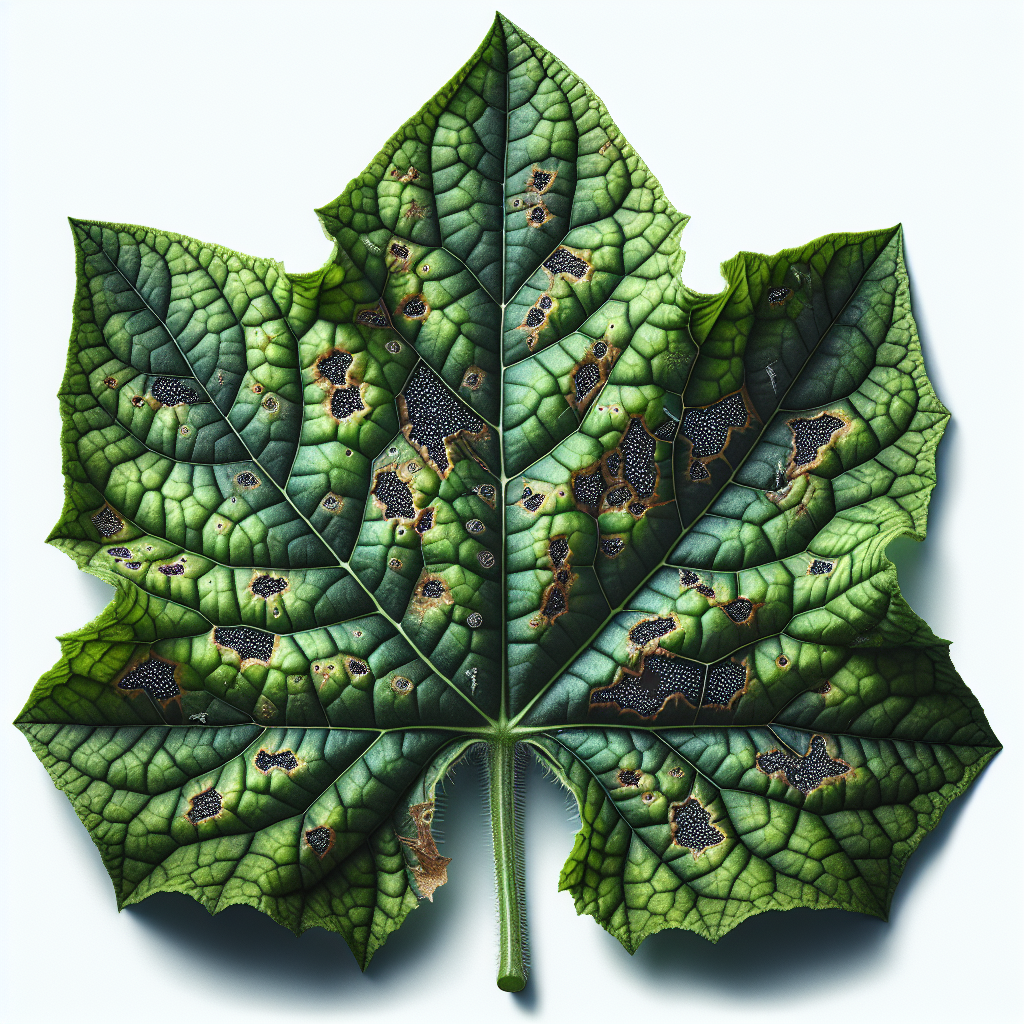
Introduction to Angular leaf spot
Angular leaf spot, caused by the bacterium Pseudomonas syringae pv. lachrymans, is a destructive foliar disease that strikes cucurbit crops worldwide, leading to significant yield losses if unmanaged. First identified in the early 20th century, this pathogen thrives in warm, humid conditions, producing water-soaked lesions that evolve into angular, necrotic spots bounded by leaf veins—hence the name. Farmers growing cucumber, squash, pumpkin, zucchini, cantaloupe, watermelon, and other cucurbits face annual threats from this disease, especially in regions with high rainfall or overhead irrigation.
The economic impact is profound: infected fields can see 20-50% yield reductions, with fruit quality compromised by secondary infections or sunscald from defoliation. Unlike fungal leaf spot diseases, angular leaf spot spreads rapidly via splashing water, tools, and human activity, making it a staple concern in both commercial and small-scale operations. Early detection is critical, as symptoms mimic other issues like downy mildew or powdery mildew. This definitive guide equips growers with professional diagnostic tools, organic management plans, and prevention tactics to safeguard harvests. For small farms optimizing operations, check out Why Misidentifying Plants Costs Small Farms Thousands - And How AI Camera Diagnosis Fixes It Fast to enhance disease scouting.
Understanding the pathogen's biology is key: P. syringae pv. lachrymans is a Gram-negative bacterium that enters through natural openings or wounds, multiplying in the intercellular spaces of leaf tissue. It produces toxins and enzymes that kill host cells, forming the characteristic angular lesions. Overwintering in crop debris, seeds, and volunteer plants, it becomes airborne or splash-dispersed during rain events. Climate change exacerbates outbreaks by increasing storm frequency, underscoring the need for resilient IPM strategies.
Identifying Symptoms & Damage
Accurate diagnosis begins with recognizing hallmark symptoms. Initial signs appear as small, water-soaked spots on the underside of lower leaves, often 1-3 mm in diameter. These translucent areas turn dark brown to black within 1-2 days, adopting an angular shape due to vein limitations—typically 3-12 mm across. A key diagnostic feature is the white, milky exudate (bacterial ooze) visible on lesion undersides during humid mornings, drying to a translucent film.
As lesions expand and coalesce, leaves yellow, wilt, and drop prematurely, exposing fruit to sunscald. Advanced stages show shot-hole appearance from center tissue sloughing. On fruits, greasy, water-soaked spots evolve into raised, corky lesions, rendering produce unmarketable. Stems may develop cankers with similar ooze. Differentiate from Septoria leaf spot (fungal, round spots with fruiting bodies) or Cercospora leaf spot (gray centers). Use a hand lens to spot bacterial streaming in water suspensions from lesions—a confirmatory lab test.
Damage quantification: In severe cases, 100% defoliation occurs, slashing photosynthesis by 70% and yields by 40%. Secondary invaders like Botrytis accelerate decay. Economic thresholds vary: scout when 5-10% of leaves show symptoms, acting before 25% incidence. Photograph suspect samples for records; consult extension services for PCR confirmation if unsure.
Lifecycle and Progression of Angular leaf spot
The pathogen's lifecycle is polycyclic, with multiple infection cycles per season. Primary inoculum survives in infected debris (up to 2 years), seeds (up to 50% contamination), and weeds. Spring germination occurs with temperatures above 16°C (61°F), splashing onto seedlings via rain or irrigation. Optimal infection window: 22-28°C (72-82°F) with leaf wetness >8 hours.
Bacteria multiply exponentially (doublings every 2-4 hours), producing lesions in 2-5 days. Lesions release 10^8-10^9 CFU/cm² ooze, disseminating via wind-driven rain up to 10 meters. Latent period: 1-3 days; infectious period: 7-14 days per lesion. Disease progresses from lower to upper canopy, peaking mid-season. In cool, wet falls, it overwinters systemically in volunteers. Seed transmission perpetuates via mechanical harvest.
Progression phases: Incubation (24-48 hours, asymptomatic); Symptomatic (lesion formation); Sporulation (ooze production); Dispersal (rain events). Models predict epidemics when RH>90% for 6+ hours. Understanding this enables timely interventions, breaking the cycle at inoculum sources.
Environmental Triggers & Risk Factors
Angular leaf spot epidemics hinge on the disease triangle: susceptible host, virulent pathogen, conducive environment. Key triggers: prolonged leaf wetness from overhead irrigation, frequent rains (>25 mm/week), temperatures 20-30°C, high nitrogen fertility (lush tissue), dense canopies reducing airflow. Poor drainage, compacted soils, and wounding (hail, cultivation) facilitate entry.
Risk factors include monocropping cucurbits, planting contaminated seeds, inadequate rotation (<2 years), and volunteer plants harboring inoculum. Overhead sprinkling multiplies spread 10-fold vs. drip. High humidity (>85% RH) indoors greenhouses accelerates. Climate variability—erratic rains—amplifies risks. Assess farm via disease forecasting tools tracking weather data for preemptive sprays.
Organic Control & Treatment Plans
Organic management integrates cultural, biological, and OMRI-listed bactericides. Step 1: Sanitation—remove debris post-harvest, till deeply, avoid volunteers. Step 2: Resistant varieties—select hybrids like 'Poinsett 76' cucumber or 'Gray Zucchini'. Step 3: Crop rotation—3+ years away from cucurbits.
Biologicals: Apply Bacillus subtilis (Serenade) or Streptomyces (Actinovate) weekly from transplant, 3-5 gal/acre. Bactericides: Copper octanoate (Cueva), 0.5-2 gal/acre, every 5-7 days in high risk; tank-mix with citric acid for efficacy. Plant extracts: Garlic oil or thyme oil sprays (1-2% v/v). Timing: Begin at first symptoms, 7-day intervals, 4-hour REI.
Treatment plan: Scout twice weekly; threshold 1-5% incidence. Prune lower leaves, improve spacing (18-24" rows). Drip irrigate, mulch to reduce splash. Integrate with whiteflies control to avoid vectors. Monitor via sticky traps. Yields recover 20-30% with IPM vs. untreated.
Preventing Angular leaf spot in the Future
Prevention trumps cure: Use certified pathogen-free seeds, hot-water treat (50°C/30 min). Rotate with non-hosts like onion or lettuce. Site selection: well-drained, full sun, windbreaks for airflow. Fertilize balanced (avoid excess N), stake for ventilation.
Cultural prophylaxis: 4-6 ft row spacing, basal pruning, reflective mulches deter vectors. Forecasting: Track leaf wetness hours, apply preventives pre-rain. Quarantine: Footbaths, tool disinfection (10% bleach). Biological seed treatments: Pseudomonas fluorescens coatings. Long-term: soil solarization (6 weeks summer). Annual audits reduce incidence 80%. For holistic farm planning, explore Soil Health Mastery: 5 Proven Strategies for Small Farms to Build Fertile Ground Without Breaking the Bank.
Crops Most Affected by Angular leaf spot
Primarily cucurbits: cucumber (most susceptible), squash, zucchini, pumpkin, cantaloupe, honeydew, watermelon. Less common on muskmelon, gourds. Rare on non-cucurbits but reported on bean. Global hotspots: US Midwest, Europe, Asia. Yield hits worst on pickling cucumber (50%+ losses). Diversify with tolerant varieties.