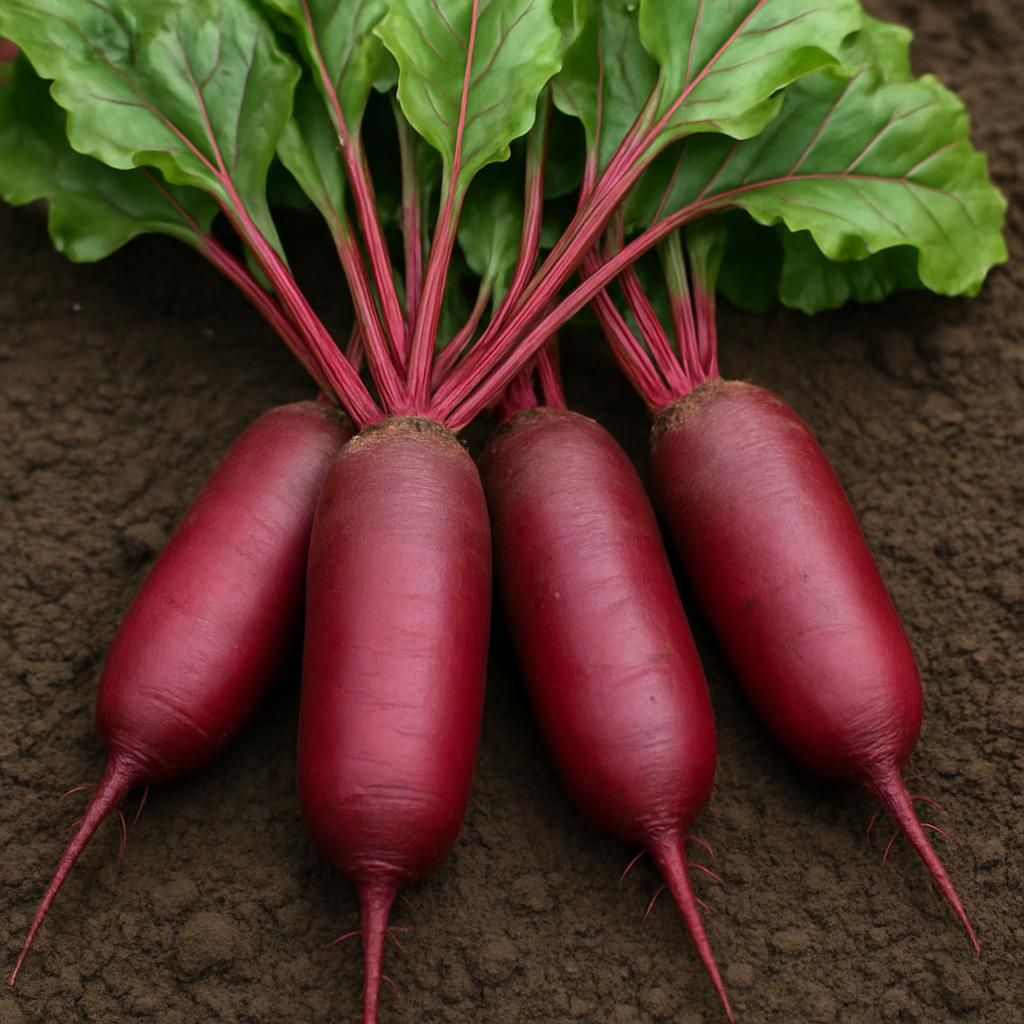
Introduction to Beet (Cylindra - Formanova)
Cylindra (Formanova) is a specialty cylindrical beet variety developed in Europe and now popular worldwide for its uniform, elongated roots that slice evenly for pickling, roasting, and commercial processing. Unlike traditional globe-shaped beets, this cultivar grows 6-8 inches long with a consistent 2-inch diameter, reducing waste and improving market appeal. The variety is known for its sweet, earthy flavor, vibrant red-purple color, and resistance to zoning (internal rings). Its deep taproot also accesses soil nutrients efficiently, making it productive even in moderately fertile soils.
This beet type matures faster than many globe varieties and maintains quality over a longer harvest window. Both roots and leaves are edible, offering dual-purpose production for fresh market or home use. Cylindra performs well in raised beds, containers, and traditional field rows when given proper spacing and consistent moisture.
Botanical Profile of Beet (Cylindra - Formanova)
Beet (Cylindra - Formanova) belongs to the Amaranthaceae family, formerly Chenopodiaceae. It is a biennial grown as an annual for its enlarged hypocotyl and taproot. The plant produces a rosette of dark green, glossy leaves with prominent red veins and petioles. The cylindrical root develops underground, with the upper portion sometimes exposed at the soil surface. Flowers are small, greenish, and wind-pollinated if allowed to bolt in the second year. Seeds are actually seed clusters (glomerules) containing 2-5 true seeds each.
Soil, pH, and Climate Requirements for Beet (Cylindra - Formanova)
Cylindra beets require well-drained, loose soil free of stones to allow straight root development. Heavy clay or compacted soils cause forking and misshapen roots. The crop prefers cool temperatures and tolerates light frost but bolts under prolonged heat.
| Parameter | Ideal Range | Notes |
|---|---|---|
| Soil Type | Sandy loam to loam | Avoid heavy clay; incorporate organic matter |
| Soil pH | 6.0 - 7.0 | Below 6.0 increases scab risk |
| Temperature (Day) | 15-24°C (59-75°F) | Optimal for root expansion |
| Temperature (Night) | 7-13°C (45-55°F) | Prevents bolting |
| Soil Temperature | 10-29°C (50-85°F) | Germination range |
| Spacing (In-row) | 7-10 cm (3-4 inches) | Allows cylindrical roots to expand |
| Row Spacing | 30-45 cm (12-18 inches) | Facilitates cultivation and harvest |
| Sun Exposure | Full sun (6+ hours) | Partial shade reduces root size |
| Frost Tolerance | Light frost OK | Seedlings tolerate -4°C (25°F) |
Step-by-Step Planting & Propagation
Site Preparation: Loosen soil to 30 cm (12 inches) depth. Remove rocks and debris. Incorporate 5-7 cm of well-rotted compost or aged manure. Test soil pH and amend with lime if below 6.0.
Seed Treatment: Soak seed clusters in water for 12-24 hours to improve germination. Cylindra seed is multigerm; thin seedlings later.
Sowing Time: Direct sow 2-3 weeks before last spring frost when soil reaches 10°C (50°F). For fall harvest, sow 8-10 weeks before first frost. Successive sowings every 2-3 weeks extend the season.
Planting Depth and Spacing: Sow seeds 1-2 cm (½-¾ inch) deep. Space rows 30-45 cm apart. After germination (7-14 days), thin seedlings to 7-10 cm apart when they have 2-3 true leaves.
Transplant Option: Although direct sowing is preferred, 3-week-old seedlings can be transplanted carefully without disturbing the taproot.
Care & Maintenance regimes for Beet (Cylindra - Formanova)
Consistent moisture prevents woody texture and internal zoning. Mulch helps retain moisture and suppress weeds. Fertilize moderately; excess nitrogen promotes leafy growth at the expense of roots.
| Growth Stage | Watering Schedule | Fertilizer Application | Pruning/Thinning Schedule |
|---|---|---|---|
| Germination (0-14 days) | Keep soil evenly moist (light daily watering) | None; pre-plant compost sufficient | None |
| Seedling (2-4 weeks) | 2.5 cm (1 inch) per week; avoid waterlogging | Side-dress with balanced 10-10-10 (low N) at 3 weeks | Thin to 7-10 cm spacing |
| Vegetative (4-7 weeks) | Deep watering 1-2x weekly; mulch to conserve moisture | Light compost tea or fish emulsion monthly | Remove any weeds; do not remove leaves |
| Root Bulking (7+ weeks) | Maintain even moisture; reduce frequency near harvest | Avoid high-nitrogen; potassium boost if needed | Harvest outer leaves sparingly for greens |
Pests, Diseases & Organic Management
Common pests include aphids, flea beetles, cutworms, and root-knot nematodes. Diseases include Cercospora leaf spot, Alternaria leaf spot, powdery mildew, and Rhizoctonia crown and root rot. Use floating row covers for insect protection during early growth. Practice crop rotation with non-hosts for at least 3 years. Apply neem oil or insecticidal soap for aphids. Improve drainage and avoid overhead watering to reduce fungal diseases. Beneficial nematodes can suppress soil pests.
Harvesting, Curing & Optimal Storage
Cylindra beets reach harvest maturity in 55-65 days when roots are 15-20 cm long. Harvest by loosening soil with a fork and pulling gently to avoid breakage. Greens can be harvested when 10-15 cm tall. Remove tops, leaving 2-3 cm of stem to prevent bleeding. Do not wash roots before storage. Cure briefly in a shaded, ventilated area for 1-2 days. Store at 0-2°C (32-36°F) with 90-95% humidity for 4-6 months. Smaller roots store longest. Greens keep 3-5 days refrigerated.
Companion Planting for Beet (Cylindra - Formanova)
Beets grow well alongside onion, garlic, lettuce, cabbage, bush beans, and kohlrabi. Aromatic herbs such as thyme and rosemary deter pests. Avoid planting near pole beans and mustard which may inhibit growth. Beets are excellent predecessors for heavy feeders like tomato because they leave soil in good condition.