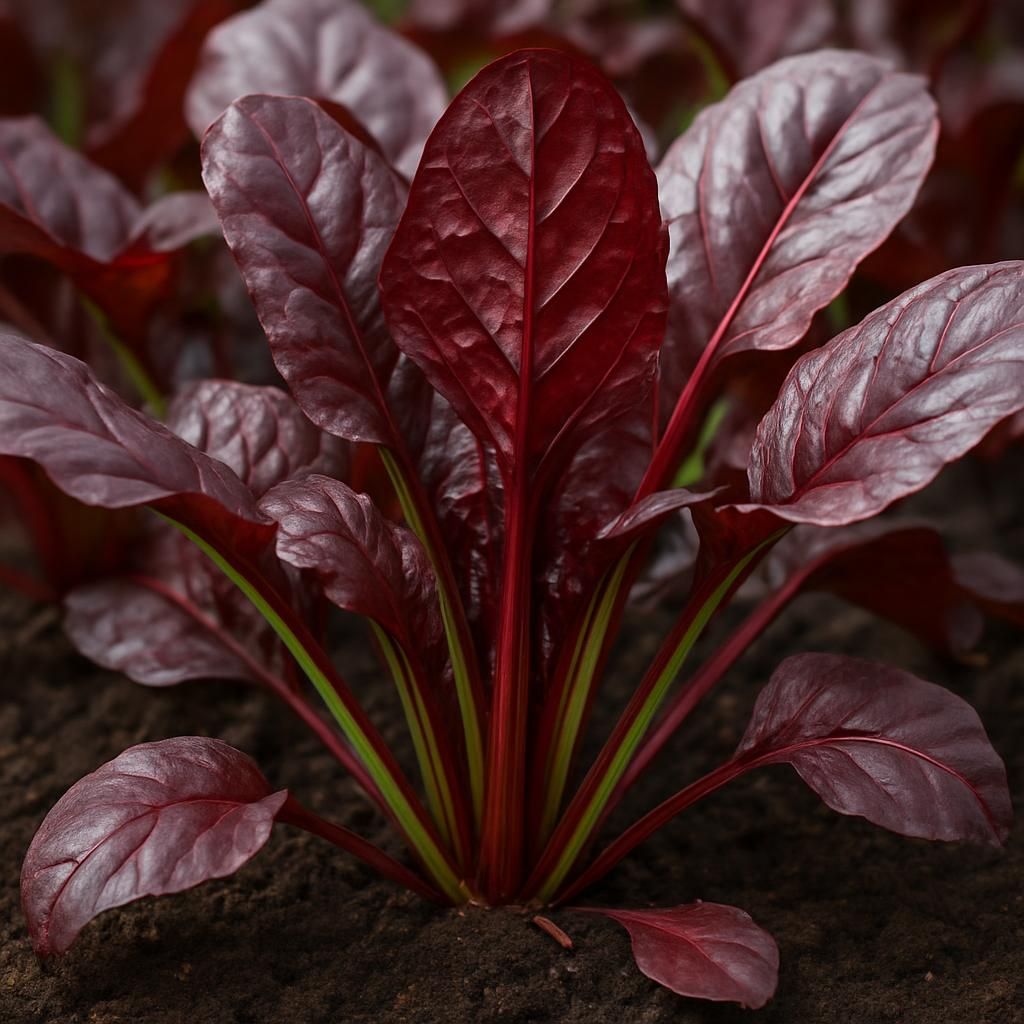
Introduction to Beet (Bull’s Blood)
Bull’s Blood beet (Beta vulgaris subsp. vulgaris 'Bull’s Blood') is an heirloom variety celebrated for its striking deep-red foliage and sweet, earthy roots. Originally selected in the 19th century for its ornamental leaves, this cultivar has become a favorite among market gardeners and home growers seeking both visual appeal and culinary versatility. The glossy burgundy leaves are rich in antioxidants and can be harvested young for microgreens or allowed to mature for use as a colorful salad green or sautéed vegetable. The roots, though smaller than modern hybrid beets, deliver exceptional sweetness and a smooth texture that holds up well to roasting, pickling, and fresh eating. Because the variety matures quickly and tolerates cool temperatures, it fits easily into spring and fall production windows across temperate climates.
Botanical Profile of Beet (Bull’s Blood)
Bull’s Blood belongs to the Amaranthaceae family and is a biennial grown as an annual for its edible roots and leaves. The plant forms a rosette of glossy, deeply veined leaves that emerge in shades of dark purple to burgundy, contrasting beautifully with bright green stems. The taproot is typically globe-shaped, 5–8 cm in diameter at maturity, with smooth skin and a deep crimson interior that retains color when cooked. Flowers are small, greenish, and wind-pollinated, appearing in the second year if the plant is allowed to overwinter. Seeds are technically fruits (glomerules) containing 2–5 true seeds each, requiring careful thinning after germination.
Soil, pH, and Climate Requirements for Beet (Bull’s Blood)
Bull’s Blood performs best in well-drained, fertile loam soils with high organic matter. Heavy clay should be amended with compost or aged manure to improve structure and drainage. The crop is moderately tolerant of salinity but sensitive to waterlogging, which can cause root rot.
| Parameter | Ideal Range | Notes |
|---|---|---|
| Soil Type | Loam to sandy loam | Well-drained; avoid compacted clays |
| Soil pH | 6.0–7.5 | Slightly acidic to neutral |
| Soil Temperature | 10–24 °C | Germination optimum 15–21 °C |
| Air Temperature | 10–24 °C day / 4–10 °C night | Bolting risk above 27 °C |
| Sunlight | Full sun (6–8 h) | Tolerates light afternoon shade in heat |
| Spacing | 7–10 cm between plants | 30–45 cm between rows |
| Frost Tolerance | Light frost (−2 °C) | Seedlings hardy; mature roots less so |
Step-by-Step Planting & Propagation
- Site Preparation: Till soil to 20–25 cm depth, removing stones and breaking up clods. Incorporate 5–7 cm of well-rotted compost or aged manure. Conduct a soil test and adjust pH with lime if below 6.0.
- Seed Selection & Treatment: Use fresh seed; soak in water for 12–24 hours to improve germination uniformity. Avoid using seed older than two years.
- Sowing Time: Direct sow 2–4 weeks before last spring frost or 8–10 weeks before first fall frost. Soil temperature should be at least 10 °C.
- Sowing Depth & Spacing: Plant seeds 1–2 cm deep, 5 cm apart in rows 30–45 cm apart. Thin seedlings to 7–10 cm once true leaves appear.
- Succession Planting: Sow new rows every 2–3 weeks for continuous harvest through the season.
- Transplanting Option: Start seedlings in 128-cell trays 3–4 weeks before field planting; transplant at 4–6 true leaves, disturbing roots minimally.
Care & Maintenance regimes for Beet (Bull’s Blood)
Consistent moisture and balanced fertility are critical. Over-fertilization with nitrogen produces lush leaves at the expense of root development.
| Growth Stage | Watering Schedule | Fertilizer Schedule | Pruning / Thinning Schedule |
|---|---|---|---|
| Germination (0–14 days) | Keep top 2 cm moist; light daily mist | None; pre-plant compost only | None |
| Seedling (2–4 weeks) | 2.5 cm/week; avoid waterlogging | Side-dress with 5-10-10 at 3 weeks | Thin to 7–10 cm spacing |
| Vegetative (4–8 weeks) | 2.5–3.8 cm/week; deep soak | Compost tea every 3 weeks | Remove yellowing outer leaves |
| Root Bulking (8–10 weeks) | 2.5 cm/week; reduce 1 week before harvest | No additional N; light K boost if needed | None |
Mulch with 5 cm of straw or shredded leaves after thinning to suppress weeds and retain moisture. Hand-weed carefully to avoid damaging shallow roots.
Pests, Diseases & Organic Management
Common insect pests include Aphids, flea beetles, and cutworms. Use floating row covers during early growth and introduce beneficial insects such as lady beetles. Slugs and snails can be managed with beer traps and iron-phosphate baits. Major diseases are Cercospora leaf spot, powdery mildew, and root rot caused by Rhizoctonia or Pythium. Practice 3–4 year crop rotation, avoid overhead irrigation, and remove crop debris at season end. Beet cyst nematode populations are suppressed by planting marigold as a biofumigant cover crop.
Harvesting, Curing & Optimal Storage
Harvest roots when 5–8 cm in diameter, typically 55–70 days after sowing. Pull gently by the tops or use a fork to loosen soil. Cut tops 2–3 cm above the crown to reduce moisture loss. For storage, cure roots at 10–15 °C and 85–90 % RH for 3–5 days, then store at 0–2 °C and 95 % RH for up to 4 months. Leaves can be harvested continuously from 30 days onward; cut outer leaves to encourage regrowth.
Companion Planting for Beet (Bull’s Blood)
Bull’s Blood pairs well with onion, garlic, lettuce, and bush beans. These companions deter pests and improve soil structure. Avoid planting near Swiss chard or other beet varieties to reduce cross-pollination and shared disease pressure. Interplanting with nasturtium provides aphid-trapping benefits while adding edible flowers. For more companion strategies, see Summer Companion Planting: 10 Organic Pairings to Boost Small Farm Resilience.