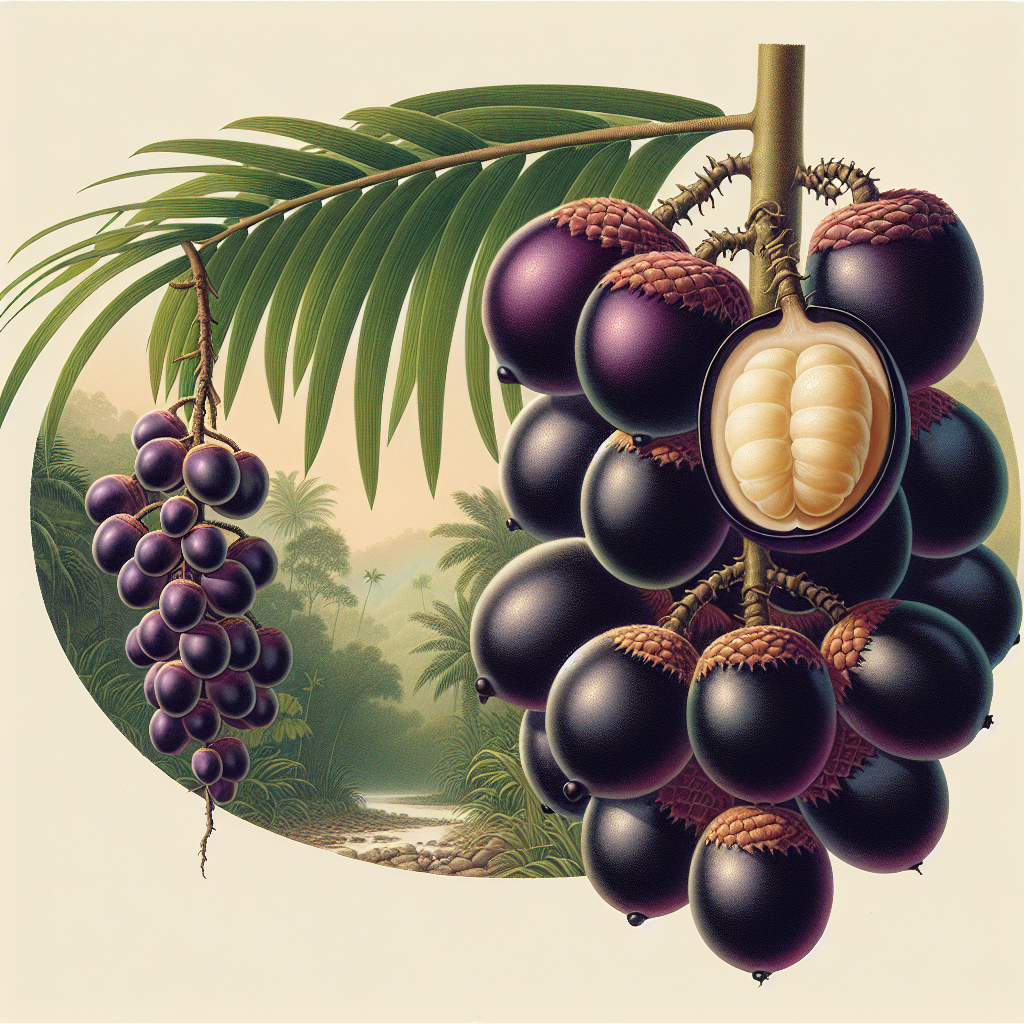
Introduction to Bacaba (Oenocarpus bacaba)
Bacaba (Oenocarpus bacaba), a striking feather palm native to the Amazon basin, stands as one of the most promising underutilized crops for tropical agroforestry systems. Reaching heights of 20-30 meters with a slender, ringed trunk and cascading fronds, this palm produces abundant bunches of small, grape-like fruits that ripen to a deep purple-black hue. The fruit's translucent, oily pulp delivers a unique, slightly effervescent flavor reminiscent of açaí but milder and more refreshing, making it a staple in Brazilian Amazonian cuisine for fresh juices, ice creams, liqueurs, and fermented beverages.
In recent years, Bacaba has gained traction among small-scale farmers and agroecologists for its resilience to poor soils, low maintenance needs, and ability to thrive under partial shade—perfect for intercropping in coconut or banana plantations. Yields can reach 50-100 kg per mature tree annually, with fruits harvested non-destructively from the ground or lower bunches, supporting sustainable livelihoods in regions like Pará, Amazonas, and Acre in Brazil. As global demand rises for superfruits rich in antioxidants, healthy fats, and vitamins A and C, Bacaba offers a lucrative alternative to more competitive crops like açaí, with minimal post-harvest losses if properly managed. Why Companion Planting Feels Like Guesswork for Small Farms - And How AI Makes It Foolproof highlights how strategic pairings enhance such palm systems.
This comprehensive guide draws from decades of field research by botanists, entomologists, and agronomists, providing practical, professional-grade advice for propagating, cultivating, and harvesting Bacaba in home gardens, small farms, or commercial orchards. Whether you're diversifying a tropical farm or experimenting with native species, Bacaba's slow but steady growth rewards patient growers with ecological and economic benefits.
Botanical Profile of Bacaba (Oenocarpus bacaba)
Oenocarpus bacaba belongs to the Arecaceae family, subfamily Arecoideae, and is classified as a single-stemmed, understory palm adapted to the humid, lowland rainforests of northern South America. Mature trees boast a straight, grayish trunk up to 30 cm in diameter, marked by prominent leaf scars and crowned by 15-20 pinnate fronds spanning 3-5 meters. Each frond consists of 100-150 linear leaflets, 50-80 cm long, giving the palm a feathery, tropical elegance.
Flowering begins around 5-7 years from seed, with inflorescences emerging from the leaf axils as pendulous spikes up to 1.5 meters long. These bear bisexual flowers that develop into infructescences holding 200-500 small drupes (1-2 cm diameter), each containing a single seed surrounded by juicy, translucent pulp. The pulp's high oil content (up to 20%) and low sugar levels contribute to its refreshing taste and nutritional profile: 100g provides approximately 150 kcal, 15g fat, 5g carbs, rich in oleic acid, tocopherols, and polyphenols.
Bacaba exhibits dioecious tendencies in some populations, though most cultivated strains are monoecious. Root systems are fibrous and shallow, extending laterally 5-10 meters, which supports its shade tolerance but demands wide spacing. Phenologically, it fruits year-round in equatorial zones, peaking in the rainy season (December-March), with seeds dispersing via birds, bats, and agoutis. Genetic diversity is high across the Amazon, with ecotypes varying in fruit size and oil content—select larger-fruited strains from Pará for commercial viability.
Soil, pH, and Climate Requirements for Bacaba (Oenocarpus bacaba)
Bacaba thrives in the infertile, acidic soils of its native Amazon terra firme forests, tolerating conditions that challenge many crops. Optimal soil is deep, well-drained sandy loam or yellow latosol with pH 4.5-6.0; it excels in low-fertility profiles (CEC <10 meq/100g) but resents waterlogging, which promotes root rot. Incorporate 5-10 kg organic matter per planting hole to boost microbial activity and nutrient cycling—avoid heavy clays or compacted sites.
Climatically, Bacaba demands hot, humid tropics: USDA zones 10b-12, average temperatures 25-30°C (77-86°F), with no frost tolerance below 5°C (41°F). Annual rainfall of 2000-3000 mm, evenly distributed, is ideal; it endures short dry spells (<3 months) via deep roots but benefits from mulching during droughts. High humidity (80-95%) prevents inflorescence abortion, while full sun to 50% shade suits young plants—mature trees prefer canopy gaps. Wind exposure above 10 m/s can shred fronds, so site plantations in sheltered valleys or use windbreaks like guava.
Soil testing is crucial: aim for N 10-20 ppm, P 5-15 ppm, K 50-100 ppm, with micronutrients like boron and zinc often deficient in leached tropics. Raised beds (30-50 cm) mitigate seasonal flooding in floodplains, enhancing aeration for fibrous roots.
Step-by-Step Planting & Propagation
Seed Propagation (Primary Method): Collect ripe fruits from healthy mother trees, depulp by soaking in water 24-48 hours, then sow cleaned seeds 2-3 cm deep in 50% sand:50% compost mix. Germination takes 2-6 months at 28-32°C; maintain 80% humidity under shade cloth. Prick out seedlings at 10-15 cm into 5L pots, transplant to field at 50-80 cm (6-12 months old), spacing 8x8m (150 trees/ha).
Vegetative Propagation: Rarely used due to single-stem nature, but offshoots or division from coppiced stumps can be trialed. Treat basal suckers with 0.5% IBA rooting hormone; success rate 30-50% in mist propagation.
Planting Steps:
- Dig 50x50x50 cm holes, amend with 10 kg compost + 200g rock phosphate.
- Plant at same depth as container, stake if windy.
- Mulch 10 cm thick with palm fronds or gliricidia prunings.
- Irrigate 20-30L/week first year, taper to rainfall. Best planting: onset of rains (November). Expect 80% survival with proper site prep.
Care & Maintenance regimes for Bacaba (Oenocarpus bacaba)
Young palms need consistent moisture and light fertilization: apply 100-200g NPK 10-30-10 + micronutrients yearly for 3 years, split into 3 applications. Mature trees are low-input; top-dress 1-2 kg organic manure annually under canopy drip line. Prune dead fronds at 1.5m trunk height to reduce pest harbor; avoid over-pruning to maintain microclimate.
Weed control via mulch suppresses competition; slash intercrops like cassava or legumes. Water stressed plants during fruit set (20L/tree/week). Monitor for nutrient deficiencies: yellowing lower leaves signal potassium lack—apply potassium sulfate. Intercrop with shade-tolerant pineapple or ginger rows 1 to boost early income and soil cover. Annual growth 50-80 cm; canopy closure by year 10.
Pests, Diseases & Organic Management
Bacaba's tough fronds and height deter many pests, but watch for scale insects, mealybugs, and rhino beetles boring into crowns—apply neem oil (2%) or spinosad sprays at dusk. Leaf-eating caterpillars controlled by Bacillus thuringiensis (Bt). Rodents and birds target fallen fruits; use trunk collars or netting.
Diseases include Phytophthora palmivora causing bud rot in wet conditions—improve drainage, apply copper fungicide. Leaf spot diseases from Cercospora managed with potassium bicarbonate. Organic IPM: release predatory beetles, maintain biodiversity with companion marigold. Why 90% of Small Farms Fail at Pest Management - And 8 Organic Fixes That Actually Work offers broader strategies adaptable here.
Harvesting, Curing & Optimal Storage
Harvest when 80% fruits purple-black, 6-12 months post-anthesis; cut bunches or collect fallen fruits daily to avoid fermentation. Yield peaks years 10-25. Depulp manually or mechanically, freeze pulp at -18°C for 12+ months (retains 90% nutrients). Dry seeds at 40°C for 48h, store in airtight at 10-15°C (viability 1-2 years). Fresh pulp lasts 3-5 days chilled; process into juice within 24h for best quality. Minimal curing needed—ferment for wine (7-10 days at 25°C).
Companion Planting for Bacaba (Oenocarpus bacaba)
Bacaba's shade tolerance enables multilayer agroforestry: underplant with arrowroot, black pepper, or coffee for dappled light. Nitrogen-fixers like pigeon pea or hairy vetch enrich poor soils. Repel pests with thyme or yarrow borders. Avoid aggressive competitors like bamboo; pair with papaya for short-term canopy.