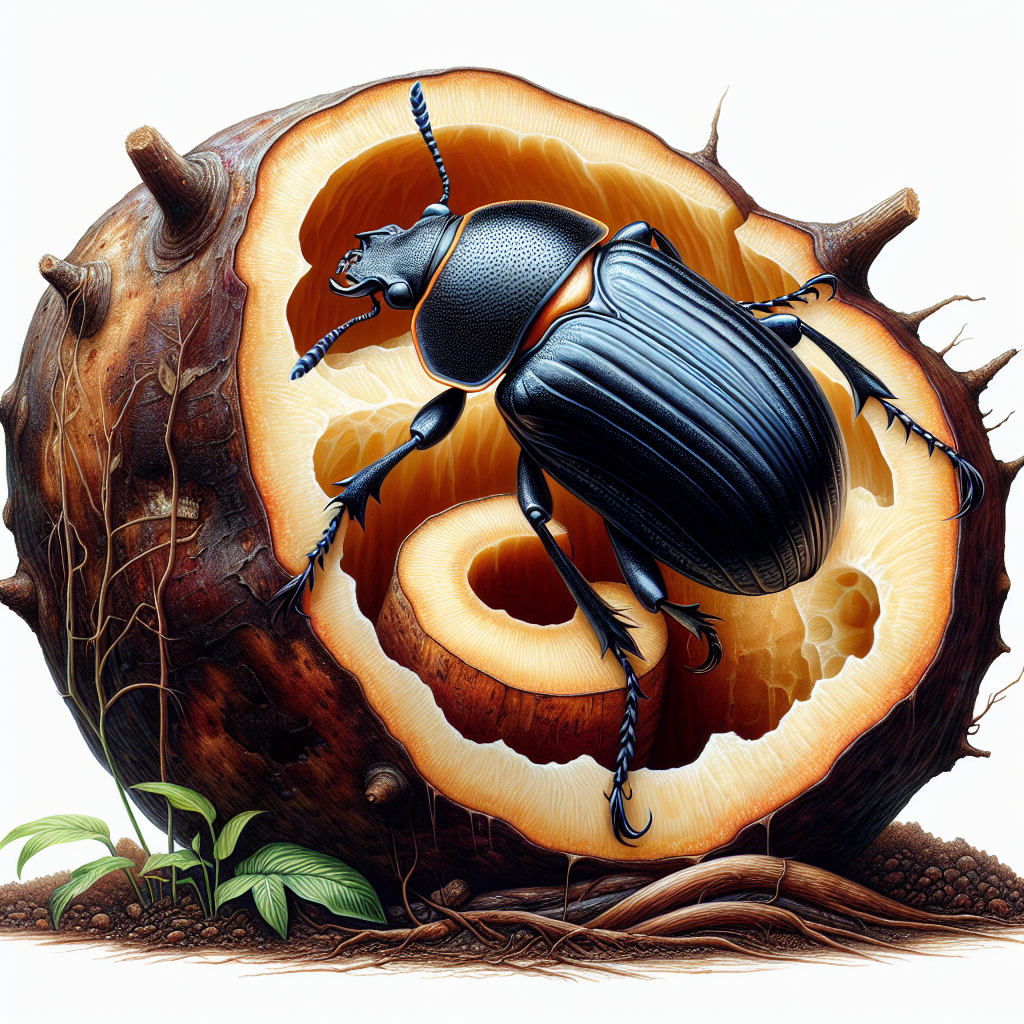
Introduction to Yam beetles
Yam beetles, scientifically known as Heteroligus species (primarily Heteroligus meles), represent one of the most devastating pests affecting yam cultivation in tropical regions, particularly in West and Central Africa. These robust, shiny black beetles belong to the Scarabaeidae family and are notorious for their underground feeding habits that directly target yam tubers—the economic heart of the crop. Farmers in yam-producing powerhouses like Nigeria, Ghana, and Côte d'Ivoire lose up to 30-50% of their harvests annually to these pests, making them a critical threat to food security and livelihoods.
Adult yam beetles measure 2-3 cm in length with a glossy exoskeleton that provides protection against predators and environmental stress. They emerge during the rainy season, coinciding with yam planting, to lay eggs in moist soil near host plants. The larvae, known as white grubs, are C-shaped, creamy-white creatures up to 5 cm long that inflict the primary damage by burrowing into tubers. Unlike surface-feeding beetles, yam beetles operate covertly below ground, making early detection challenging. This guide provides comprehensive diagnostics, lifecycle insights, and proven management strategies to safeguard your Yam (crop) crops. For small farms battling multiple threats, check out this Spring Pest Patrol: Organic AI Strategies to Shield Your Crops from Common Invaders for broader protection tips.
Understanding yam beetles is essential because their damage often goes unnoticed until harvest, leading to rotten, tunneled tubers unfit for market. Integrated pest management (IPM) focusing on organic methods can reduce populations by over 70% without synthetic chemicals, preserving soil health and export quality. This definitive resource draws from entomological research and field trials across Africa, offering actionable advice for commercial growers, smallholders, and home gardeners alike.
Identifying Symptoms & Damage
Early identification of yam beetle infestation is crucial, as damage manifests primarily underground. Look for irregular holes (1-2 cm diameter) on tubers during harvest—these entry points lead to extensive internal galleries filled with frass (beetle waste). Affected tubers appear spongy, discolored, and emit a foul odor due to secondary bacterial infections. Surface symptoms include wilting vines during dry spells, stunted growth, and yellowing leaves, often mistaken for root rot or drought stress.
Larval damage is the most severe: white grubs tunnel longitudinally through tubers, reducing marketable yield by 40-90% in heavy infestations. Adults feed on vine bases and organic matter, creating shallow trenches around plant crowns. Scout by digging 30 cm deep trenches near affected plants; presence of 2-3 grubs per cubic meter signals economic thresholds. Differentiate from wireworms by yam beetle grubs' larger size, reddish-brown heads, and raster patterns (grid-like arrangement on the last abdominal segment).
Secondary signs include clusters of adult beetles under leaf litter or near stakes at night—use a flashlight for nocturnal scouting. Tuber cross-sections reveal clean-cut tunnels unlike the irregular scarring from root-knot nematodes. In storage, infested tubers rot rapidly, attracting storage beetles. Document damage patterns: young mounds (1-3 months old) show minimal topside impact, while mature stands exhibit vine collapse. Use these diagnostics to confirm yam beetles versus mimics like millipedes or cutworms, enabling targeted interventions.
Lifecycle and Progression of Yam beetles
Yam beetles complete one generation per year, tightly synced with tropical wet seasons. Adults emerge from pupae in soil (April-June) post-dry season, attracted to fresh yam setts. Females lay 20-40 eggs singly in moist soil at 10-20 cm depth near roots; eggs hatch in 7-14 days into 1st instar larvae. These progress through three instars over 6-9 months: 1st (1 cm, 2 weeks), 2nd (2-3 cm, 2 months), 3rd (4-5 cm, 4-5 months)—the voracious feeding stage causing 80% of damage.
Pupation occurs in earthen cells at 20-30 cm depth (January-March), lasting 3-4 weeks. Adults remain soil-bound until rains trigger emergence, mating, and oviposition. Lifecycle duration: 10-12 months, with peak larval activity October-February. Soil temperatures above 25°C accelerate development; drought prolongs pupal diapause. Overwintering adults survive 1-2 years, amplifying outbreaks.
Progression phases: Egg (clustered, pearly-white); Larva (C-shaped, increasing size); Pupa (exarate, reddish); Adult (nocturnal, flight-capable). Monitor monthly: plant 4-6 weeks post-planting for eggs/young larvae; 3-5 months for mature grubs. Understanding this cycle informs precise timing—e.g., treatments target 2nd/3rd instars when 70% of feeding occurs. Disrupt at weak points: egg predation via tillage or larval drowning via flooding.
Environmental Triggers & Risk Factors
Yam beetles thrive in warm (26-32°C), humid conditions with sandy-loam soils (pH 5.5-7.0) rich in organic matter—ideal for West African yam belts. Heavy pre-planting rains (>200 mm/month) stimulate egg hatch; prolonged dry spells concentrate adults near irrigation points. Monocropping yams for 2+ years builds populations, as beetles host on cassava, sweet potato, and weeds like elephant grass.
Risk factors: Poor drainage fostering larval survival (90% pupation success); shallow planting (<10 cm) exposing setts; residue mulching harboring adults; ratooning (reusing vines) recycling pests. Fields near forests face spillover from wild hosts. Climate change exacerbates via erratic rains syncing with emergence. High N-fertilization boosts vine growth, indirectly favoring larval feeding. Assess risk: History of infestation (>20% loss last season), soil type (sands > clays), planting density (>40,000 plants/ha). Mitigate via crop rotation with non-hosts like cowpeas or legumes.
Organic Control & Treatment Plans
Organic IPM for yam beetles emphasizes prevention and biologicals, achieving 60-85% control. Cultural: Rotate with cereals or legumes (3-year cycle); plant at 15-20 cm depth; ridge-hill to bury grubs; flood fields 2-3 days biweekly early season. Mechanical: Hand-pick adults evenings; solarize soil pre-planting (clear plastic, 6 weeks, 50°C kills 95% eggs/larvae); trap with yam sett-baited pits (dig 50 cm deep, check weekly).
Biological: Introduce entomopathogenic nematodes (Heterorhabditis bacteriophora, 10^9 IJ/ha, irrigate post-application); apply Metarhizium anisopliae Beauveria bassiana* (10^12 spores/ha, 70% mortality); encourage predators like ground beetles, birds via perches. Botanicals: Neem seed kernel extract (5%, drench setts); Tephrosia vogelii leaf mulch (2 t/ha, repels 80%); garlic-chili spray (preventive). Treatment Plan: Week 0: Treat setts with neem; Month 1: Nematodes + solar traps; Month 3: Fungal biopesticide + flooding; Monitor: Grub counts <1/m³ threshold. Integrate with termites management, as they compete.
Preventing Yam beetles in the Future
Long-term prevention builds resilient systems. Select resistant varieties like 'Florido' or local landraces with thick skins. Use healthy, pest-free setts from certified sources; hot-water treat (50°C, 20 min). Crop rotation: Yam-cassava-[cowpea]-fallow disrupts cycles. Maintain soil health: Cover crops (clover) suppress grubs; compost adds antagonists. Scout grids (10 traps/ha weekly); pheromone traps for adults emerging. Post-harvest: Destroy culls, deep-plow residues. Farm hygiene: Clean tools, quarantine new stock. Monitor weather for emergence cues; community action curbs migration. Annual IPM audits sustain <5% loss.
Crops Most Affected by Yam beetles
Yam beetles primarily target Dioscorea spp., with white yam (D. rotundata) suffering 50% losses, yellow yam (D. cayenensis) 30%, and water yam (D. alata) 20%. Secondary hosts include taro, sweet potato, cassava, and potato—grubs feed opportunistically. Minor damage to ginger, turmeric, and vines like banana. In mixed farms, proximity to yams risks spillover; isolate high-value Japanese Yam (Nagaimo). Focus vigilance on tuber crops in infested zones.