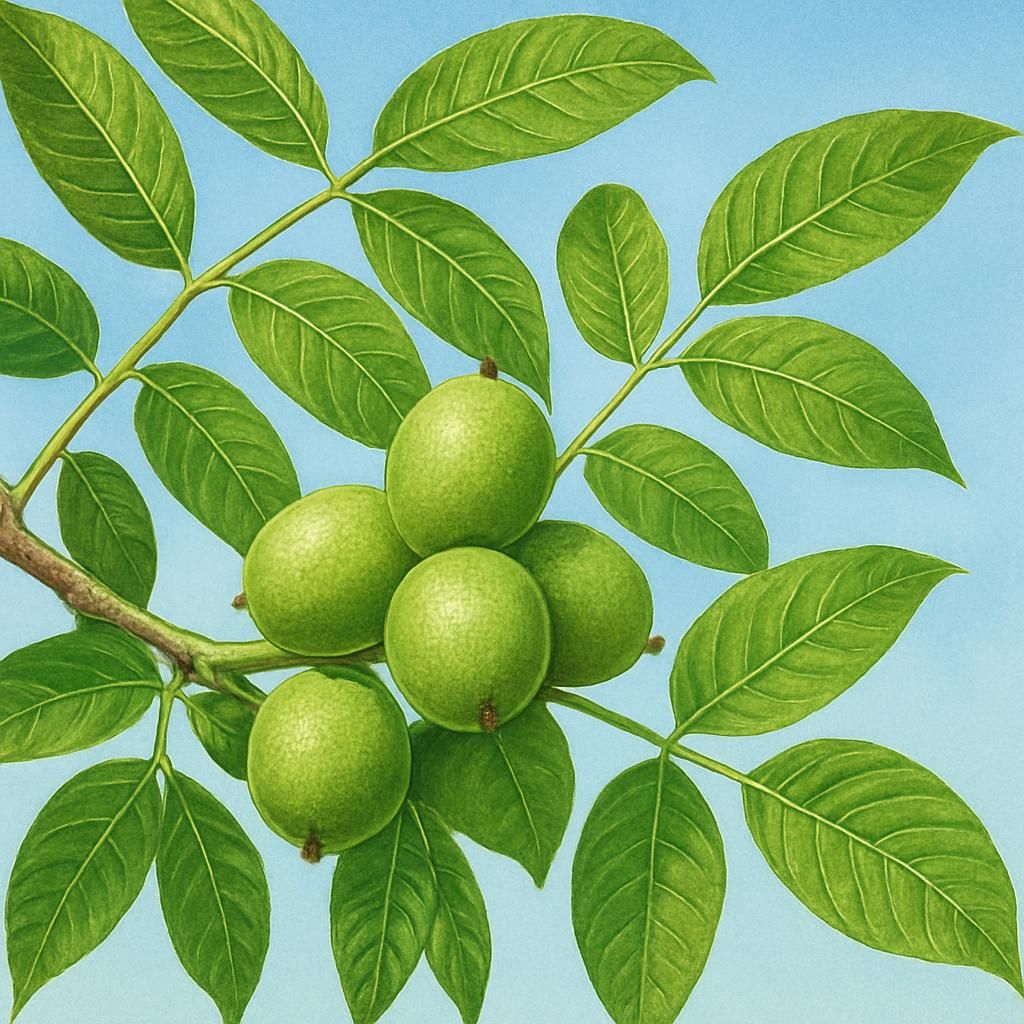
Introduction to Walnut (English - Franquette)
The Franquette walnut is the benchmark late-leafing English walnut cultivar grown across temperate regions worldwide. Selected in France in the late 19th century, it combines reliable productivity, frost avoidance through delayed bud break, and kernels of exceptional flavor and color. Modern orchards value Franquette for its strong central leader, moderate vigor, and compatibility with a wide range of rootstocks.
Commercial growers appreciate its thin shell that facilitates mechanical harvesting and its relatively low susceptibility to walnut husk fly compared with earlier cultivars. Home gardeners prize the tree for both nuts and the high-quality timber it eventually produces. This guide delivers professional-grade, field-tested protocols for establishing and maintaining productive Franquette plantings.
Botanical Profile of Walnut (English - Franquette)
Franquette belongs to the Juglandaceae family. It is a deciduous, monoecious tree that can reach 15–25 m at maturity with a broad, spreading canopy. Leaves are pinnately compound with 5–9 leaflets; new growth emerges after most spring frost events have passed. Male catkins appear on previous-season wood while female flowers form terminally on current-season shoots, requiring cross-pollination from compatible cultivars such as Hartley or Chandler.
The fruit is a drupe with a fleshy green husk that splits at maturity to release the hard nut. Kernels are light-colored, mild, and high in oil content. Franquette is self-fertile to a degree but benefits from pollinizers planted at a 1:8 ratio.
Soil, pH, and Climate Requirements for Walnut (English - Franquette)
Franquette performs best on deep, fertile, well-drained loams. It tolerates a range of textures provided drainage is excellent; heavy clays or saline soils reduce vigor and increase disease pressure.
| Parameter | Ideal Range | Notes |
|---|---|---|
| Soil Texture | Loam to sandy loam | Avoid compacted or poorly drained sites |
| Soil Depth | ≥1.5 m | Allows deep taproot development |
| Soil pH | 6.0–7.5 | Slightly acidic to neutral |
| Organic Matter | 3–5% | Improves water and nutrient retention |
| Salinity (EC) | <2 dS/m | Sensitive above this threshold |
| Growing Season | 150–200 frost-free days | Late leaf-out reduces spring frost risk |
| USDA Zones | 5–9 | Protect young trees in zone 5 winters |
| Chill Requirement | 700–1,000 hours below 7 °C | Ensures uniform bud break |
| Summer Temperature | 20–32 °C daytime | Optimal photosynthesis and kernel fill |
Step-by-Step Planting & Propagation
- Site Selection: Choose full-sun locations with protection from strong winds. Conduct soil tests and amend based on results.
- Rootstock Choice: Paradox (J. hindsii × J. regia) or seedling English walnut rootstocks are standard. Paradox offers vigor and some resistance to soil-borne pathogens.
- Tree Spacing: Standard spacing is 10 m × 10 m (100 trees/ha). High-density plantings use 7 m × 4 m with pruning to a central leader.
- Planting Window: Late winter to early spring while trees are dormant. Soak bare-root trees 1–2 hours before planting.
- Hole Preparation: Dig holes twice the width of the root ball and the same depth. Backfill with native soil mixed with aged compost.
- Irrigation at Planting: Apply 20–30 L of water per tree immediately after planting to settle soil and eliminate air pockets.
- Staking: Stake young trees for the first two seasons using flexible ties to prevent trunk damage.
Grafting is performed in late winter using whip-and-tongue or cleft methods on one-year-old rootstock. Success rates exceed 85% when scion wood is collected from virus-indexed mother trees.
Care & Maintenance regimes for Walnut (English - Franquette)
Consistent cultural practices maximize both yield and kernel quality. The following table outlines seasonal water, fertilizer, and pruning schedules for mature bearing orchards.
| Season | Irrigation (mature trees) | Fertilizer (per tree) | Pruning Focus |
|---|---|---|---|
| Spring | 40–60 mm/week; increase during bloom | 0.5 kg N, 0.3 kg P₂O₅, 0.6 kg K₂O | Remove frost-damaged shoots; train leader |
| Summer | 50–80 mm/week; deficit irrigation post-hull split | 0.3 kg N sidedress; foliar zinc & boron | Summer prune watersprouts; maintain light penetration |
| Autumn | Reduce to 20 mm/week after harvest | Apply 2–3 kg composted manure in root zone | Remove dead/diseased wood; shape canopy |
| Winter | Minimal unless drought | Soil test every 3 years; adjust pH if needed | Dormant pruning for structure; remove crossing limbs |
Mulch with 10–15 cm of wood chips in a 1 m radius around the trunk, keeping mulch 15 cm from the bark. Maintain orchard floor with a mowed cover crop of clover or fescue to improve soil biology.
Pests, Diseases & Organic Management
Franquette is moderately resistant to walnut blight (Xanthomonas arboricola pv. juglandis) but remains susceptible to several key pests.
Major pests include Walnut husk fly, Walnut aphid, and Codling moth. Deploy yellow sticky traps and pheromone mating disruption for codling moth starting at 200–250 degree-days above 10 °C. Release beneficial insects such as lacewings for aphid control.
Walnut blight is managed with copper-based sprays at 25% and 75% pistillate flower emergence, followed by a post-harvest application. Improve air circulation through pruning to reduce humidity within the canopy.
Nematodes can be suppressed by planting marigold or mustard cover crops and solarizing soil prior to replanting.
Harvesting, Curing & Optimal Storage
Harvest begins when the husk begins to split and kernels reach 8–10% moisture. Shake trees mechanically or by hand; collect nuts within 24 hours to prevent staining. Float-test nuts in water; sinkers are sound and ready for curing.
Cure nuts in a single layer at 25–30 °C with 60–70% RH and good airflow for 7–14 days until kernel moisture reaches 4–6%. Store in-shell at 0–5 °C and <60% RH for up to 12 months. Shelled kernels keep 6–9 months under the same conditions or 18–24 months when vacuum-packed and frozen.
Companion Planting for Walnut (English - Franquette)
Juglone produced by walnut roots inhibits many garden plants. Compatible companions include Tomato, Corn, and Beans planted outside the drip line. Deep-rooted Comfrey and Yarrow accumulate minerals and attract beneficial insects without competing for resources. Avoid planting sensitive species such as Potato or Raspberry within 15 m of established trees.
Companion Planting for Small Farms offers additional strategies for integrating walnuts into diversified plantings.