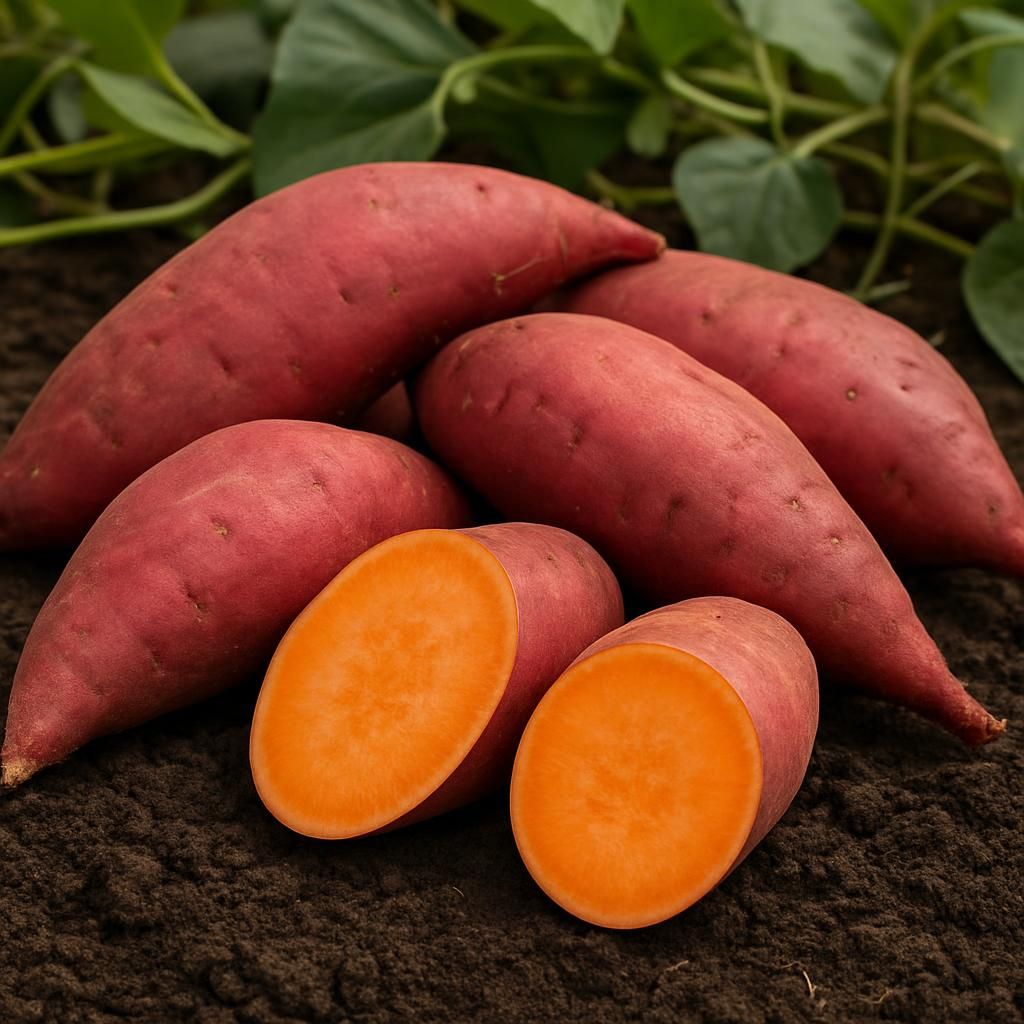
Introduction to Sweet Potato (Georgia Jet)
Georgia Jet sweet potato is an early-season variety developed for southern U.S. climates but now grown successfully across USDA zones 5–11. It produces uniform, elongated tubers with deep orange flesh rich in beta-carotene and a smooth, sweet flavor when baked or roasted. The variety matures in 90–100 days, making it ideal for shorter growing seasons while still delivering reliable yields of 1.5–2.5 pounds per plant under optimal management.
Home gardeners and small-scale commercial growers favor Georgia Jet for its vigorous vine growth, moderate resistance to soil-borne diseases, and ability to produce quality tubers even in heavier soils when properly amended. Its consistent performance and excellent storage characteristics have made it a staple in southern and mid-Atlantic production systems.
Botanical Profile of Sweet Potato (Georgia Jet)
Sweet potato (Ipomoea batatas) belongs to the Convolvulaceae family and is grown primarily for its edible storage roots rather than true tubers. Georgia Jet produces trailing vines that can reach 4–6 feet in length with heart-shaped, deeply lobed leaves. The plant forms adventitious roots at nodes where vines contact moist soil, allowing for vegetative propagation from slips.
The storage roots develop from specialized lateral roots that swell with starch and sugars. Georgia Jet roots typically measure 6–8 inches long with smooth, reddish-purple skin and vibrant orange flesh. Unlike Potato, sweet potatoes are true root crops and do not produce seeds under normal field conditions; commercial and home production relies entirely on vegetative propagation.
Soil, pH, and Climate Requirements for Sweet Potato (Georgia Jet)
Georgia Jet performs best in well-drained, sandy loam to loam soils with good aeration. Heavy clay soils should be amended with organic matter and raised beds to prevent waterlogging and root rot. The variety tolerates slightly acidic to neutral conditions but shows reduced yields and increased disease incidence outside the optimal pH range.
| Parameter | Ideal Range | Notes |
|---|---|---|
| Soil Type | Sandy loam to loam | Well-drained; avoid compacted clays |
| Soil pH | 5.8–6.5 | Below 5.5 increases scurf; above 7.0 reduces nutrient uptake |
| Temperature (Soil) | 70–85 °F (21–29 °C) | Critical for slip establishment |
| Air Temperature | 75–95 °F (24–35 °C) daytime | Frost sensitive; protect below 50 °F |
| Growing Season | 90–120 frost-free days | Minimum 90 days for Georgia Jet |
| Organic Matter | 2–4 % | Improves drainage and nutrient retention |
Step-by-Step Planting & Propagation
- Start slips 6–8 weeks before the last frost date. Select disease-free Georgia Jet storage roots and place them in a warm (75–85 °F), humid environment with the narrow end submerged in water or moist sand.
- When slips reach 6–10 inches and have several leaves, gently twist them from the mother root. Remove lower leaves, leaving 2–3 sets at the top.
- Harden off slips for 3–5 days outdoors in partial shade before transplanting.
- Prepare raised beds or ridges 8–12 inches high and 3–4 feet apart. Incorporate 2–3 inches of well-rotted compost or aged manure.
- Transplant slips 12–18 inches apart in-row and 3–4 feet between rows. Bury at least half the slip length, leaving 2–3 leaves above soil.
- Water immediately after planting and maintain consistent moisture for the first 10–14 days to encourage rapid root establishment.
Care & Maintenance regimes for Sweet Potato (Georgia Jet)
Consistent moisture, balanced fertility, and timely weed control are essential. Georgia Jet requires moderate nitrogen early for vine growth, followed by phosphorus and potassium emphasis during root bulking. Avoid over-fertilization, which promotes foliage at the expense of tubers.
| Growth Stage | Water Schedule | Fertilizer Schedule | Pruning / Canopy Management |
|---|---|---|---|
| Establishment (0–3 wks) | 1–1.5 inches/week; keep soil moist | ½ rate balanced NPK (e.g., 5-10-10) at planting | None; allow vines to spread |
| Vegetative (3–8 wks) | 1 inch/week; deep watering 2× weekly | Side-dress ½ lb 10-10-10 per 100 sq ft at wk 4 | Remove excess lateral vines if crowding occurs |
| Tuber Bulking (8–12 wks) | 0.75–1 inch/week; reduce 2 wks before harvest | Light potassium boost (0-0-10) if deficiency symptoms appear | Tip vines back at row edges to prevent rooting at nodes |
Mulch with 2–3 inches of straw or shredded leaves after vines cover 50 % of the bed to suppress weeds and conserve moisture. Hand-weed or shallow cultivate early; avoid deep cultivation once tubers begin forming.
Pests, Diseases & Organic Management
Georgia Jet faces pressure from several insects and soil-borne pathogens. Aphids, flea beetles, and wireworms are the most common above- and below-ground pests. Root-knot nematodes can cause galls and yield loss in sandy soils.
Major diseases include southern blight, fusarium wilt, and black rot. Use certified disease-free slips, practice 3–4 year rotations with non-host crops such as corn or small grains, and maintain well-drained beds. Beneficial nematodes and insecticidal soaps provide effective organic control of aphids and flea beetles. Solarization of beds for 4–6 weeks before planting reduces nematode and fungal populations.
Harvesting, Curing & Optimal Storage
Begin harvest when foliage yellows and daytime soil temperatures remain above 55 °F. Use a garden fork or potato plow to lift roots carefully, avoiding skinning or bruising. Cure harvested roots at 85–90 °F and 85–90 % relative humidity for 5–10 days to heal wounds and convert starches to sugars.
After curing, store at 55–60 °F and 85–90 % humidity. Properly cured Georgia Jet roots maintain quality for 4–6 months. Inspect monthly and remove any showing soft rot or shriveling. Never store below 50 °F, as chilling injury causes internal breakdown and off-flavors.
Companion Planting for Sweet Potato (Georgia Jet)
Georgia Jet benefits from strategic pairings that improve soil health, deter pests, and maximize space. Nasturtium planted at bed edges repels aphids and provides edible flowers. Marigold roots exude compounds that suppress nematodes while attracting beneficial insects.
Bush beans and southern peas fix nitrogen and provide light shade for young slips. Avoid planting near tomato or pepper families, which share susceptibility to verticillium wilt. Thyme and rosemary planted nearby deter flea beetles with their aromatic oils. After harvest, sow a cover crop of hairy vetch or crimson clover to rebuild soil organic matter and break pest cycles.