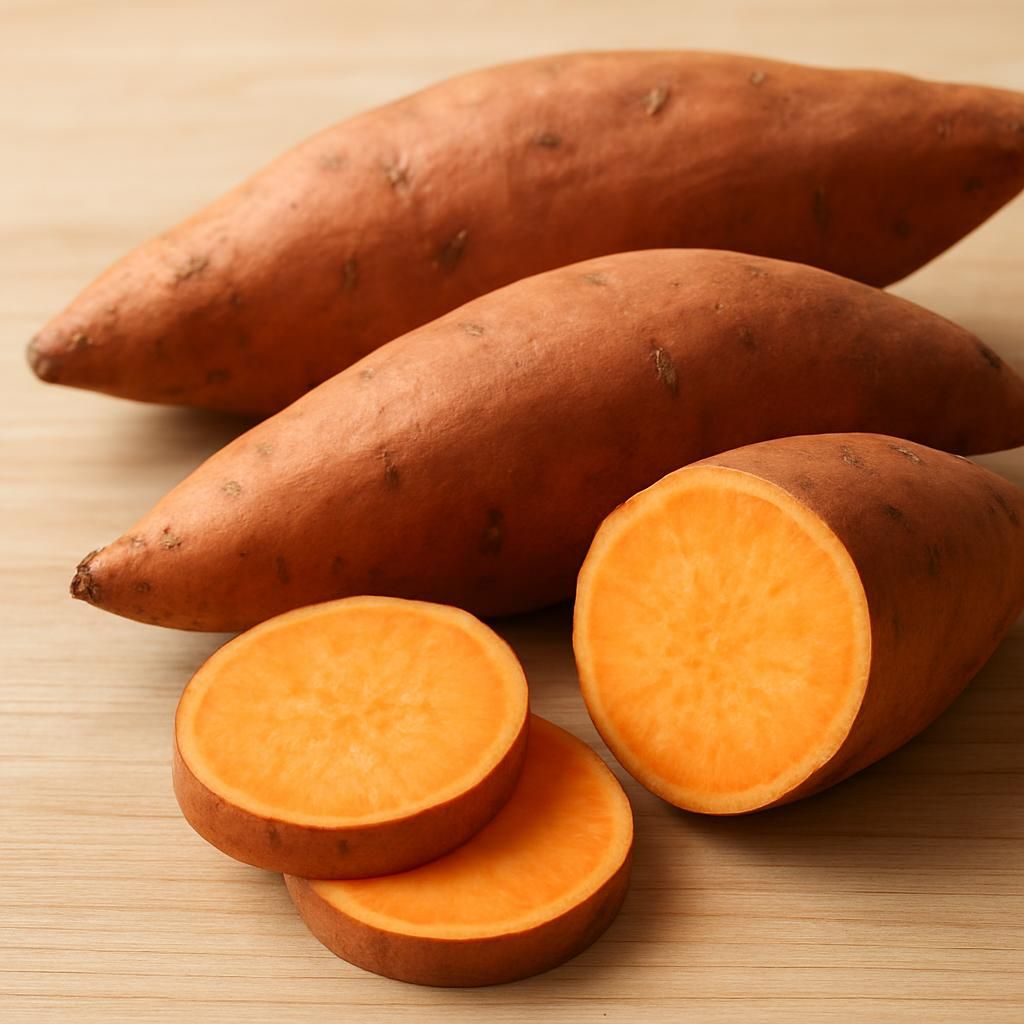
Introduction to Sweet Potato (Beauregard)
Beauregard sweet potato is the benchmark variety for commercial and home growers seeking reliable yields of smooth, copper-skinned roots with deep-orange flesh that cooks sweet and moist. Released by Louisiana State University in 1982, it quickly became the dominant cultivar in the southern United States because of its earliness (90–110 days), high pack-out percentage, and tolerance to Fusarium wilt and soil rot. The variety stores exceptionally well for 4–7 months when properly cured, making it a favorite among market gardeners and small farms focused on winter sales.
Its sprawling vines produce moderate foliage cover that suppresses weeds while allowing mechanical or hand harvest. Because Beauregard tolerates slightly cooler spring soils than many heirloom types, it extends the planting window in USDA zones 7–9 without sacrificing quality. The cultivar’s consistent shape also reduces culls during washing and grading, improving profitability for direct-market operations.
Botanical Profile of Sweet Potato (Beauregard)
Sweet potato is a member of the Convolvulaceae family and is botanically unrelated to Potato. The plant produces long, trailing stems that root at nodes and bear heart-shaped to palmately lobed leaves. Adventitious roots swell into storage tubers when soil temperatures remain above 21 °C (70 °F). Beauregard exhibits a semi-erect growth habit early in the season, transitioning to prostrate vines that reach 1.5–2 m. The skin color is a uniform rose-copper at maturity, and the flesh is uniformly orange with high beta-carotene content. Flowers are lavender and rarely set seed; propagation is achieved vegetatively from slips or vine cuttings.
Soil, pH, and Climate Requirements for Sweet Potato (Beauregard)
Beauregard performs best on sandy-loam or loamy-sand soils that warm rapidly in spring and drain freely after heavy rain. Heavy clay soils should be amended with compost or grown in raised beds to prevent waterlogging and subsequent root rot. The following table summarizes ideal conditions:
| Parameter | Ideal Range | Notes |
|---|---|---|
| Soil Texture | Sandy loam to loamy sand | Promotes uniform root shape and skin finish |
| Soil pH | 5.8–6.5 | Avoids manganese toxicity and scurf |
| Soil Temperature (planting) | 18–24 °C (65–75 °F) | Minimum 15 °C; use black plastic to warm |
| Air Temperature (day) | 24–32 °C (75–90 °F) | Vines cease growth below 15 °C |
| Air Temperature (night) | 15–21 °C (59–70 °F) | Cooler nights improve storage quality |
| Frost Tolerance | None; kill at 0 °C | Use row cover for late spring cold snaps |
| Rainfall / Irrigation | 25–38 mm per week | Consistent moisture prevents cracking |
Step-by-Step Planting & Propagation
- Produce or purchase certified disease-free slips 6–8 weeks before last frost. Each slip should be 20–30 cm long with several nodes.
- Harden slips outdoors for 3–5 days, then transplant on a cloudy afternoon or early evening.
- Prepare beds 20–25 cm high and 75–90 cm wide; incorporate 5–8 cm of well-rotted compost.
- Space slips 30 cm apart in-row and 90–100 cm between rows. Plant slips horizontally so that 2–3 nodes are buried to encourage multiple root sets.
- Water immediately after transplanting and maintain surface moisture for the first 7–10 days until new growth appears.
Care & Maintenance regimes for Sweet Potato (Beauregard)
Consistent moisture and balanced fertility are critical during the first 40 days when storage-root initiation occurs. The table below outlines recommended regimes:
| Growth Stage | Water Schedule | Fertilizer Schedule | Pruning / Canopy Management |
|---|---|---|---|
| Transplant–30 days | 25 mm every 3 days (light, frequent) | 30 kg N/ha at week 2; sidedress with 20 kg N | Remove flowers to direct energy to roots |
| 30–60 days | 25–38 mm weekly; drip irrigation ideal | No additional N; apply 40 kg K₂O if soil test low | Hill soil 5 cm over crown to cover roots |
| 60–90 days | Reduce to 20 mm weekly if rainfall adequate | Foliar K if deficiency symptoms appear | Tip vines if they exceed row width |
| 90+ days (maturity) | Withhold irrigation 10–14 days before harvest | None | None |
Mulch with 7–10 cm of straw or pine needles after vines cover 50 % of the bed to moderate soil temperature and suppress weeds.
Pests, Diseases & Organic Management
Major insect pests include wireworms, flea beetles, and root-knot nematodes. Scout weekly; beneficial nematodes (Steinernema carpocapsae) applied at 2 billion per hectare provide season-long wireworm suppression. Aphids and whiteflies vector viruses; reflective mulch and yellow sticky traps reduce populations below economic thresholds. Primary diseases are Fusarium wilt, Rhizoctonia stem canker, and Alternaria leaf spot. Rotate with corn or small grains every 3–4 years; use certified slips and avoid overhead irrigation to limit foliar disease. Copper-based sprays at 7–10 day intervals control Alternaria when disease pressure is high.
Harvesting, Curing & Optimal Storage
Harvest when a majority of roots reach 4–6 cm diameter, typically 90–110 days after transplant. Use a turning plow or garden fork to lift vines gently; avoid skinning tubers. Cure immediately at 29–32 °C (85–90 °F) and 85–90 % relative humidity for 5–7 days to heal wounds and convert starches to sugars. Store cured roots at 13–15 °C (55–60 °F) with 85 % humidity; never allow temperatures to drop below 10 °C. Properly cured Beauregard retains market quality for up to 7 months.
Companion Planting for Sweet Potato (Beauregard)
Plant okra or cowpeas on bed edges to provide light shade during extreme heat and attract beneficial insects. Marigold borders repel nematodes and enhance pollinator activity. Avoid planting near tomato or pepper because of shared nematode and virus susceptibility. Nasturtium trailing among vines acts as a trap crop for aphids. After harvest, sow a winter cover of hairy vetch to fix nitrogen and improve soil structure for the next Beauregard crop.
Stop Treating Tomato Blight Like a Spray Problem: Here Is What Works Better