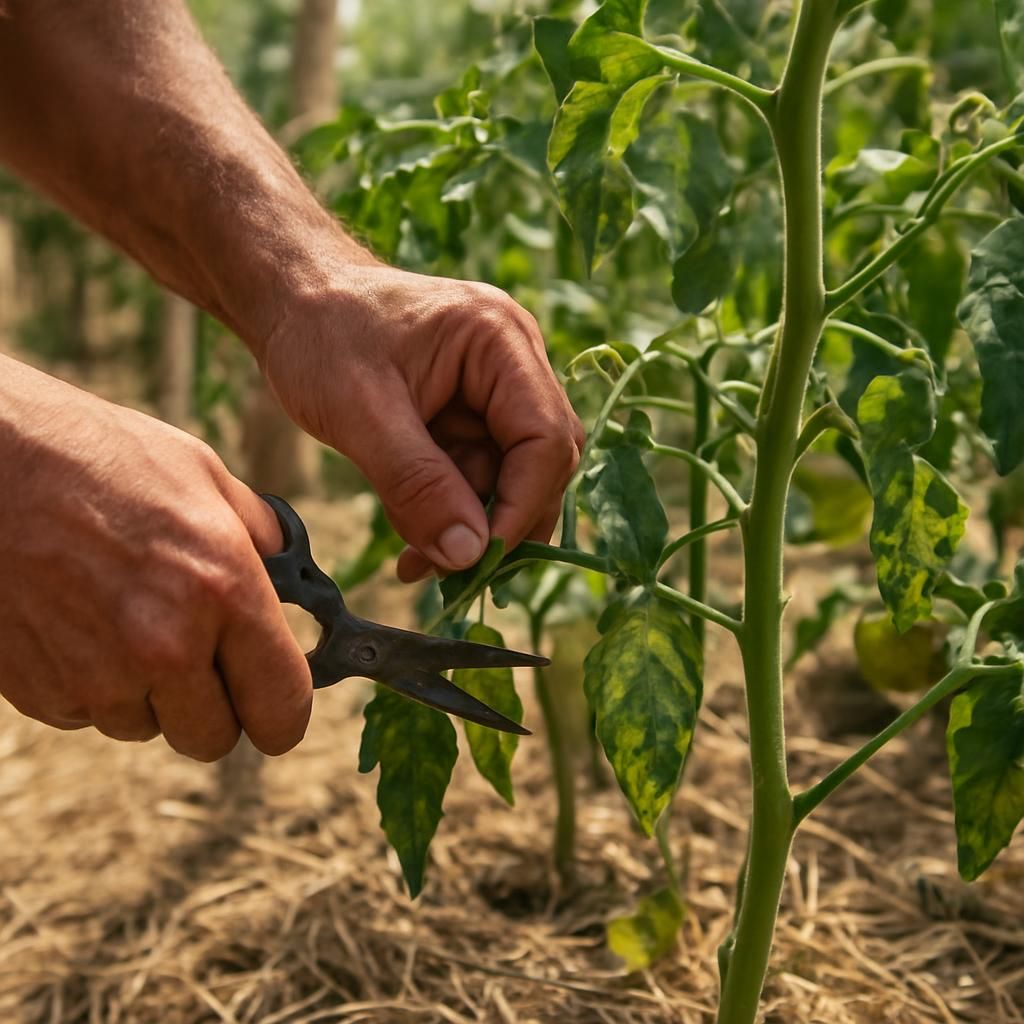
A patch of tomatoes can look nearly perfect on Monday and badly compromised by Friday, and that is exactly why blight punishes reactive growers. The biggest mistake is treating it like a one-time spraying issue when it is really a whole-system management problem shaped by moisture, spacing, sanitation, timing, and variety choice.
For small farmers, homesteaders, and serious gardeners, tomato blight is rarely just one disease event. It is usually the final result of repeated conditions that favor infection: wet leaves, crowded growth, inconsistent pruning, poor airflow, splash from bare soil, and delayed removal of infected tissue. If you only focus on what to apply after symptoms appear, you give up the cheapest and most effective part of control.
This guide takes a different route. Instead of chasing symptoms, it lays out a practical field strategy that helps you prevent outbreaks, slow spread when they start, and make calmer decisions during humid stretches of the season.
Blight is not one single problem
Growers often say "blight" as if it were one disease, but in practice tomatoes are commonly challenged by more than one major foliar disease. Early blight and late blight are the names most people know, and Septoria leaf spot is often mixed into the same conversation because it causes similar panic: leaves yellow, spots expand, plants defoliate, and harvest quality drops.
The exact organism matters, but the management pattern for small-scale organic systems overlaps in important ways. All three become harder to control once they are established. All three exploit leaf wetness and canopy density. And all three become more damaging when lower leaves are allowed to stay damp and in contact with soil splash.
If you want a technical reference on the disease group itself, review the overview of tomato diseases. Then come back to the field and focus on the conditions you can actually change.
The real driver is leaf wetness duration
Many growers pay attention to rainfall totals but miss the more important issue: how long the plant stays wet. A light shower followed by a still, humid night can be more dangerous than a heavier rain followed by sunshine and drying wind.
Blight pressure rises when the canopy remains damp for extended periods. That means your management decisions should revolve around reducing wet leaves, shortening drying time, and keeping spores from moving upward from the soil surface.
Here is the practical chain reaction that leads to trouble:
| Field condition | Immediate effect | Disease consequence |
|---|---|---|
| Dense planting | Less air movement | Leaves stay wet longer |
| Bare soil under plants | More splash during rain | Spores move onto lower foliage |
| Overhead watering late in day | Wet canopy overnight | Infection risk rises |
| Unpruned lower branches | Leaves touch soil or mulch | Easier disease transfer |
| Delayed harvest and cleanup | More damaged tissue remains | More inoculum in the patch |
When growers understand this table, blight stops looking random. It becomes a pattern.
The first fix is spacing, not spraying
Crowded tomatoes may look productive early, but they often create their own disease chamber by midsummer. Tight spacing reduces airflow, increases humidity inside the canopy, and makes scouting harder. You may save bed space at transplanting only to lose plant health later.
Tomatoes need enough room for both sunlight penetration and worker access. If you cannot easily inspect lower leaves without brushing against multiple plants, the row is likely too tight for good disease management.
A healthier setup usually includes these basic principles:
| Practice | Better target |
|---|---|
| In-row spacing | Wide enough for mature leaf spread without heavy overlap |
| Row spacing | Enough room for airflow and easy harvest access |
| Support system | Stakes, cages, or trellis that keeps foliage lifted |
| Path maintenance | Clear walkways that reduce brushing and wounding |
Spacing is not glamorous, but it is one of the cheapest forms of prevention available.
Mulch is doing more disease work than most growers realize
One of the simplest organic interventions is covering the soil surface around tomatoes. Straw, shredded leaves, or other clean organic mulches help reduce rain splash, moderate moisture swings, and keep infected soil particles from landing on lower foliage.
This is one reason mulching deserves attention far beyond weed control. A good mulch layer creates a barrier between the plant and the disease pressure coming from below. If you want a deeper look at the broader soil and crop benefits, the post on mulching is worth reading alongside this one.
The key is using mulch correctly. Wet, matted, contaminated, or overly thick mulch pressed against stems can create a different set of problems. Aim for a breathable layer that protects the soil without smothering the planting zone.
Pruning should be strategic, not aggressive
Blight management often inspires over-pruning. A grower sees spots, panics, and strips too much foliage, leaving fruit exposed to sunscald and the plant under stress. The goal is not to skeletonize the plant. The goal is to reduce the most disease-prone tissue and improve drying conditions.
Focus first on the lower part of the plant. Remove leaves that:
| Remove first | Reason |
|---|---|
| Touch the soil or mulch | Highest splash exposure |
| Show clear spotting or yellowing | Likely active disease tissue |
| Block airflow at the plant base | Slows drying after rain or irrigation |
| Are badly damaged or aging out | Low productivity, higher disease risk |
Make cuts when foliage is dry, sanitize tools regularly, and avoid turning pruning into a plant-to-plant disease transfer event. A light, consistent approach throughout the season is usually better than one heavy pruning session after symptoms explode.
Water timing changes everything
If you irrigate from above, the timing matters almost as much as the method. Morning watering is usually far safer than late-day watering because it gives leaves time to dry before nightfall. Evening irrigation can trap the canopy in prolonged dampness exactly when temperatures and humidity encourage trouble.
For small growers using hoses, watering wands, or simple lines, the best practical rule is this: water the root zone, not the whole plant, and do it early enough for any accidental leaf wetness to disappear quickly.
Use this simple irrigation priority guide:
| Situation | Best move |
|---|---|
| Soil dry, leaves dry, morning hours | Water at base of plant |
| Soil slightly moist, heavy humidity expected | Delay and reassess |
| Late afternoon, warm but still air | Avoid wetting foliage |
| Rain expected overnight | Skip unnecessary irrigation |
This sounds basic, but disease control is often basic work done on time.
Rotation matters, but only if you are honest about your space
Crop rotation is frequently recommended, yet many home gardens and micro-farms do not have the luxury of ideal movement. If your tomato family crops return to the same bed too quickly, disease carryover becomes more likely. But pretending you are rotating when you are really shifting plants a few feet is not enough.
Even modest rotation can help if paired with sanitation and residue management. Remove infected plant debris promptly. Do not leave diseased vines in pathways or at bed edges. If a bed had heavy foliar disease pressure, treat it as a higher-risk zone the following season.
If you are working rotation into a broader planning system, the piece on crop rotation can help connect disease control with bed design and seasonal flow.
Variety choice is a financial decision, not just a taste decision
Many growers pick tomatoes almost entirely by flavor, color, or market appeal. Those factors matter, but disease tolerance belongs in the same conversation. In humid climates especially, susceptible varieties can consume labor through pruning, scouting, spraying, and repeated harvest loss.
That does not mean abandoning beloved heirlooms. It means balancing them with more resilient slicers, cherries, or paste types, and avoiding the trap of putting your entire season into a variety that collapses under local conditions.
A practical farm mix might look like this:
| Variety category | Main advantage | Main caution |
|---|---|---|
| Heirloom types | Exceptional flavor and visual appeal | Often more vulnerable to disease pressure |
| Hybrid disease-tolerant types | Better field resilience | Flavor may vary by cultivar |
| Cherry tomatoes | Often productive over a long window | Can become dense if not managed |
| Paste tomatoes | Useful for preservation and sales diversity | Still need airflow and sanitation |
This is not about purity. It is about keeping harvest coming through difficult weather.
The scouting mistake that costs the most
Most growers look at the top of the plant first because that is where the eye naturally goes. Blight usually punishes that habit. Trouble often starts lower, where humidity lingers, splash hits first, and old leaves are slowest to dry.
A good scouting routine checks the lower canopy before the upper canopy. Turn leaves over. Look for spotting patterns, yellow halos, concentric lesions, rapid browning, or clusters of tiny dark lesions. Then note where the issue is concentrated: one row, one bed edge, one low area, one variety, or one section with weaker airflow.
The point of scouting is not just detection. It is pattern recognition. When you know where disease starts first, you learn where your system is weak.
A practical blight response plan for wet weeks
When a humid stretch arrives, casual management usually fails. You need a short, repeatable checklist.
| Time frame | Priority action |
|---|---|
| Before wet weather | Harvest ripe fruit, prune problem leaves, reinforce mulch, check supports |
| During wet spell | Avoid unnecessary handling, monitor lower canopy, remove clearly infected leaves when dry |
| First dry window | Sanitation pass, airflow adjustment, targeted organic protection if part of your system |
| After outbreak slows | Evaluate spacing, variety performance, and irrigation decisions |
This plan is valuable because it prevents emotional decisions. Wet weather creates urgency, and urgency leads to random interventions. A checklist keeps you focused on the factors that actually reduce spread.
Organic treatments still have a place, but they are not the foundation
Organic growers often use approved foliar materials as part of a disease program, and they can be useful when timed correctly. But no product can rescue a planting that stays wet, crowded, unsanitized, and poorly ventilated. Treatments are strongest when they support a system already designed to reduce infection pressure.
In practical terms, this means:
| If this is true | Then treatment results are usually |
|---|---|
| Plants are crowded and damp daily | Limited and disappointing |
| Lower leaves are infected and left in place | Short-lived |
| Soil splash is reduced and canopy is managed | More useful |
| Applications are timed before severe spread | More consistent |
Think of approved sprays as a reinforcing layer, not the whole strategy.
When to pull plants instead of fighting for them
Small growers often hang on too long. A heavily infected plant can become a disease engine that threatens healthier neighbors. If a tomato is collapsing, defoliated, and producing poorly, removal may protect the rest of the bed better than continued attention.
That is a hard call because growers naturally want to save every plant. But some seasons reward selectivity more than rescue. Pulling the worst performers, cleaning the area, and preserving stronger plants is often the wiser move.
The best blight control plan is built before symptoms appear
By the time blight is obvious from several steps away, the cheap fixes are already behind you. The growers who handle it best are usually doing a dozen small things early: spacing better, mulching on time, watering low and early, keeping the base of the plant clean, supporting vines properly, rotating as honestly as space allows, and scouting the bottom leaves before problems climb.
That approach is less dramatic than emergency spraying, but it is far more reliable. Small-scale growing rewards systems thinking. Blight is a perfect example. Treat the environment that favors the disease, and you give the crop a fighting chance. Ignore that environment, and no last-minute rescue will feel like enough.