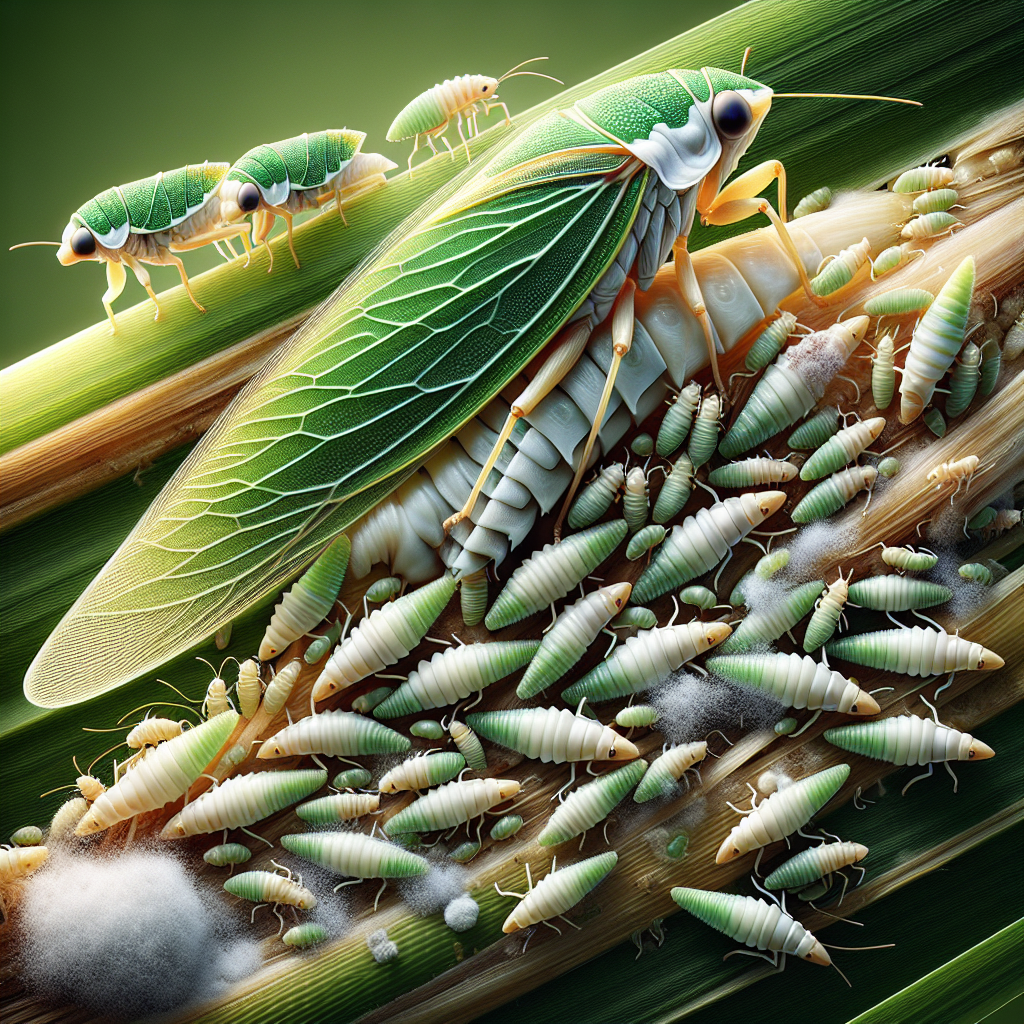
Introduction to pyrilla leafhopper
Pyrilla leafhopper, scientifically known as Pyrilla perpusilla, is a notorious agricultural pest belonging to the family Fulgoridae in the order Hemiptera. Native to South Asia, this leafhopper has become a significant threat to gramineous crops, particularly sugarcane and rice, across India, Pakistan, Bangladesh, and parts of Southeast Asia. Adults are wedge-shaped insects measuring 6-8 mm in length, with a distinctive brownish body, yellowish wings, and prominent white stripes on the head and thorax. Nymphs are smaller, wingless, and exhibit a soft, pale green to yellowish body covered in white wax-like filaments.
This pest thrives in warm, humid environments typical of tropical and subtropical regions, with populations exploding during monsoon seasons. Pyrilla leafhoppers feed by piercing plant tissues and sucking sap, primarily from the underside of leaves. Their feeding not only deprives plants of vital nutrients but also excretes copious amounts of honeydew, a sticky substance that promotes the growth of sooty mold fungus. This black fungal coating blocks photosynthesis, further weakening the crop. In severe infestations, yield losses can reach 30-50% in sugarcane and up to 20% in rice, making timely diagnosis and management critical for farmers. For more on related sucking pests, see our guide on leafhoppers. Understanding its biology and implementing integrated pest management (IPM) strategies is essential for minimizing economic damage while promoting sustainable farming practices.
Identifying Symptoms & Damage
Early detection of Pyrilla leafhopper infestations is key to preventing widespread crop loss. Initial symptoms appear on lower leaves, where nymphs congregate in colonies on the undersides. Look for pale yellowing or chlorotic patches along veins, caused by the insect's stylet penetrating phloem tissues. As feeding intensifies, leaves curl upwards, become brittle, and develop a mottled appearance with reddish-brown discoloration.
The hallmark sign is the presence of honeydew droplets on leaf surfaces, often accompanied by shiny black sooty mold (Capnodium spp.). This mold gives foliage a characteristic blackened, sooty appearance, reducing photosynthetic efficiency by up to 40%. In heavy infestations, entire plants exhibit stunted growth, shortened internodes, and reduced tillering in cereals. Sugarcane stalks may show poor girth development and delayed maturity, while rice panicles become sparse and poorly filled.
Physical identification includes spotting nymphs (1-5 mm long) with white waxy tufts for camouflage and adults leaping away when disturbed. Use a hand lens to confirm: nymphs have red eyes and spiny legs. Differentiate from other pests like aphids or jassids by the waxy filaments and larger size. Damage thresholds: 5-10 nymphs per leaf warrant action in sugarcane; monitor weekly from tillering stage in rice. Scouting involves tapping plants over white trays to count dislodged insects. For small farms, check 20-30 plants per acre, focusing on field edges and moist areas. Read our Spring Pest Patrol: Organic AI Strategies to Shield Your Crops from Common Invaders for advanced monitoring tips.
Lifecycle and Progression of pyrilla leafhopper
Pyrilla leafhopper completes 4-6 generations per year, depending on climate, with a lifecycle of 20-40 days. Eggs are laid in clusters of 50-200 on leaf undersides, covered in white frothy secretion for protection. Hatching occurs in 5-7 days, producing pale nymphs that pass through five instars over 12-20 days. Nymphs are highly gregarious, feeding voraciously and molting periodically, shedding white skins visible on leaves.
Adults emerge after the final molt, living 15-30 days. Females are prolific, laying up to 500 eggs. Peak activity aligns with monsoon rains (June-September in India), when humidity exceeds 70% and temperatures range 25-35°C. Overwintering occurs as eggs or diapause nymphs on alternate hosts like sorghum or wild grasses. Migration via wind disperses adults over long distances, infesting new fields.
Progression: Eggs (5-7 days) → Nymphs (12-20 days, most damaging stage) → Adults (15-30 days, dispersal phase). Population dynamics follow a boom-bust cycle, with outbreaks every 2-3 years. Natural enemies like spiders, ladybird beetles, and parasitoids (Epiricania melanoleuca) regulate numbers. Understanding this cycle allows targeted interventions, such as egg predation or nymphal sprays.
Environmental Triggers & Risk Factors
Pyrilla leafhopper thrives under specific conditions that farmers must monitor. High humidity (above 80%) and temperatures of 28-32°C trigger rapid reproduction, especially post-monsoon. Excessive nitrogen fertilization promotes lush, succulent growth attractive to hoppers, increasing susceptibility. Poor drainage and waterlogged fields exacerbate infestations, as nymphs prefer moist microclimates.
Alternate hosts like sorghum, maize, and wild Pennisetum grasses serve as reservoirs, facilitating spillover to main crops. Monoculture farming and lack of crop rotation heighten risks, as does proximity to previous season's stubble fields. Wind currents during July-August aid migration from 10-50 km away. Drought stress weakens plants, making them more vulnerable, while heavy rains wash off natural predators.
Risk assessment: Fields near rivers or with dense canopies are high-risk. Early planting in rainy season coincides with peak hopper activity. Companion pests like whiteflies compound damage through shared honeydew issues. Climate change, with erratic monsoons, may extend outbreak windows. Mitigation starts with site selection away from wild grasses and balanced NPK application.
Organic Control & Treatment Plans
Organic management of Pyrilla leafhopper emphasizes IPM, integrating multiple tactics for 80-90% control without synthetics. Cultural Controls: Remove alternate hosts and burn crop residues post-harvest to break lifecycle. Intercrop sugarcane with marigold or trap crops like sunflower to divert hoppers. Ensure proper drainage and avoid excess nitrogen.
Biological Controls: Encourage predators like lacewings, spiders, and the pyrilla parasitoid Epiricania melanoleuca (larval parasitism up to 70%). Release Chrysoperla carnea at 10,000/ha during nymphal peaks. Neem-based biopesticides (azadirachtin 0.03%) disrupt feeding and reproduction; apply 2-3 sprays at 10-day intervals, 500-1000 ml/ha.
Organic Sprays: Insecticidal soaps (1-2% potassium salts) suffocate nymphs; apply evenings to avoid bees. Garlic-chili extracts (50g garlic + 50g chili per liter) repel adults. Stick traps (yellow with castor oil) capture 20-30% adults. Treatment Plan: Scout weekly; act at 5 nymphs/leaf. Week 1: Neem + soap spray. Week 2: Predators + traps. Rotate to prevent resistance.
Advanced Organic: Beauveria bassiana (fungal entomopathogen) at 10^12 spores/ha infects nymphs in humid conditions. Combine with overhead irrigation to dislodge hoppers. Efficacy: 85% reduction in 3 weeks. Always test on small areas first.
Preventing pyrilla leafhopper in the Future
Long-term prevention focuses on farm hygiene and resilience. Implement 2-year crop rotation with non-hosts like legumes (chickpeas). Plant resistant varieties: Co 0238 sugarcane or IR36 rice show tolerance. Establish border hedges of thyme or yarrow as repellents.
Timing: Delay sugarcane planting to February-March, avoiding monsoon peaks. Use clean seedlings and rogue infested plants early. Mulch fields to suppress weed hosts. Monitor with pheromone traps (under development) for early warnings.
Farm-wide IPM: Foster biodiversity with flowering strips for predators. Soil health via cover crops reduces stress susceptibility. Regular pruning improves airflow, deterring colonies. Annual audits: Map infestation hotspots for targeted prevention. With consistent practices, outbreaks drop by 70%. For broader strategies, explore Soil Health Mastery: 5 Proven Strategies for Small Farms to Build Fertile Ground Without Breaking the Bank.
Crops Most Affected by pyrilla leafhopper
Pyrilla leafhopper primarily targets Poaceae family crops, with sugarcane suffering the most (up to 40% losses). Rice ranks second, especially Basmati varieties during vegetative stages. Sorghum and maize serve as secondary hosts and reservoirs. Wild grasses like Cynodon dactylon perpetuate populations. Minor impacts on pearl millet, wheat, and barley under heavy pressure. In mixed systems, spillover to cotton occurs rarely. Focus protection on high-value sugarcane fields.