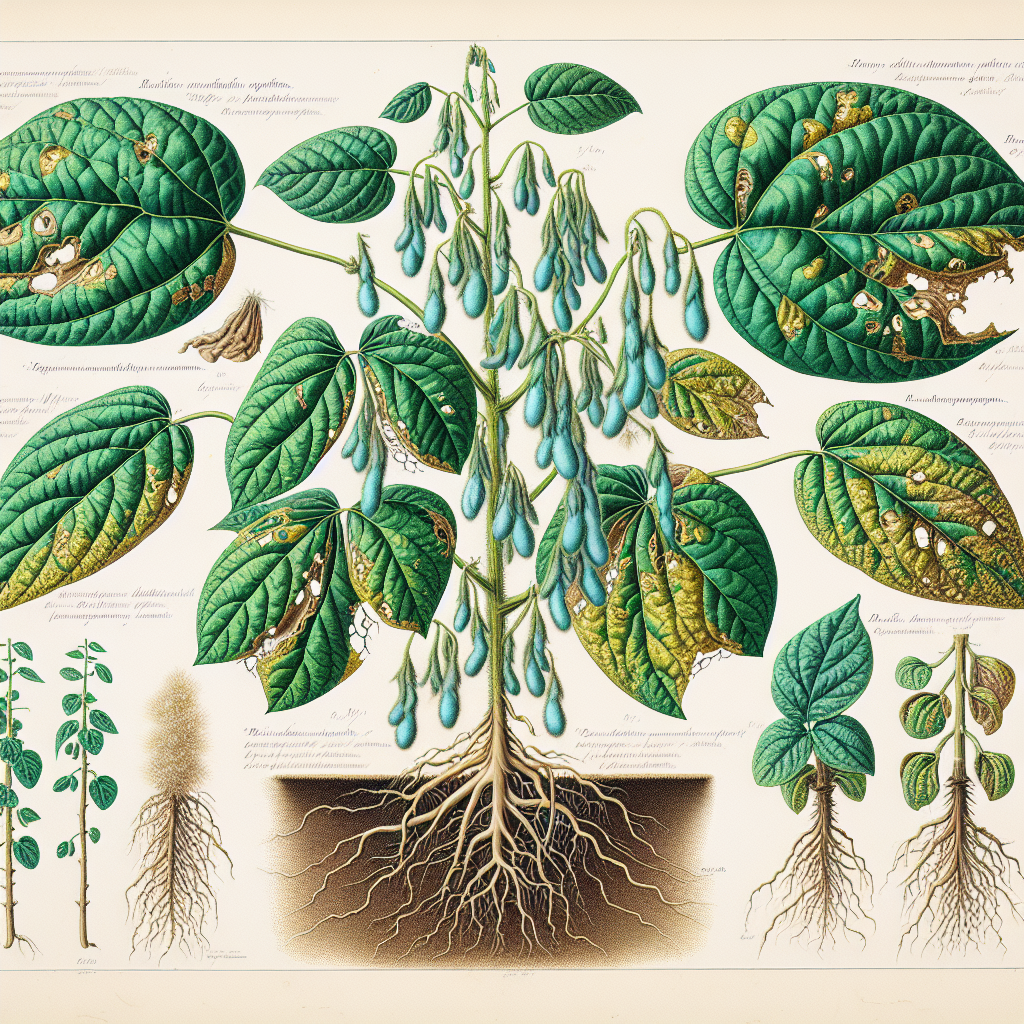
Introduction to sudden death syndrome
Sudden Death Syndrome (SDS), caused by the soilborne fungus Fusarium virguliforme, represents one of the most destructive diseases in soybean production worldwide. First identified in the 1990s in the Midwestern United States, SDS has since spread across major soybean-growing regions, causing billions in annual economic losses. The pathogen infects roots early in the season, remaining asymptomatic until environmental stress triggers rapid foliar symptoms that mimic drought or nutrient deficiencies, hence the name "sudden death."
This guide provides professional-grade diagnostic criteria, lifecycle insights, and organic management strategies tailored for small to mid-sized farms. Understanding SDS is critical for soybeans growers, as it can devastate yields by 20-80% in severe outbreaks. Early detection and integrated prevention are key to sustaining productivity. For hyper-local risk assessment, check resources like Why 80% of Small Farms Battle Weather Disasters - And How Hyper-Local AI Forecasts Can Save Your Harvest.
SDS thrives in cool, wet soils during early growth but expresses symptoms under hot, dry conditions later in the season. Unlike other wilts like Fusarium wilt, SDS primarily affects the vascular system without significant stem discoloration. This definitive resource empowers farmers with actionable steps to diagnose, treat, and prevent SDS effectively.
Identifying Symptoms & Damage
SDS symptoms appear suddenly, often overnight, distinguishing it from gradual declines. Initial signs emerge 4-8 weeks after planting on lower leaves: interveinal chlorosis (yellowing between veins) progressing to necrosis, creating a "mottled" appearance. Unlike Phytophthora, no stem lesions occur; instead, roots show bluish-gray discoloration and rot.
Foliar Symptoms:
- Early: Pale green to yellow leaves with green veins.
- Advanced: Leaf margins and tips brown, leaves drop prematurely, leaving bare stems.
- Severe: Plants wilt permanently, pods fail to fill, yielding empty or small seeds.
Root and Stem Indicators: Dig up affected plants to reveal stubby, rotted roots and possible white mycelium in taproots. Stem pith remains white, unlike brown discoloration in root rot. Yield impacts are profound: 10-30% loss in mild cases, total stand loss in patches.
Diagnostic Confirmation:
- Split stems: No blue-gray fungal growth inside (unlike Rhizoctonia).
- Lab test: PCR for F. virguliforme DNA.
- Symptom timing: Mid-season under stress, not early damping-off.
Differentiate from iron deficiency (uniform yellowing) or stem rots via root inspection. Scouting every 7-10 days in V3-R3 stages is essential.
Lifecycle and Progression of sudden death syndrome
Fusarium virguliforme survives indefinitely in soil as chlamydospores, resilient to tillage, flooding, or dry conditions. Infection begins at planting via hyphae penetrating root hairs in cool (60-75°F), moist soils. The fungus colonizes the root cortex without immediate symptoms, producing toxins that travel systemically.
Key Stages:
- Dormancy (Soil): Chlamydospores persist 10+ years.
- Infection (VE-V2): Roots invaded; no visible signs.
- Latency (V3-R1): Toxins accumulate; minor leaf yellowing.
- Expression (R2-R5): Heat/moisture stress triggers foliar necrosis; plants die within days.
- Reproduction: Microsclerotia form in roots, releasing spores to soil.
Progression accelerates with root-knot nematodes, which create entry wounds. Disease cycles continuously without a sexual stage, relying on asexual spores. Crop rotation breaks the cycle minimally due to long soil survival.
Environmental Triggers & Risk Factors
SDS epidemics correlate with specific conditions:
- Soil: No-till fields, pH <6.5, compacted soils retain moisture.
- Temperature: Cool springs (60°F) for infection, hot summers (85°F+) for symptoms.
- Moisture: Wet early, dry late.
- Preceding Crops: Continuous corn or soybeans increase inoculum.
Risk factors include:
- Susceptible varieties.
- High plant populations (>150,000/acre).
- Plant-parasitic nematodes co-infections.
- Poor drainage.
Map fields using GIS for high-risk zones; avoid planting in history-affected areas.
Organic Control & Treatment Plans
No cure exists post-infection; focus on suppression:
Cultural Practices (Immediate): Reduce populations to 20-30% via:
- Crop rotation: 3-4 years with corn or wheat; include brassicas.
- Tillage: Moldboard plowing buries spores.
- Population: 120,000-140,000 plants/acre.
Biological Controls:
- Trichoderma virens or Bacillus subtilis seed treatments suppress Fusarium.
- Mycorrhizal fungi enhance root health.
Organic Fungicides:
- Serenade (Bacillus subtilis) at V2 and R1.
- Regalia (Reynoutria extract) for induced resistance.
- Apply potassium phosphite for defense boosting.
Integrated Plan:
- Select partially resistant varieties (e.g., group III).
- Seed-treat with organic biofungicides.
- Scout weekly; rogue infected plants.
- Foliar sprays at R1-R3 if >5% incidence.
Monitor with soil tests; maintain K levels >150 ppm. For companion strategies, see Why Companion Planting Feels Like Guesswork for Small Farms - And How AI Makes It Foolproof. Yields recover 15-40% with these.
Preventing sudden death syndrome in the Future
Long-term prevention builds resilient systems:
Variety Selection: Plant SDS-rated varieties (scale 2-4); test locally. Soil Health:
- Cover crops: Clover, rye suppress nematodes.
- pH: Lime to 6.5-7.0.
- Organic matter: >4% via compost.
Rotation Blueprint: Year 1: Soybeans Year 2: Corn Year 3: Wheat + cover Year 4: Vegetables
Monitoring Tools: Soil inoculum assays pre-planting. Threshold: <500 propagules/g soil. Sanitation: Clean equipment; avoid field-to-field spread. Nutrient Management: Balanced NPK; avoid excess N.
Annual audits reduce incidence by 50-70%. Integrate with soil health plans from Soil Health Mastery: 5 Proven Strategies for Small Farms to Build Fertile Ground Without Breaking the Bank.
Crops Most Affected by sudden death syndrome
SDS primarily targets soybeans, with 95% of cases in maturity groups I-IV. Rare infections occur in edamame-soybean, snap beans, and lupins, but economic impact is soybean-centric. Susceptibility varies: group II > III > 0.
Regional hotspots: US Midwest, Argentina, Brazil. Co-occurs with Fusarium in cassava but not as SDS. Diversify rotations with non-hosts like potato or corn to mitigate.