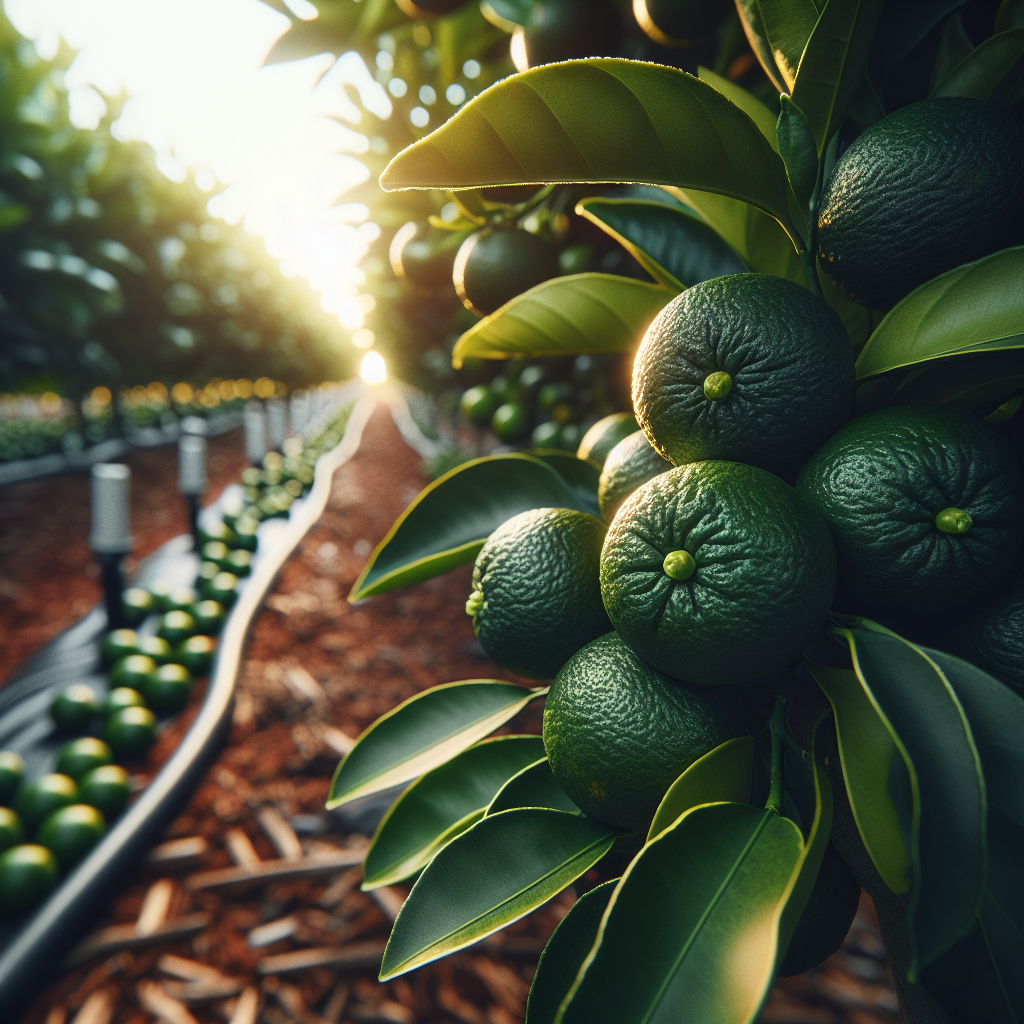
Introduction to Sudachi
A classic Japanese sour citrus, this fruit is most closely associated with Tokushima Prefecture, where it has long been cultivated as a culinary ingredient rather than a dessert fruit. It is typically harvested while still green, when the rind is richly aromatic, the juice is briskly acidic, and the essential oil profile is at its brightest. In Japanese cuisine, the juice and zest are used over grilled fish, noodles, mushrooms, hot pots, and dressings, giving it a role more similar to a finishing acid than a snack fruit.
For growers, this is an important distinction: management should prioritize peel quality, aroma, juiciness, and balanced acidity instead of sugar accumulation alone. Fruit left too long on the tree turns yellow and mellows somewhat, but the premium market stage is usually earlier. In orchard terms, this means harvest timing is narrower and more quality-sensitive than for sweet oranges. If you already grow other citrus, compare general nutrition and canopy care with a standard orange guide, but expect stronger emphasis on aroma retention, rind color stage, and careful handling.
Sudachi is especially valuable for diversified farms, home orchards, and specialty market growers because it can command premium prices where chefs and consumers recognize authentic Japanese citrus. It is also well suited to container culture, espalier against warm walls, and compact orchard systems because trees are generally smaller and more manageable than many vigorous citrus types. However, it is not a neglect-tolerant crop. Consistent moisture, good drainage, micronutrient balance, and protection from hard freezes are essential if you want heavy bloom, strong fruit set, and smooth-skinned fruit.
Botanical Profile of Sudachi
This citrus is generally treated as Citrus sudachi Hort. ex Shirai, though its ancestry is complex and, like many East Asian citrus, likely involves older hybridization within the Citrus group. It is believed to be closely related to yuzu-type acid citrus and is often described as a small-fruited, seedy, strongly fragrant sour citrus adapted to Japanese growing conditions.
Trees are typically small to medium in stature, often reaching 3 to 5 meters in the ground under routine management, though older trees can become larger if unpruned. Growth is somewhat upright to rounded, with dense branching and a tendency to produce thorns, especially on juvenile or vigorous shoots. Leaves are glossy, evergreen, and distinctly citrus-like, with winged petioles that can help distinguish it from some lime types. Flowers are white, fragrant, and borne in spring, though climate can shift bloom timing slightly.
The fruit is usually 3 to 4.5 cm in diameter, round to slightly flattened, with a thin to medium rind and numerous seeds. Unlike sweet citrus selected for eating quality, this fruit is prized for volatile aroma compounds in the peel and the sharp, clean acidity of the juice. Commercially preferred fruit are often harvested deep green to green-yellow, before full yellow maturity. At this stage, juice content is adequate, rind oil is highly expressive, and market appearance is traditional.
One useful grower nuance is that fruit quality is shaped strongly by canopy light distribution. Fruit on the outer, well-lit canopy often develops better aroma and more uniform shape, but excessive direct heat can cause rind hardening or sunscald in hot inland climates. Fruit buried in overly dense canopies may stay small, remain damp after rain, and be more susceptible to fungal blemishes.
Sudachi is generally self-fertile, so a single tree can crop well without a pollinizer. Even so, pollinator activity can improve fruit set and uniformity under some conditions. Blossom drop is natural, but severe drop usually points to moisture stress, nutrient imbalance, cold injury during bloom, or excessive nitrogen driving vegetative growth at the expense of fruit retention.
Soil, pH, and Climate Requirements for Sudachi
This crop performs best in deep, well-drained loam or sandy loam with high aeration and moderate water-holding capacity. Ideal soil pH is about 5.8 to 6.8, with the practical sweet spot near 6.2 to 6.5. Trees can survive slightly outside that range, but nutrient uptake becomes less efficient. Above pH 7.2, iron, manganese, and zinc deficiencies become more likely, leading to interveinal chlorosis on young leaves and reduced vigor. In strongly acidic soils below pH 5.5, root stress and imbalanced calcium-magnesium availability can become limiting.
Drainage is non-negotiable. Citrus roots need oxygen, and Sudachi is particularly unforgiving of waterlogged conditions. If water stands for more than 24 hours after irrigation or rain, roots begin to suffocate, feeder roots die back, and the tree becomes predisposed to Phytophthora root rot. In practical terms, the top 5 to 8 cm of soil can dry slightly between irrigations, but the root zone at 15 to 30 cm depth should remain lightly moist, never saturated and never powder-dry.
A target soil moisture condition for established in-ground trees is roughly equivalent to soil that forms a weak ball in the hand but does not smear or ooze water. If the soil is sticky, shiny, and airless, it is too wet. If it crumbles instantly and feels hot and dusty at root depth, irrigation intervals are too long. Leaves that cup slightly by afternoon and recover by evening may indicate mild water deficit; persistent dull leaves, yellowing, twig dieback, and fruit drop indicate more serious stress.
Climatically, Sudachi prefers humid subtropical to warm temperate citrus belts. It grows best where annual temperatures commonly range from 15 to 30°C during active growth, with warm summers and relatively mild winters. It has better cool tolerance than many tropical limes, but it is not truly cold-hardy in the face of hard freezes. Light frosts may be tolerated by mature, hardened trees, especially if grafted onto compatible rootstocks and grown in sheltered sites, but damage becomes increasingly likely below about -3 to -4°C, with severe wood injury possible in colder events.
The best sites have full sun, protection from desiccating winter winds, and air drainage that reduces frost pooling. Coastal or sheltered hillside plantings are often superior to low pockets where cold settles. In hot inland climates, reflected heat from bare ground or masonry can stress fruit; a living understory or mulch ring helps stabilize soil temperature. In marginal climates, south- or southeast-facing exposures are preferable.
For containers, use a coarse citrus mix with roughly 40 to 60% bark-based material, 20 to 30% mineral drainage component such as pumice or coarse sand, and the remainder high-quality composted organic matter. Avoid peat-heavy mixes that collapse and stay wet around roots.
Step-by-Step Planting & Propagation
Propagation is usually by grafting rather than seed if you want reliable horticultural performance. Seedlings are variable, slower to fruit, and may differ in thorniness, vigor, and fruit quality. Most professional growers use budded or grafted nursery trees on disease-free rootstock selected for local soil and climate conditions. Rootstocks influence cold tolerance, vigor, tolerance to calcareous soils, and disease resilience.
Planting is best in spring after frost risk has passed, or in early autumn in climates with mild winters and warm soil. The goal is to allow root establishment before temperature extremes.
Step 1: Choose a healthy tree. Select a grafted plant with a straight trunk, visible graft union above the root flare, no cankers, and dark green leaves free from chlorosis. Avoid pot-bound specimens with circling roots thicker than a pencil.
Step 2: Prepare the site. Clear perennial weeds in at least a 1 meter diameter circle. If drainage is questionable, build a mound or raised berm 20 to 40 cm high. Do not over-amend just the planting hole with rich compost, as this can create a water-holding basin.
Step 3: Dig correctly. Make the hole 2 to 3 times as wide as the root ball but no deeper than the root ball height. The top of the root ball should sit slightly above surrounding grade, usually 2 to 5 cm high, to account for settling and protect the crown.
Step 4: Set the tree. Gently loosen only the outermost circling roots. Position the tree so the graft union remains well above soil level. Backfill with native soil, breaking large clods but not pulverizing the structure.
Step 5: Water in deeply. Apply enough water to settle soil around the roots, usually 10 to 20 liters for a young tree depending on root ball size. After settling, ensure the tree has not sunk below grade.
Step 6: Mulch wisely. Apply 5 to 8 cm of coarse organic mulch over the root zone, keeping it 10 to 15 cm away from the trunk. Mulch moderates temperature, conserves moisture, and supports microbial life. For broader soil-building ideas, see soil health strategies.
Step 7: Stake only if necessary. In windy sites, use a low, flexible tie for the first season. Overstaking can weaken trunk development.
For spacing, allow about 3 to 4.5 meters between trees in compact plantings, more if using vigorous rootstocks or low-pruning systems. Container trees need at least a 45 to 60 liter pot for sustained performance, eventually larger.
Propagation by budding is the preferred nursery method. T-budding onto compatible citrus rootstock is typically done when bark is slipping actively. Cuttings are less common and usually inferior for long-term orchard performance.
Care & Maintenance regimes for Sudachi
Irrigation should be frequent enough to maintain active root function but not so frequent that oxygen is excluded from the soil. Young trees often need watering 1 to 3 times weekly in warm weather, depending on soil texture. Sandy soils may require smaller, more frequent applications; heavier loams require deeper, less frequent soaking. Mature trees generally benefit from deep irrigation that wets the main root zone to 30 to 45 cm depth, then a partial drying period near the surface.
The most common watering mistake is shallow daily sprinkling. This encourages roots near the surface, increases salt accumulation, and predisposes trunks and lower canopies to disease. A better approach is drip or microsprinkler irrigation delivering enough water to moisten a broad root zone. During flowering and early fruit set, avoid large swings between drought and saturation because they increase fruit drop.
Overwatering signs include yellow leaves that drop while soil remains wet, soft rank shoots, algae or moss near emitters, sour-smelling soil, and little new white root growth. Underwatering signs include leaf curl, brittle new shoots, small hard fruit, and premature fruit drop. In containers, water when the upper 3 to 5 cm of mix is dry but the root ball beneath is still slightly cool and damp.
Nutrition should be steady and balanced. Sudachi responds well to split applications of citrus fertilizer with nitrogen, potassium, magnesium, and essential micronutrients. Young trees may receive light feeding every 6 to 8 weeks during active growth. Mature trees can be fertilized 3 to 4 times annually, often in early spring, late spring, midsummer, and late summer in long seasons. Avoid pushing high nitrogen late into autumn, as tender growth is more frost-sensitive and may reduce fruit quality.
A useful leaf color target is a healthy medium to deep green without exaggerated softness. Excess nitrogen produces lush, dark, floppy growth with more pest pressure and fewer quality fruits. Potassium supports fruit size and rind quality; magnesium and iron are particularly important where leaf yellowing develops. Foliar micronutrient sprays can correct in-season deficiencies, but long-term soil or root-zone correction is preferable.
Pruning is light compared with deciduous fruit trees. Remove dead, diseased, crossing, or weak inward shoots, and maintain an open but shaded interior that protects scaffold limbs from sunburn. Remove suckers below the graft union immediately, as they divert energy and can overtake the scion. The best pruning window is after harvest or before strong spring flush, avoiding heavy cuts during cold weather.
Fruit thinning is not always necessary, but in very heavy set years, selective thinning can improve fruit size and reduce limb strain, especially on young trees. Keep weeds and turf away from the trunk zone because citrus roots compete poorly with dense grass.
Pests, Diseases & Organic Management
Like other citrus, this crop is vulnerable to a suite of sucking insects, mites, fungal pathogens, and root diseases. The most common pests include Aphids, Citrus leafminer, Scale insects, Mealybugs, Spider mites, and sometimes Whiteflies or Thrips. Young flush is especially attractive to sap feeders, which distort leaves and reduce photosynthetic efficiency.
Aphids and leafminers are especially problematic in spring flush. Leafminers tunnel in tender leaves, causing curled, silvery trails; severe infestations reduce vigor in young trees more than in mature ones. Scale and Mealybugs often colonize stems and leaf undersides, excreting honeydew that supports sooty mold. Spider mites become more common under hot, dusty conditions and cause stippling, bronzing, and leaf drop.
Organic management begins with canopy balance. Overfertilized, dense, soft growth attracts pests. Encourage airflow, avoid unnecessary nitrogen, wash dust from trees in dry climates, and preserve beneficial insects. Horticultural oils are highly effective against scale, mites, and some soft-bodied pests when applied with complete coverage and at safe temperatures. Insecticidal soaps help with Aphids and Mealybugs but require repeated, direct contact.
Companion habitat can support natural enemies. Plantings of thyme, clover, and yarrow near but not directly against the trunk can attract predatory wasps, hoverflies, and lacewings while helping manage orchard floor ecology. Nasturtium can also function as a visual trap crop for certain sap-feeding pests.
Disease concerns include Phytophthora root and crown rot, Greasy spot in humid regions, Anthracnose on stressed tissues, Citrus canker where present, and various post-bloom fruit blemishes. Root disease is most often caused by poor drainage, excessive mulch against the trunk, or chronic overirrigation. Symptoms include sparse canopy, dull leaves, small fruit, dieback, and bark deterioration near the crown.
Organic disease prevention is primarily cultural: excellent drainage, sanitized pruning tools, removal of dead wood, and irrigation that keeps the trunk and lower foliage dry. Copper-based sprays may be used preventively in some systems for bacterial and fungal pressure, especially around prolonged wet periods, but they should be applied judiciously to avoid unnecessary soil accumulation.
Snails and Slugs can also damage low fruit and tender bark in moist orchards. Keep mulch pulled back from the trunk and use physical barriers or hand removal where populations are high.
Harvesting, Curing & Optimal Storage
Fruit is usually harvested when fully sized but still green, often from late summer into autumn depending on region. The ideal stage depends on the intended market. For top culinary use, select fruit that is firm, glossy, heavy for its size, and aromatic when lightly scratched. Skin should be smooth to slightly pebbled without major blemishes, and the fruit should have developed enough juice to yield well without being overmature.
Do not pull fruit by hand. Use clean clippers and cut with a short stem to avoid tearing the rind. Rind injury dramatically shortens storage life and reduces market value because aromatic citrus lose moisture and aroma quickly through damaged peel. Harvest in the cool part of the day and keep fruit shaded immediately.
Unlike some storage crops, this fruit is not cured in the classic sense, but postharvest conditioning is still important. Field heat should be removed quickly. Sort out cracked, bruised, insect-damaged, or overyellow fruit. Wash only if necessary, and if you do wash, dry thoroughly before packing to reduce mold development.
Optimal storage is around 7 to 10°C with relative humidity near 85 to 90%. Too warm, and fruit dehydrates and yellows rapidly; too dry, and the rind shrivels; too cold, and chilling injury may occur depending on harvest maturity and storage duration. Under good conditions, fruit may store for 2 to 4 weeks with acceptable quality, though peak aroma is best when marketed sooner.
For home use, refrigeration in a perforated bag can hold fruit for a couple of weeks, but quality is always highest fresh. Juice can be frozen in small portions, and zest can be preserved, though fresh peel oils are the premium expression.
Companion Planting for Sudachi
The best companions are low-growing, non-competitive species that improve beneficial insect activity, protect soil, and avoid harboring major citrus pests. Good orchard-floor companions include clover for nitrogen contribution and living groundcover, thyme for pollinator support and low moisture competition, yarrow for attracting parasitoids and predatory insects, and nasturtium as a useful insectary and sacrificial attractant.
Keep companions at the dripline or just beyond the immediate trunk zone rather than packed tightly against the stem. The area within 30 to 45 cm of the trunk should remain clear to reduce crown rot risk and rodent shelter. In young orchards, low annual companions are preferable to vigorous perennial spreads.
Avoid heavy-feeding vegetables directly under the canopy, especially those needing frequent cultivation that can damage shallow citrus roots. Also avoid dense, wet understories that keep humidity trapped around the trunk. The best companion system for this crop is a managed, breathable understory: open near the trunk, biologically active across the root zone, and easy to mow or trim before it competes for water during peak summer demand.