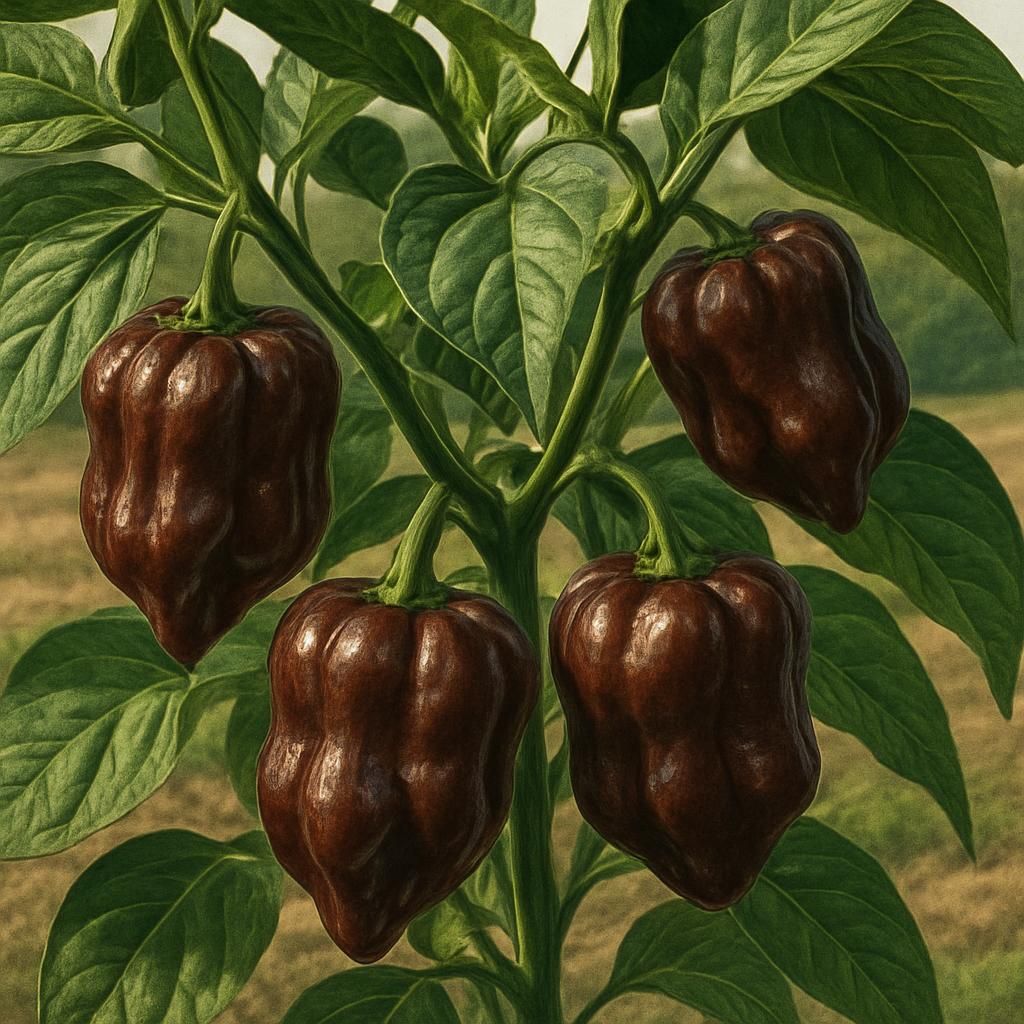
Introduction to Scotch Bonnet Chocolate
Scotch Bonnet Chocolate is a distinctive cultivar of the Chili Pepper species Capsicum chinense, originating from the Caribbean islands. Its pods ripen from green to a deep, glossy chocolate-brown and deliver a complex flavor profile of tropical fruit, smoke, and floral notes behind a searing heat level. Commercial and home growers prize this variety for both fresh market sales and value-added hot sauce production because of its unique color and concentrated capsaicin content.
The plant forms a compact, bushy shrub reaching 60–90 cm in height with dark green, slightly wrinkled leaves and prolific branching. Under optimal tropical conditions it can produce 1.5–2.5 kg of fresh pods per plant over a 10–12 week harvest window. Because of its Caribbean genetics, Scotch Bonnet Chocolate performs best in consistently warm, humid environments and is sensitive to temperatures below 15 °C.
Botanical Profile of Scotch Bonnet Chocolate
Scotch Bonnet Chocolate belongs to the nightshade family Solanaceae. The flowers are small, creamy-white with five petals and produce self-pollinating fruit. Mature pods are 3–5 cm wide, lantern-shaped with distinctive ridges and a blunt, bonnet-like apex. Inside, 20–40 cream-colored seeds are embedded in placental tissue rich in capsaicinoids. The cultivar’s anthocyanin and chlorophyll breakdown during ripening creates the signature chocolate hue.
Compared with the classic red Scotch Bonnet, the Chocolate variant often shows slightly thicker flesh and a marginally higher average heat level. Like other C. chinense types, it exhibits a long maturation period of 90–110 days from transplant to first ripe fruit, making season length a critical planning factor.
Soil, pH, and Climate Requirements for Scotch Bonnet Chocolate
Scotch Bonnet Chocolate demands well-drained, fertile soil with high organic matter. Heavy clay or waterlogged conditions quickly lead to root rot. The following table summarizes ideal growing parameters:
| Parameter | Ideal Range | Notes |
|---|---|---|
| Soil Type | Sandy loam to loam | 2–4 % organic matter; raised beds recommended |
| pH | 6.0–6.8 | Lime if below 5.8; avoid alkaline soils |
| Temperature (Day) | 24–32 °C | Optimal fruit set above 21 °C |
| Temperature (Night) | 18–22 °C | Chilling injury below 15 °C |
| Relative Humidity | 60–80 % | Good airflow prevents fungal issues |
| Annual Rainfall | 1000–1500 mm | Supplemental irrigation in dry spells |
| Sunlight | Full sun, 8+ hours | Afternoon shade in extreme heat (>35 °C) |
| Frost Tolerance | None | Protect or grow under cover below 10 °C |
Step-by-Step Planting & Propagation
- Start seeds indoors 8–10 weeks before the last expected frost. Sow 6 mm deep in sterile seed-starting mix at 26–28 °C; germination occurs in 7–14 days.
- Provide 14–16 hours of light daily; thin to one seedling per cell when the first true leaves appear.
- Harden off seedlings for 7–10 days when nighttime temperatures remain above 15 °C.
- Transplant into prepared beds or 20–30 L containers once soil temperature reaches 18 °C. Space plants 45–60 cm apart in rows 75–90 cm apart.
- Install drip irrigation and 5–8 cm of organic mulch immediately after transplanting to conserve moisture and suppress weeds.
Care & Maintenance regimes for Scotch Bonnet Chocolate
Consistent moisture and balanced nutrition are essential for high yields and pod quality. The table below outlines a professional weekly schedule:
| Growth Stage | Watering Schedule | Fertilizer Schedule | Pruning Schedule |
|---|---|---|---|
| Seedling (0–4 wks) | Keep evenly moist; 50–75 ml per plant daily | Weekly ¼-strength fish emulsion (NPK 2-3-1) | Pinch growing tip at 4th true leaf |
| Vegetative (4–8 wks) | 2–3 L per plant every 2–3 days | Bi-weekly 10-5-10 at 5 g/L; foliar Ca/Mg | Remove lower leaves touching soil |
| Flowering (8–12 wks) | Maintain 60 % field capacity; avoid wetting flowers | Switch to 5-10-10; apply every 10 days | Light tipping of laterals for bushiness |
| Fruiting (12+ wks) | Deep watering 3–4 L every 3 days | Side-dress with aged compost + 2-4-8 every 3 wks | Remove diseased or crossing branches weekly |
Monitor leaf color weekly; yellowing between veins indicates magnesium deficiency—apply Epsom salts at 10 g/L as a foliar spray.
Pests, Diseases & Organic Management
Major threats include aphids, broad mites, pepper weevil, phytophthora, and powdery mildew. Implement an integrated program:
- Scout twice weekly; release lady beetles and lacewings at first aphid detection.
- Apply neem oil (0.5 %) or insecticidal soap every 7–10 days during humid periods.
- Use yellow sticky traps for whiteflies and thrips.
- Rotate beds every 3–4 years and solarize soil between crops to reduce root-knot nematodes.
- Maintain 30 cm spacing and prune lower foliage for airflow to limit anthracnose.
Harvesting, Curing & Optimal Storage
Harvest pods when they reach full chocolate color and firm texture, typically 95–110 days after transplant. Use clean pruners and harvest in the cool morning to reduce field heat. For fresh market, store at 10–12 °C and 85–90 % RH for up to 14 days. For drying, spread pods in single layers at 35–40 °C with good airflow until brittle (5–7 days). Vacuum-seal dried pods or grind into flakes; store in light-proof containers at 15 °C for 12–18 months without significant capsaicin loss.
Companion Planting for Scotch Bonnet Chocolate
Pair Scotch Bonnet Chocolate with Thai Basil and marigold to repel nematodes and aphids while attracting pollinators. Nasturtium acts as a trap crop for aphids. Avoid planting near fennel or dill which can inhibit growth. Interplant with okra or eggplant for efficient use of vertical space and shared irrigation infrastructure. Clover living mulch between rows fixes nitrogen and suppresses weeds without competing for light.