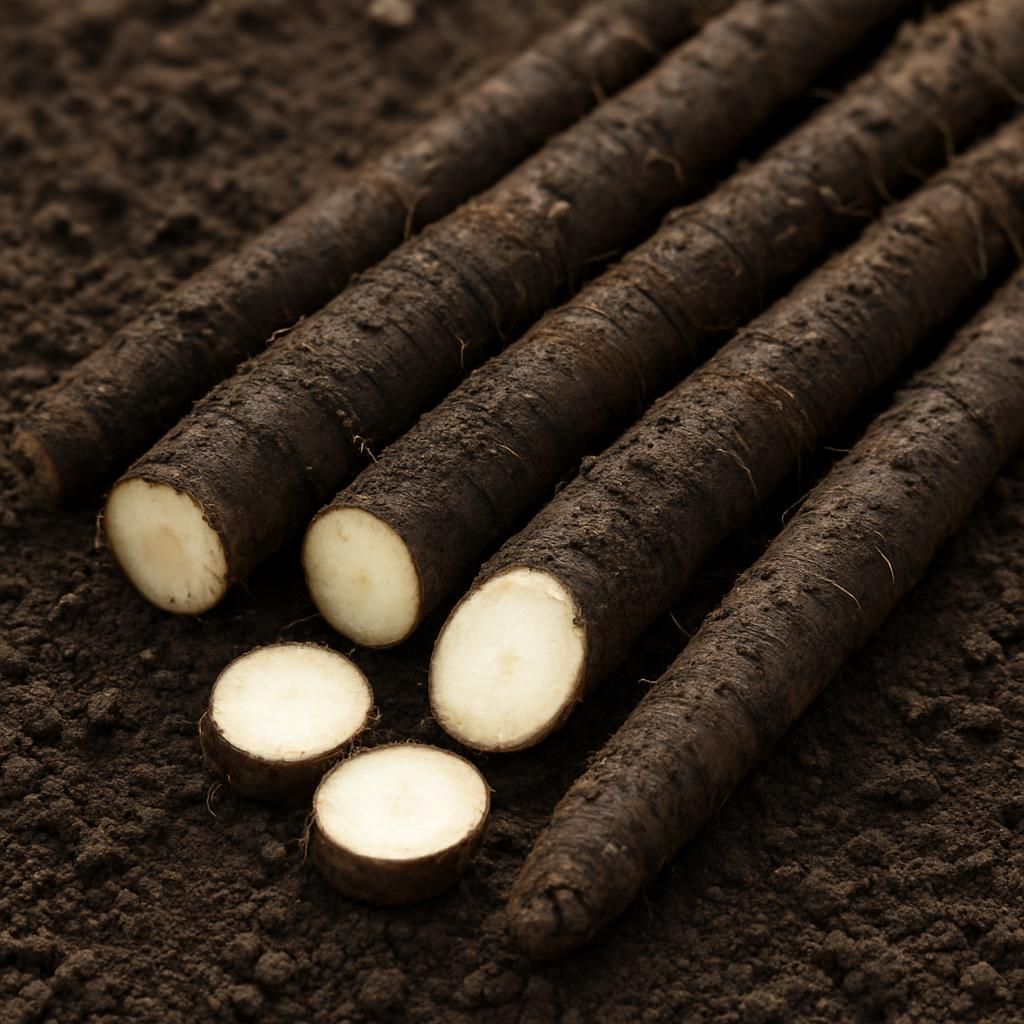
Introduction to Scorzonera (Black Salsify)
Scorzonera (Scorzonera hispanica), also called black salsify or Spanish salsify, is a biennial root crop belonging to the Asteraceae family. Native to southern Europe and parts of Asia, it has been cultivated since the 16th century for both culinary and medicinal uses. The plant produces long, slender taproots with dark, corky skins that conceal creamy white flesh with a subtle flavor often compared to oysters or artichokes.
Unlike its relative Tragopogon porrifolius (white salsify), scorzonera roots maintain quality during long-term winter storage and are less prone to becoming woody. The crop is gaining renewed interest among professional growers and home gardeners seeking cold-hardy, low-maintenance vegetables with high market value. Its deep roots also help improve soil structure in compacted beds.
Botanical Profile of Scorzonera (Black Salsify)
Scorzonera hispanica forms a rosette of long, narrow, lanceolate leaves that emerge from a central crown. The leaves are smooth or slightly hairy and can reach 30–50 cm in length. In the second year, the plant sends up a sturdy flowering stalk 60–120 cm tall bearing bright yellow, dandelion-like composite flowers.
The edible portion is the taproot, which grows straight and cylindrical, typically 20–35 cm long and 2–4 cm in diameter at maturity. The skin is dark brown to black and covered in fine lateral roots, while the interior is ivory-white and exudes a milky latex when cut. The root contains high levels of inulin, a prebiotic fiber, along with potassium, calcium, and iron.
Soil, pH, and Climate Requirements for Scorzonera (Black Salsify)
Scorzonera performs best in deep, loose, stone-free loam soils that allow unrestricted taproot development. Heavy clays or shallow soils lead to forked or stunted roots. The crop prefers cool temperatures and will bolt or produce poor-quality roots if exposed to prolonged heat.
| Parameter | Ideal Range | Notes |
|---|---|---|
| Soil Type | Deep sandy loam to loam | Avoid compacted or stony soils |
| Soil pH | 6.0–7.5 | Slightly acidic to neutral; liming if below 6.0 |
| Soil Temperature | 10–18 °C (50–65 °F) | Optimal germination and root growth |
| Air Temperature | 15–22 °C daytime | Tolerates light frost; avoid >28 °C |
| Spacing | 10–15 cm between plants | Rows 30–45 cm apart |
| Planting Depth | 1–2 cm | Sow directly; thin to final spacing |
| Days to Maturity | 120–150 days | Harvest after first frost for best flavor |
Step-by-Step Planting & Propagation
Scorzonera is almost always grown from seed sown directly in the field or garden. Begin by preparing the bed in early spring once soil temperatures reach 10 °C. Remove all stones and break up any compaction to a depth of at least 30 cm.
Sow seeds in rows 30–45 cm apart, placing seeds 1–2 cm deep and 5 cm apart. Keep the seedbed evenly moist until germination, which occurs in 10–21 days. Once seedlings reach 5–7 cm, thin to 10–15 cm between plants to allow root expansion.
For succession planting in mild climates, sow a second crop in late summer for fall and winter harvest. In colder regions, a single early-spring sowing is sufficient. Avoid transplanting, as root disturbance causes forking.
Care & Maintenance regimes for Scorzonera (Black Salsify)
Consistent moisture and weed suppression are critical. Mulch with 5–8 cm of organic material after thinning to retain soil moisture and suppress weeds. Avoid high-nitrogen fertilizers, which promote leafy growth at the expense of root quality.
| Activity | Schedule | Details |
|---|---|---|
| Watering | Weekly 2.5–3.5 cm | Maintain even moisture; reduce in late fall |
| Fertilizer | Pre-plant: 5-10-10 at 500 kg/ha | Side-dress with potassium if leaves pale |
| Weeding | Every 2–3 weeks until canopy closes | Hand-weed or shallow hoe to protect roots |
| Mulching | Immediately after thinning | 5–8 cm straw or leaf mold |
| Pruning | Remove flower stalks in year 1 | Prevents energy diversion from roots |
Pests, Diseases & Organic Management
Scorzonera is relatively pest-resistant but can be affected by Aphids, Slugs and snails, and Wireworms. Monitor young plants and use floating row covers or diatomaceous earth as needed. Root-knot nematodes may become problematic in sandy soils; rotate with Onion or Garlic to break cycles.
Common diseases include Powdery mildew and Alternaria leaf spot. Ensure good air circulation and avoid overhead irrigation. Remove and destroy infected foliage. In severe cases, apply approved organic fungicides such as potassium bicarbonate.
Harvesting, Curing & Optimal Storage
Harvest scorzonera roots after the first hard frost when flavor has sweetened. Use a digging fork to loosen soil beside the row, then lift roots carefully to avoid breakage. Trim tops to 2 cm and brush off excess soil.
For storage, pack roots in moist sand or sawdust in a cool (0–4 °C), dark cellar. Properly stored roots remain firm for 4–6 months. Smaller roots can be left in the ground under mulch for winter harvest in mild climates.
Companion Planting for Scorzonera (Black Salsify)
Scorzonera pairs well with Carrot, Parsley, and Lettuce because these crops share similar soil and temperature preferences without competing for space. Aromatic herbs such as Thyme and Rosemary help deter Aphids.
Avoid planting near Potato or Tomato, as shared pests and diseases can spread. Interplanting with Marigold provides additional pest suppression through root exudates. For more ideas on beneficial pairings, see Summer Companion Planting: 10 Organic Pairings to Boost Small Farm Resilience.