Introduction to Blackleg
Blackleg (Brassica napus), commonly known as rapeseed or canola in its low-erucic acid form, stands as one of the world's most important oilseed crops, cultivated across millions of hectares globally. Native to the Mediterranean region but now thriving in temperate zones worldwide, blackleg delivers high oil content (40-45%) from its seeds, making it a staple for cooking oil, biodiesel, and animal feed. This deep-dive growing guide equips professional farmers and agronomists with evidence-based strategies to achieve optimal yields of 2-4 tons per hectare under ideal conditions.
Renowned for its cold tolerance and rapid growth cycle (90-120 days), blackleg fits seamlessly into crop rotations with cereals like wheat or barley, enhancing soil nitrogen levels through its brassica root exudates. However, success hinges on precise management of soil-borne pathogens, nutrient balance, and pest pressures. Whether you're scaling up for commercial production or diversifying a small farm, mastering blackleg cultivation promises robust returns amid rising demand for sustainable oils. For more on fall planting synergies, check this Fall Companion Planting Guide: Boost Yields and Soil Health for Small Farms and Gardens.
Botanical Profile of Blackleg
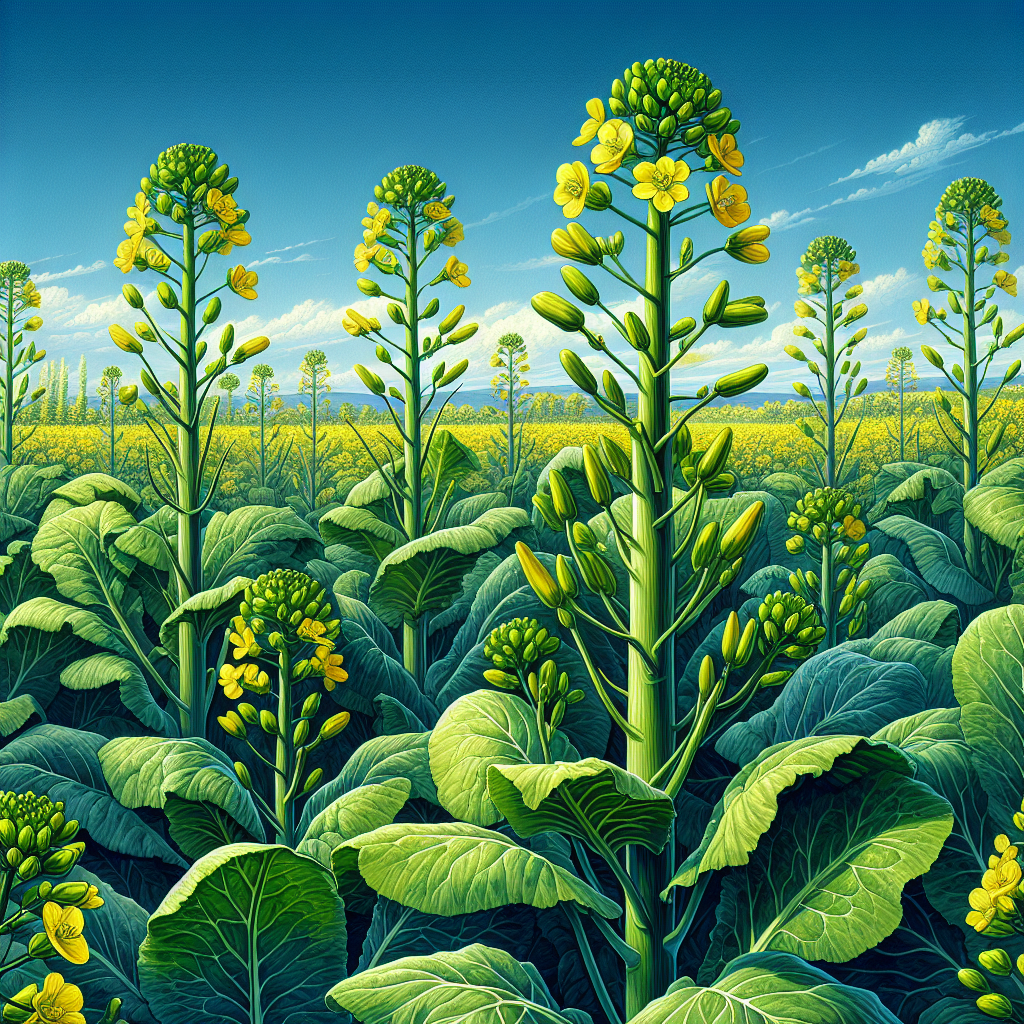
Blackleg belongs to the Brassicaceae family, sharing lineage with mustard, cabbage, and turnips. It is an annual herbaceous plant growing 1-2 meters tall, with a sturdy taproot system penetrating up to 1.5 meters deep, ideal for breaking up compacted soils. Stems are hairless, branching profusely in the upper canopy, supporting vibrant yellow flowers in dense racemes that bloom sequentially from spring to early summer.
Leaves are deeply lobed and glaucous (waxy blue-green), arranged alternately, with the lower rosette leaves forming a basal cluster. Seeds develop in long, cylindrical siliques (pods) containing 20-30 small, black or brown seeds each, averaging 3-5 mm in diameter. Varieties like 'Tower' or 'Hyola' are bred for disease resistance and high oil content. Botanically, blackleg is a self-pollinating diploid (2n=38), though cross-pollination by bees boosts hybrid vigor in seed production fields. Its C3 photosynthetic pathway excels in cool, moist conditions, with peak biomass accumulation during vegetative growth (BBCH 30-39 stages).
Genetically, blackleg exhibits high heritability for traits like yield (h²=0.7-0.9) and blackleg resistance (h²=0.6), enabling rapid breeding advances. Flowering is indeterminate, allowing extended harvest windows, but photoperiod sensitivity in some cultivars requires latitude-specific selections. Understanding this profile is crucial for timing interventions and selecting cultivars matched to your agroecological zone.
Soil, pH, and Climate Requirements for Blackleg
Blackleg thrives in well-drained, fertile loams with 2-4% organic matter, tolerating a wide range but excelling in silt loams (sand:silt:clay ratio ~40:40:20). Optimal pH is 6.0-7.5; below 5.5, aluminum toxicity stunts roots, while above 8.0, molybdenum deficiency impairs nitrogen fixation. Conduct soil tests targeting 25-40 ppm P, 100-150 ppm K, and 15-25 ppm S—sulfur is non-negotiable for glucosinolate synthesis and oil quality.
Climate-wise, blackleg demands 2,500-3,500 growing degree days (base 5°C), with vernalization at 0-10°C for 4-6 weeks enhancing bolting uniformity in winter types. It withstands -10°C as seedlings and -25°C as established plants, but prolonged frost (>7 days below -5°C) risks winterkill. Rainfall of 400-600 mm suffices, with critical wet periods during flowering (BBCH 50-69) to avoid pod abortion. Drought tolerance is moderate (via deep roots), but irrigation (20-30 mm/week) during pod fill boosts yields 20-30%.
Avoid waterlogged soils prone to Phytophthora or compacted fields reducing tillering. In rotations, follow cereals or legumes, never preceding brassicas to break disease cycles. Mulch with straw post-harvest to build soil organic matter, targeting 1-2% annual gains for sustained productivity.
Step-by-Step Planting & Propagation
Seed Selection & Preparation: Choose certified, clubroot-resistant hybrids (e.g., 'DK Cabbage') with >85% germination. Treat seeds with fungicide (e.g., fludioxonil) and insecticide (e.g., neonicotinoids where permitted) at 10-20 g/100 kg. Aim for 5-7 kg/ha seeding rate for 300-400 plants/m².
Tillage & Bed Prep: Direct-seed into no-till or minimum-till fields post-cereal harvest (mid-August for winter types). Incorporate 30-50 kg/ha N pre-plant, plus 50 kg/ha P and 40 kg/ha S. Create firm seedbeds with 1-2 cm clods max.
Planting: Drill at 1-2 cm depth, 15-20 cm row spacing, into 10-15°C soil. Use precision planters for uniform emergence. Roll post-seeding to enhance seed-soil contact.
Early Management: Apply pre-emergent herbicide (e.g., trifluralin) within 3 days. Scout for flea beetles; threshold 25% defoliation triggers control.
Propagation is seed-based; transplants are rare due to root disturbance sensitivity. For small-scale, winter sowing in modules mimics field conditions. Expect 80-90% establishment with proper calibration.
Care & Maintenance regimes for Blackleg
Nutrition: Split N into 30% pre-plant, 40% at 4-6 leaves (BBCH 14-16), 30% at stem elongation (BBCH 30-32)—total 120-180 kg/ha. Monitor with tissue tests (4-5% N at rosette). Foliar B (0.2 kg/ha) at bud stage prevents hollow stem.
Irrigation: 25 mm/week during peak demand (flowering to pod fill); deficit irrigation post-flowering saves water without yield loss.
Weeding: Post-emergent graminicides (e.g., quizalofop) at 2-4 leaves; mechanical cultivation between rows.
Growth Monitoring: Use NDVI drones for N status; thin to 30-40 plants/m² if overcrowded. Desiccation (e.g., glyphosate) 7-10 days pre-harvest swathes evenly.
Regimes adapt to winter (sow Aug-Sep, harvest Jul) vs. spring types (sow Mar-Apr, harvest Jul-Aug), with side-dressing based on soil nitrate tests.
Pests, Diseases & Organic Management
Key Pests: Flea beetles (flea-beetles), aphids (aphids), pollen beetles. Organic: Row covers, neem oil, beneficial insects like hoverflies.
Diseases: Blackleg (Leptosphaeria spp.)—namesake fungal canker causing stem lesions and lodging. Manage via resistant varieties, 4-year brassica rotation, stubble removal. Clubroot (Plasmodiophora brassicae), powdery-mildew. Organic: Lime to pH 7.0+, biofumigants like mustard cover crops.
Integrated Approach: Threshold-based scouting, BT for caterpillars, sulfur fungicides. Avoid overhead irrigation to curb Alternaria. Yield losses average 20-50% untreated; IPM cuts to <10%.
Harvesting, Curing & Optimal Storage
Swathe at 30-40% seed moisture (black seeds, 60% green pods) using straight-cut or windrowed combines. Direct harvest viable at 15% moisture if shatter-resistant. Yields peak at 110-130 g/plant.
Dry swathes to 8-10% moisture in windrows or bins (35-40°C air). Clean via air-screen cleaners, store at <8% MC, 10-15°C, 60% RH in ventilated silos—viable 2-3 years. Test for sclerotinia to avoid discounts.
Companion Planting for Blackleg
Pair with clover (clover) or hairy-vetch for N-fixation and erosion control. Avoid brassicas like cabbage. Oats as nurse crop suppress weeds. Nasturtium traps aphids; legumes like peas boost soil N pre-sowing.
Grow Smarter: This growing guide was brought to you by OnlyCrops AI. Optimize your crop planning, succession scheduling, and yield forecasting with our Free Agricultural Tools or see how our app helps growers like you.