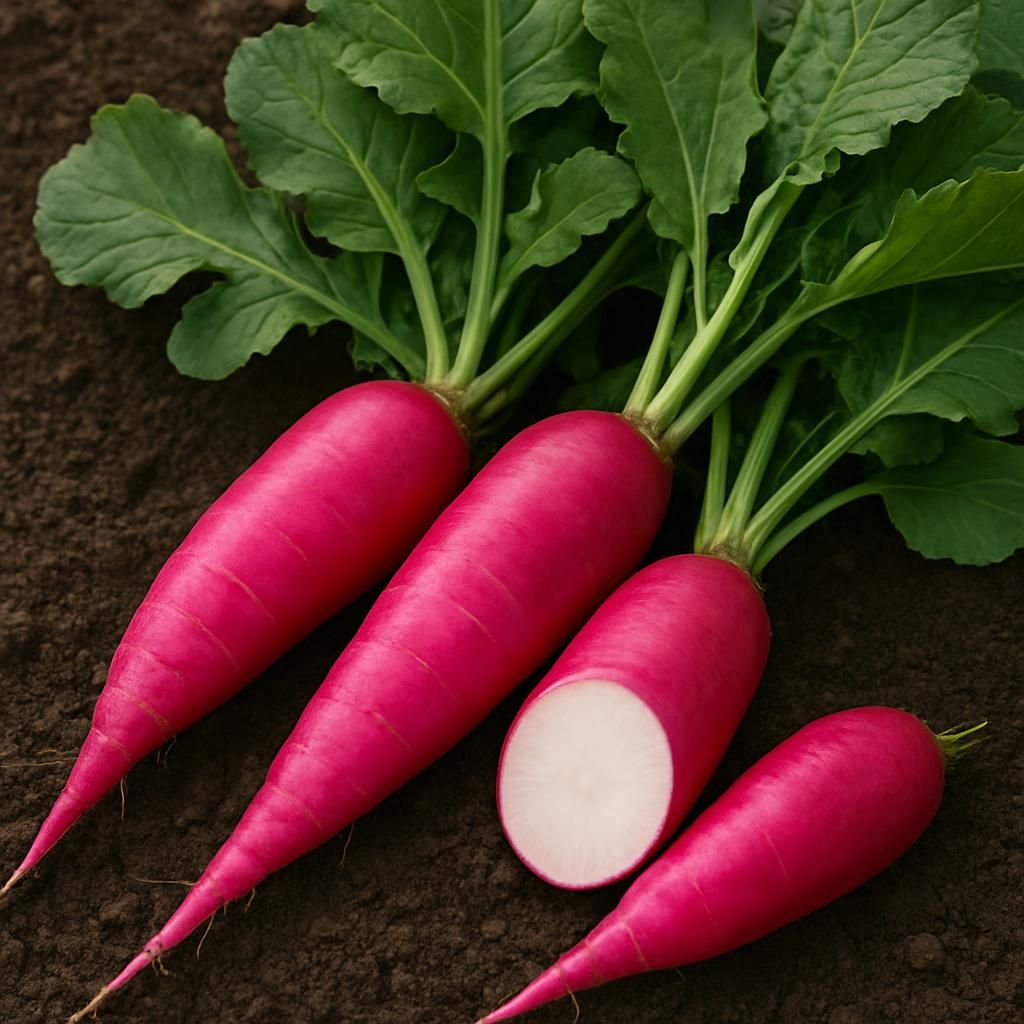
Introduction to Radish (China Rose)
China Rose radish is a winter radish cultivar known for its elongated pink roots, crisp texture, and mild, slightly sweet flavor. Unlike small spring radishes, this variety produces larger, storage-quality roots that remain firm and flavorful for weeks after harvest. It is a cool-season crop that performs best when daytime temperatures stay between 50-65°F (10-18°C). Gardeners and commercial growers value it for its reliability, disease resistance, and ability to fill the gap between summer and winter harvests.
This guide provides detailed, field-tested recommendations for growing China Rose radish successfully in home gardens and small-scale farms. Emphasis is placed on soil health, precise spacing, organic pest control, and post-harvest handling to maximize both yield and quality.
Botanical Profile of Radish (China Rose)
China Rose belongs to the Brassicaceae family and is botanically classified as Raphanus sativus var. longipinnatus 'China Rose'. The plant produces a long, cylindrical taproot that can reach 6-10 inches (15-25 cm) in length and 1.5-2 inches (4-5 cm) in diameter. The exterior skin is vibrant pink to rose-red, while the interior flesh is white, firm, and mildly pungent.
The foliage consists of deeply lobed, dark-green leaves that form a rosette above the soil. Flowers are small, four-petaled, and typically white to pale lavender. Like other radishes, China Rose is a biennial but is grown as an annual for its edible root. It stores carbohydrates in the taproot, allowing it to withstand light frosts and continue growing in cool weather.
Soil, pH, and Climate Requirements for Radish (China Rose)
China Rose radish requires well-drained, fertile soil with good structure to allow straight root development. Heavy clay soils should be amended with compost or aged manure to improve aeration and prevent forking. The crop performs optimally in cool climates and can tolerate light frost but suffers in heat, which causes pithiness and bolting.
| Parameter | Ideal Range | Notes |
|---|---|---|
| Soil Type | Loamy, well-drained sandy loam | Avoid compacted or waterlogged soils |
| Soil pH | 6.0 - 7.0 | Slightly acidic to neutral; test annually |
| Soil Temperature | 45-65°F (7-18°C) | Optimal for germination and root growth |
| Air Temperature | 50-65°F (10-18°C) daytime | Bolting occurs above 75°F (24°C) |
| Spacing | 2-3 inches (5-8 cm) between plants | Rows 12-18 inches (30-45 cm) apart |
| Sunlight | Full sun (6+ hours) | Tolerates light afternoon shade in warm areas |
| Organic Matter | 3-5% | Incorporate well-rotted compost |
Step-by-Step Planting & Propagation
Site Selection and Preparation: Choose a location with full sun and loose, fertile soil. Remove rocks, weeds, and debris. Work the soil to a depth of 10-12 inches (25-30 cm) and incorporate 2-3 inches (5-8 cm) of compost.
Soil Testing and Amendment: Test soil pH and nutrient levels. If pH is below 6.0, apply agricultural lime. For low fertility, add a balanced organic fertilizer (5-5-5) at 2 lbs per 100 sq ft (1 kg per 9 m²).
Seed Sowing: Direct sow seeds ½ inch (1.3 cm) deep and 1 inch (2.5 cm) apart. Thin seedlings to 2-3 inches (5-8 cm) once they reach 2 inches (5 cm) tall. Sow every 2-3 weeks for continuous harvest.
Timing: Plant in early spring 2-3 weeks before the last frost or in late summer for fall harvest. In mild climates, winter sowing is possible.
Germination: Expect germination in 4-7 days at soil temperatures of 45-65°F (7-18°C). Keep soil evenly moist during this period.
Care & Maintenance regimes for Radish (China Rose)
Consistent moisture and balanced nutrition are critical for tender, non-pithy roots. Mulch with straw or shredded leaves to retain moisture and suppress weeds. Avoid over-fertilization with nitrogen, which promotes leafy growth at the expense of roots.
| Task | Schedule | Details |
|---|---|---|
| Watering | 1 inch (2.5 cm) per week | Maintain even moisture; water deeply 2-3x weekly |
| Fertilizer | At planting and 3 weeks later | Side-dress with compost tea or fish emulsion (2-3-1) |
| Weeding | Weekly until canopy closes | Hand-pull or shallow hoe to avoid root damage |
| Mulching | Immediately after thinning | 2-inch (5 cm) layer of organic mulch |
| Thinning | Once at 2-inch (5 cm) height | Maintain 2-3 inch (5-8 cm) spacing |
| Pest Scouting | Twice weekly | Check leaf undersides for aphids and flea beetles |
Pests, Diseases & Organic Management
Common pests include flea beetles, aphids, and root-knot nematodes. Flea beetles create small holes in leaves; control with floating row covers or neem oil. Aphids cluster on new growth and can be managed with insecticidal soap or beneficial insects such as ladybugs.
Diseases such as clubroot, Alternaria leaf spot, and downy mildew may occur in wet, poorly drained soils. Practice crop rotation with non-brassica crops every 3-4 years. Improve drainage and avoid overhead irrigation to reduce foliar disease pressure. Remove and destroy infected plant material at season end.
Harvesting, Curing & Optimal Storage
China Rose radishes are ready for harvest 55-65 days after sowing when roots reach 6-8 inches (15-20 cm). Gently loosen soil with a fork and pull roots by the tops. Avoid leaving mature roots in the ground too long, as they can become woody.
Curing is minimal; simply brush off soil without washing. Store roots in perforated plastic bags in the refrigerator at 32-40°F (0-4°C) with 90-95% humidity for up to 3-4 weeks. For longer storage, pack in damp sand in a cool root cellar (35-40°F / 2-4°C).
Companion Planting for Radish (China Rose)
China Rose radish benefits from strategic companions that deter pests and improve soil. Plant with lettuce, spinach, and peas to maximize space and provide shade during warmer periods. Nasturtium and marigold repel aphids and flea beetles.
Avoid planting near other brassicas such as cabbage or broccoli to reduce clubroot risk. Onion and garlic can mask radish scent from pests. After harvest, follow with nitrogen-fixing cover crops like clover to restore soil fertility.