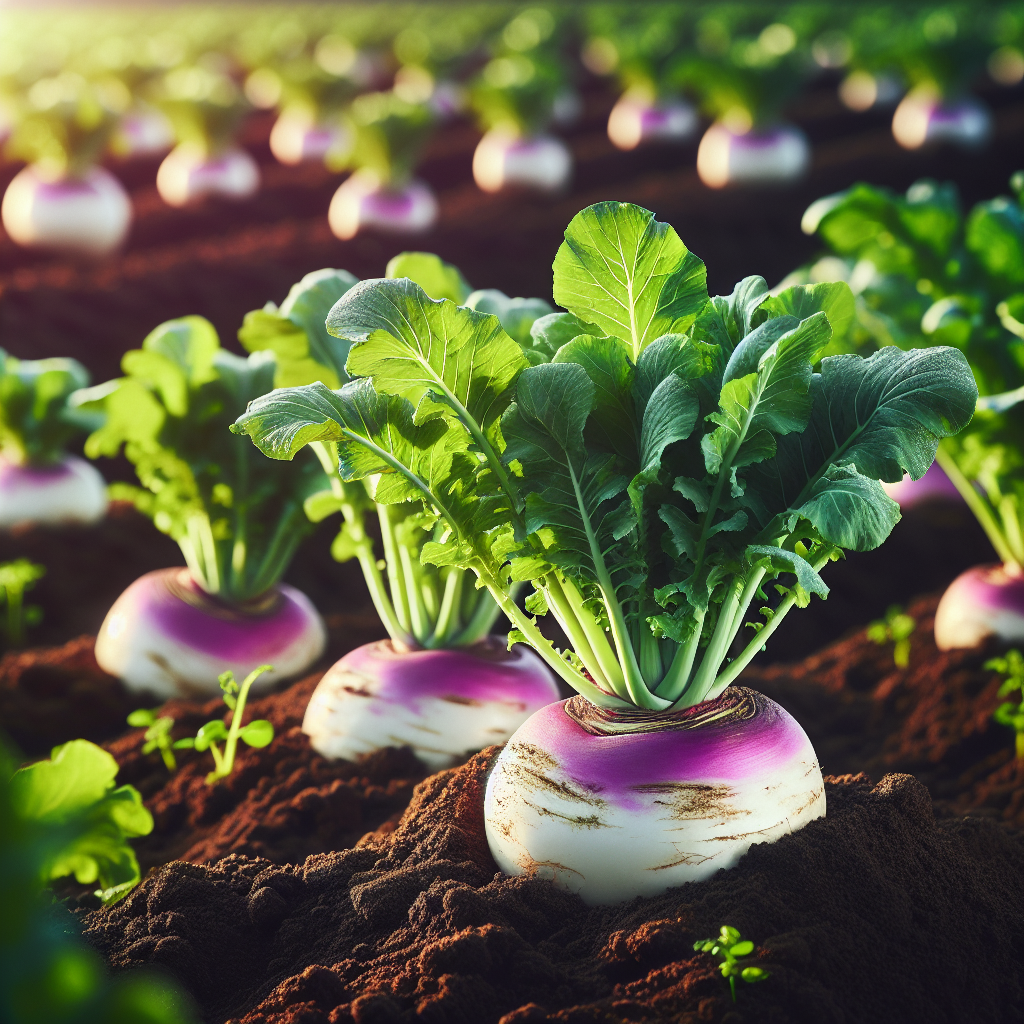
Introduction to Purple Top White Globe Turnip
A standard-bearer among old-fashioned turnip cultivars, this heirloom-type variety has remained popular because it is dependable, quick, and dual-purpose: both the swollen storage root and the leafy tops are edible. The root is typically globe-shaped to slightly flattened, white below the soil line, and develops a purple blush or cap where sunlight reaches the crown. That coloration is not merely ornamental; it is one of the signatures that helps growers identify proper shoulder development and market maturity.
This variety is especially valued for autumn production, when cool nights improve texture and sweetness. In spring, it can also produce attractive roots, but warmer conditions increase the risk of pithiness, fibrous texture, and premature bolting. Compared with some specialty turnips bred purely for greens or for tiny salad roots, Purple Top White Globe is a practical field and garden variety suited to fresh eating, roasting, mashing, stews, and livestock forage in some systems.
Historically, turnips have been central to temperate agriculture for centuries as both human food and animal feed. Purple Top White Globe became widely adopted because it combined uniformity, visible shoulder color, solid yields, and adaptability across many soil types. For growers seeking a classic Turnip guide reference point, this cultivar represents the familiar benchmark by which many other table turnips are judged.
Botanical Profile of Purple Top White Globe Turnip
This crop belongs to the mustard family, Brassicaceae, a large family that includes cabbage, broccoli, radish, and canola. Botanically, the edible “root” is actually a swollen storage organ formed from both hypocotyl and upper root tissue. In Purple Top White Globe, the upper exposed section develops anthocyanin pigmentation, creating the characteristic purple top, while the subterranean section remains creamy white.
Plants form a basal rosette of leaves that may be medium green, lightly hairy, and somewhat lobed depending on growing conditions. The greens are edible when young and tender, though older leaves can become coarse, especially under heat or moisture stress. If left too long or exposed to strong vernalization followed by warming temperatures, the plant enters its reproductive phase and sends up a flowering stalk. Once bolting begins, root quality drops rapidly.
Days to maturity are commonly around 50 to 60 days for roots, although baby turnips may be pulled earlier at 30 to 40 days. Greens can be harvested selectively before full root maturity if care is taken not to strip too much foliage. Typical marketable root diameter ranges from 2 to 4 inches, though oversizing is not desirable; very large roots often become more pungent, woody, or internally corky.
This variety is open-pollinated in many seed lines, which means saved seed can remain reasonably true if isolated from other flowering Brassica rapa types. However, because turnips cross readily with related crops and wild relatives, seed saving requires significant isolation distances or caging with managed pollinators.
Soil, pH, and Climate Requirements for Purple Top White Globe Turnip
The best roots come from loose, friable, stone-free soil with moderate to high fertility and even moisture. Sandy loam to silt loam is ideal because it allows rapid enlargement without deformation. Heavy clay can produce usable turnips, but only if the soil has been improved with organic matter and is not compacted. Clods, gravel, and fresh uncomposted manure commonly lead to forked, misshapen, cracked, or rough roots.
Optimal soil pH falls between 6.0 and 6.8. The crop tolerates slightly more acidic ground than some brassicas, but yields and nutrient uptake are best near neutral. If pH drops below about 5.8, root development may slow, and nutrient issues such as poor calcium availability or micronutrient imbalance become more likely. Liming should be done well ahead of planting, ideally based on a soil test, not guessed at in-season.
A fertile bed should contain enough phosphorus and potassium to support early root initiation and bulking. Nitrogen should be adequate but not excessive. Too much readily available nitrogen, especially from fresh manure or heavy doses of soluble fertilizer, causes lush tops at the expense of root quality and may produce oversized shoulders with smaller lower bulbs. It can also increase susceptibility to some foliar pests.
Cool weather is essential for premium flavor. Germination occurs well from about 45 to 85°F (7 to 29°C), but the sweet spot for growth is approximately 50 to 70°F (10 to 21°C). Once daytime temperatures repeatedly exceed 75°F (24°C), especially with warm nights, roots tend to become stronger in flavor and less tender. Light frost usually improves flavor, while hard freezes can damage exposed shoulders and foliage if plants are unprotected.
For soil moisture, aim to keep the top 4 to 6 inches consistently moist but never saturated. A useful field target is roughly 60 to 80% of field capacity: the soil should hold together when squeezed but should not release free water or feel greasy. If the bed alternates between drought and heavy irrigation, roots may crack, become woody, or develop uneven texture. Overwatered turnips often show yellowing lower leaves, sluggish growth, and a sour, anaerobic smell in the bed; roots may become translucent in patches or prone to rot. Underwatered plants wilt during midday, produce strong-flavored roots, and may stall before bulking.
For site planning and fertility preparation, a broader soil strategy matters as much as direct fertilization. Practical approaches to long-term bed improvement are well summarized in soil health tips.
Step-by-Step Planting & Propagation
This crop is propagated by seed and is almost always direct-sown. Transplanting is possible but not preferred because any root disturbance can cause misshapen bulbs and delayed establishment.
Prepare the bed thoroughly. Remove stones, break up clods, and incorporate well-finished compost at a moderate rate, such as 1 to 2 inches worked into the top 6 to 8 inches. Avoid fresh manure within the same season.
Create a fine seedbed. Turnip seed is small, so uniform emergence depends on close seed-to-soil contact and a smooth surface. Raised beds are useful where drainage is imperfect.
Time the sowing for cool conditions. In spring, sow 2 to 4 weeks before the last expected frost once soil is workable. In autumn, sow 6 to 10 weeks before the first hard freeze, depending on your climate and desired root size. Fall sowings are often superior.
Sow shallowly. Place seeds about 1/4 to 1/2 inch deep. Deeper planting in crusting soils can reduce emergence.
Space correctly. Rows can be 12 to 18 inches apart for hand culture, wider if mechanical cultivation is planned. Thin seedlings to 3 to 6 inches apart in the row. Closer spacing produces smaller roots suitable for bunching; wider spacing gives fuller globes.
Keep the seed zone evenly moist. Germination usually takes 3 to 10 days depending on temperature. If the soil surface dries and crusts after sowing, emergence can become patchy.
Thin early. Do not delay thinning until roots begin to crowd one another. Competition at the seedling stage causes elongated tops, poor bulb initiation, and uneven maturity. Thinnings can be eaten as baby greens.
For succession planting, sow every 10 to 14 days during the cool season for a continuous harvest. Commercially, this helps avoid a glut of oversized roots. In home gardens, it improves kitchen quality because young turnips are consistently milder.
Care & Maintenance regimes for Purple Top White Globe Turnip
Once established, the crop requires disciplined but simple management: steady moisture, shallow weed control, and balanced nutrition.
Irrigation should be frequent enough to prevent stress but light enough to avoid waterlogging. Most plantings need about 1 inch of water per week from rain or irrigation in cool weather, and somewhat more in sandy soils or windy conditions. Rather than watering by calendar alone, check the soil 2 to 3 inches deep. If it feels barely damp or begins to crumble into dry granules, irrigate. If it feels sticky, airless, or remains wet for more than a day after watering, reduce frequency or improve drainage.
Mulch can help in garden settings, especially with shredded leaves or clean straw applied lightly after seedlings are established. Keep mulch away from the crown to reduce rot risk and to avoid creating a haven for slugs. In production beds, shallow hoeing is often preferable because young turnips do not compete well with weeds. Weed pressure in the first 3 to 4 weeks is especially damaging because that is when the storage organ is initiating.
Fertilization should favor steady growth, not a burst of leafiness. If the bed was prepared well, additional feeding may be minimal. On low-fertility ground, a light sidedress when seedlings have 2 to 4 true leaves can help. Choose a balanced or slightly potassium-forward amendment rather than a heavy nitrogen source. Pale leaves with slow growth may indicate nitrogen deficiency, but dark lush foliage with poor bulbing usually signals excess nitrogen.
Leaf harvest should be selective if roots are also desired. Remove only 1 or 2 outer leaves per plant at a time. Aggressive stripping reduces photosynthesis and slows bulb enlargement. If the main goal is roots for storage, avoid harvesting greens at all.
Temperature management matters. Row cover can improve establishment, exclude insects, and buffer light frosts. In spring, remove or vent covers during unexpected warm spells, as excess heat can push the crop toward stress and stronger flavor. Autumn plantings usually benefit the most from protected growth.
Signs of excellent crop progress include a compact, healthy leaf rosette, shoulders beginning to color purple as they expand, and roots that size uniformly without cracks. Warning signs include split roots, rough skin, strong sulfurous smell, excessive top growth, or a sudden central stalk indicating bolting.
Pests, Diseases & Organic Management
Like many brassicas, this variety attracts a predictable set of pests. The most serious early threat is flea beetles, which create many tiny shot holes in cotyledons and young leaves. Severe feeding can stunt seedlings before roots even begin to form. Floating row covers applied immediately after sowing or at emergence are among the most effective organic protections, provided edges are sealed well.
root maggots, especially cabbage maggot larvae, can tunnel into the developing root and cause collapse, yellowing, or foul-smelling decay. Adult flies lay eggs at the soil line, so exclusion with row cover is again highly effective. Cardboard or felt collars around stems can also reduce egg laying in small plantings.
aphids may cluster on the undersides of leaves during cool-to-mild weather, especially when nitrogen is abundant. Heavy infestations distort foliage and leave sticky honeydew. Strong water sprays, encouraging beneficial insects, and avoiding overfertilization are usually sufficient. Mustard-family trap crops can sometimes help, but they must be managed carefully to avoid increasing pest reservoirs.
slugs may damage seedlings and scar root shoulders in damp mulch-heavy beds. Reduce surface debris, irrigate in the morning, and use iron phosphate baits if needed.
Disease pressure rises most in poorly rotated or waterlogged soils. clubroot is among the most notorious turnip problems, causing swollen, distorted roots and severe stunting. It thrives in acidic, infected soils and can persist for years. Prevention is far better than cure: maintain pH near the recommended range, improve drainage, and avoid planting brassicas repeatedly in the same bed.
downy mildew and white rust can affect foliage in cool, wet, crowded plantings. Good spacing, morning irrigation, and airflow reduce severity. bacterial soft rot may follow insect injury or saturated conditions, producing wet, foul breakdown of the root tissue.
A strong organic management program includes 3- to 4-year rotation away from brassicas, clean crop residue removal, sanitation of tools when working diseased beds, and vigorous seedling growth supported by balanced fertility. Healthy, quickly growing plants tolerate minor feeding much better than stressed ones.
Harvesting, Curing & Optimal Storage
Harvest timing determines eating quality more than almost any other factor. The best roots are typically lifted when 2 to 4 inches across, before they become oversized and fibrous. Small roots are usually sweeter and more tender, with thinner skin and less pungency. Waiting for maximum size is rarely rewarded in table quality.
Use a digging fork or undercutting tool in compact soils rather than pulling forcefully by the tops, which can snap and damage the crown. Harvest when the soil is slightly moist, not muddy; this reduces skin abrasion and cleaning damage. For bunching, wash gently and cool rapidly. For storage, handle roots dry and minimally.
The greens are highly perishable and should be removed from storage roots unless you are marketing them fresh immediately. Twist or cut tops off, leaving about 1/2 inch of stem. If leaves remain attached, they continue to transpire and draw moisture from the root, shortening shelf life.
Turnips do not require curing in the same sense as onions or winter squash, but they do benefit from brief drying in a shaded, airy place for several hours after harvest so surface moisture evaporates. Do not sun-cure them; sunlight heats roots, toughens skin, and can increase moisture loss.
For best storage, keep roots at 32 to 36°F (0 to 2°C) with very high relative humidity, ideally 90 to 95%. Under these conditions, sound roots may store for 2 to 4 months, sometimes longer if harvested in prime condition. In a root cellar, pack them in damp sand, sawdust, or perforated liners to reduce shriveling. In a refrigerator, perforated plastic bags in the crisper work well.
Inspect stored roots regularly. Remove any that show soft spots, internal browning, mold, or sharp fermented odor. Shriveling indicates humidity is too low; sliminess indicates condensation or decay pressure is too high.
Companion Planting for Purple Top White Globe Turnip
The most useful companions are those that either improve spatial efficiency, deter key pests, or occupy a different root zone without competing too heavily during the short turnip growth cycle. Garlic is often paired nearby because its pungent growth can help confuse some pest patterns in mixed plantings, and it occupies a narrower vertical footprint than sprawling crops. Onion serves a similar function and is especially practical in tightly managed kitchen gardens.
Peas are another strong companion in cool seasons, particularly when trellised on the north side of a bed so they do not shade the turnips excessively. Because peas fix nitrogen indirectly through symbiosis, they can complement mixed cropping systems, though growers should still avoid assuming they will instantly feed adjacent turnips in a single short season. The value is often more architectural and rotational than immediate fertility transfer.
Thyme can be useful at bed edges where permanent herb plantings border annual vegetables. Its aromatic foliage may contribute to a more diverse insect environment and it occupies little space. In small gardens, these combinations also help concentrate maintenance and harvest.
Avoid pairing with large, shading brassicas or heavy feeders that compete for the same shallow soil resources during the first month of growth. Dense plantings of cabbage-family relatives may also increase shared pest pressure from flea beetles, aphids, and root maggots. Successful companion planting with turnips is therefore less about folklore and more about timing, spacing, and pest ecology.