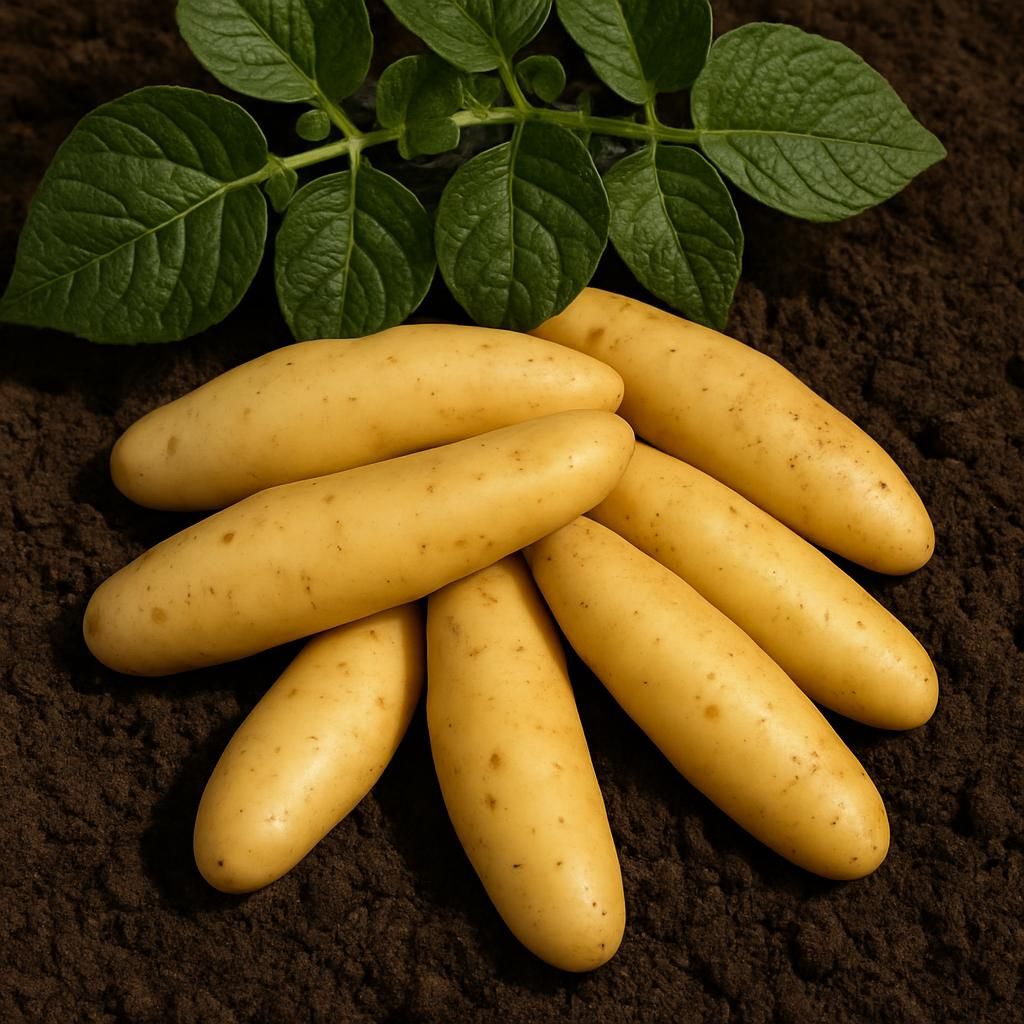
Introduction to Potato (Russian Banana Fingerling)
Russian Banana Fingerling potatoes are a heritage variety originating from Eastern Europe, known for their distinctive banana-shaped tubers, yellow flesh, and exceptional flavor. These fingerlings offer a firm, waxy texture that holds shape during cooking, making them favorites among chefs and home gardeners alike. Their thin skins and high culinary quality have made them a staple in gourmet markets and small-farm production.
This guide delivers professional-grade, practical advice for growing Russian Banana Fingerling potatoes successfully across diverse climates and production scales. Emphasis is placed on soil health, organic pest management, and maximizing yield quality.
Botanical Profile of Potato (Russian Banana Fingerling)
Russian Banana Fingerling belongs to the nightshade family, Solanaceae, and is botanically classified as Solanum tuberosum 'Russian Banana'. The plants produce compact, upright foliage with medium-green leaves and white to pale lavender flowers. Tubers are elongated, finger-like, typically 2–4 inches long, with smooth, thin, light tan skin and dense, creamy yellow flesh.
This variety is indeterminate, producing tubers along the length of underground stolons rather than in a concentrated cluster. It exhibits moderate vigor and generally matures in 90–110 days. The plants demonstrate good resistance to common scab but remain susceptible to late blight.
Soil, pH, and Climate Requirements for Potato (Russian Banana Fingerling)
Russian Banana Fingerling potatoes thrive in well-drained, fertile sandy loam or loam soils with high organic matter. Avoid heavy clay soils that retain excess moisture and promote rot. Raised beds or hilling practices improve drainage and tuber quality.
| Parameter | Ideal Range/Value | Notes |
|---|---|---|
| Soil Type | Sandy loam to loam | Well-drained; avoid compacted or clay soils |
| Soil pH | 5.8 – 6.5 | Slightly acidic; prevents common scab |
| Organic Matter | 3–5% | Incorporate compost or aged manure |
| Temperature Range | 60–70°F (15–21°C) daytime | Cool-season crop; frost sensitive |
| Minimum Soil Temp | 45°F (7°C) | For planting; tubers will not sprout below |
| Frost Tolerance | Light frost only | Protect young plants from hard freezes |
| Sunlight | Full sun (6–8+ hours) | Essential for tuber development |
Step-by-Step Planting & Propagation
- Source certified seed potatoes of Russian Banana Fingerling to ensure disease-free stock.
- Cut seed tubers into pieces with at least one or two eyes, allowing cut surfaces to cure for 1–2 days.
- Plant when soil temperature reaches 45°F (7°C) and danger of hard frost has passed.
- Space seed pieces 8–12 inches apart in rows 30–36 inches apart, planting 4–6 inches deep.
- As plants emerge, begin hilling soil around stems to encourage tuber formation and protect from light exposure.
- Maintain consistent moisture during tuber initiation and bulking stages.
Care & Maintenance regimes for Potato (Russian Banana Fingerling)
Proper irrigation, fertility management, and canopy care are critical for high-quality fingerling production. Avoid over-fertilization with nitrogen, which promotes foliage at the expense of tubers.
| Growth Stage | Water Schedule | Fertilizer Schedule | Pruning/Maintenance |
|---|---|---|---|
| Planting to Emergence | Keep soil moist but not saturated | Pre-plant: 1–2 lbs N-P-K (10-10-10) per 100 sq ft | Remove weeds; begin light hilling |
| Vegetative Growth | 1–1.5 inches per week | Side-dress with 0.5 lb N at 4–6 weeks | Hill soil 2–3 times; monitor for pests |
| Tuber Bulking | Consistent moisture; avoid fluctuations | Minimal additional N; potassium emphasis | Continue hilling; remove diseased foliage |
| Pre-Harvest | Reduce water 1–2 weeks before harvest | None | Allow vines to senesce naturally |
Pests, Diseases & Organic Management
Russian Banana Fingerling potatoes face several common threats including Colorado potato beetle, aphids, wireworms, early blight, and late blight. Implement integrated pest management combining cultural, biological, and organic controls.
Scout fields weekly. Handpick Colorado potato beetle adults and larvae. Apply Bacillus thuringiensis (Bt) or spinosad for larval control. Use floating row covers early in the season to exclude beetles and aphids. Rotate crops on a 3–4 year cycle and plant disease-free seed to reduce soil-borne pathogens.
For fungal diseases, apply copper-based fungicides preventively during humid periods. Remove and destroy infected foliage promptly. Mulching helps suppress weeds and maintain soil moisture while reducing splash-borne disease spread.
Harvesting, Curing & Optimal Storage
Harvest Russian Banana Fingerling potatoes when vines begin to yellow and die back, typically 90–110 days after planting. Use a garden fork to gently lift tubers, avoiding skin damage. Allow harvested tubers to cure in a shaded, well-ventilated area at 50–60°F (10–15°C) for 1–2 weeks to toughen skins.
Store cured tubers in a cool (38–45°F / 3–7°C), dark, humid environment with good air circulation. Avoid refrigeration below 38°F to prevent sugar accumulation. Properly stored fingerlings maintain quality for 4–6 months. Inspect regularly and remove any sprouting or rotting tubers.
Companion Planting for Potato (Russian Banana Fingerling)
Strategic companions enhance growth, deter pests, and improve soil health. Nasturtium repels aphids and Colorado potato beetles when planted nearby. Marigold and thyme provide additional pest deterrence through aromatic compounds.
Avoid planting near tomato, eggplant, or pepper due to shared disease susceptibility. Clover or other living mulches between rows suppress weeds and fix nitrogen. Garlic and onion interplanted in borders help repel insect pests.
For more on optimizing small-farm resilience through companion planting strategies, see Summer Companion Planting: 10 Organic Pairings to Boost Small Farm Resilience.
Learn more about general potato cultivation practices on Potato (crop).