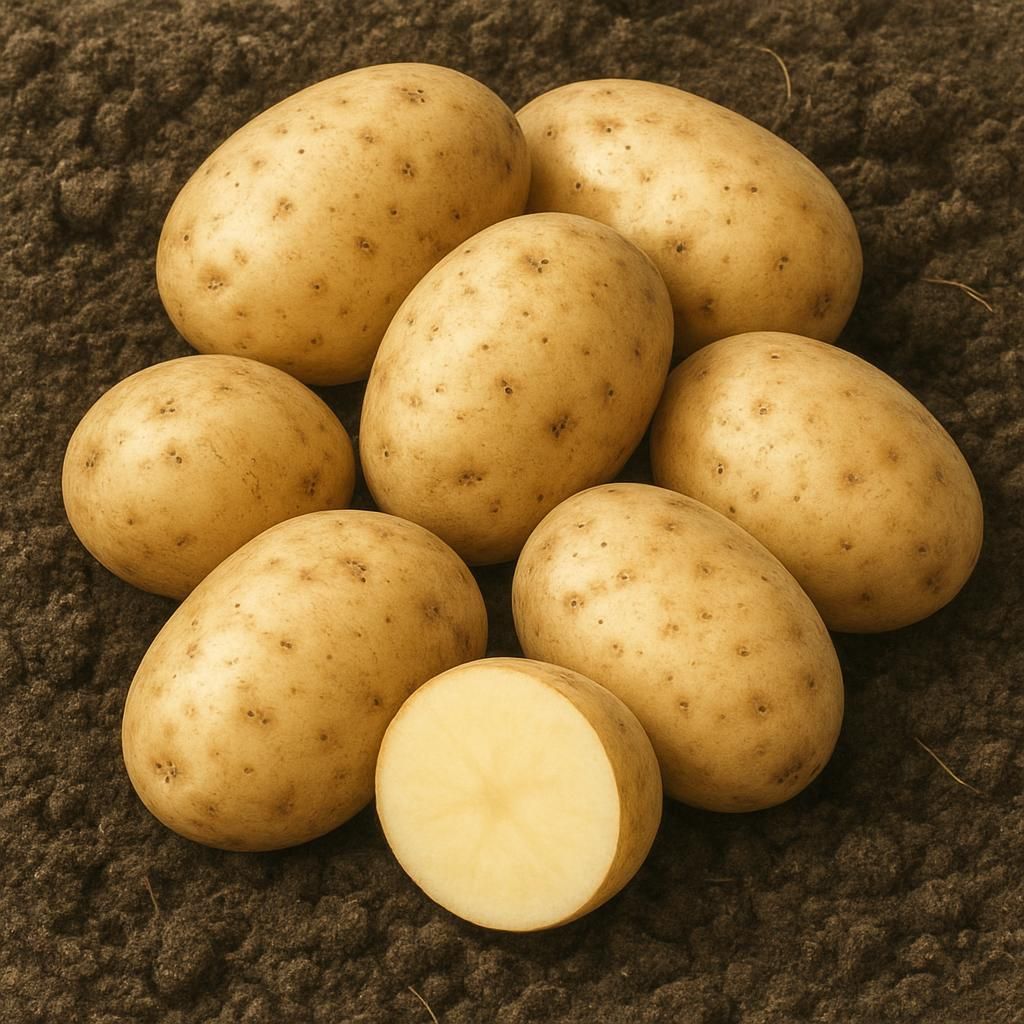
Introduction to Potato (Maris Piper)
Maris Piper is one of the most widely grown maincrop potato varieties in the United Kingdom and temperate regions worldwide. Released in the 1960s by the Plant Breeding Institute in Cambridge, it quickly became the benchmark for chipping, baking, and roasting because of its floury texture and high dry-matter content. Commercial and home growers favor it for consistent yields, strong resistance to Potato virus Y, and tolerance to common scab.
The variety produces oval to long-oval tubers with light-buff skin and creamy-white flesh. Under good management, Maris Piper can deliver 40–50 tonnes per hectare on fertile soils while maintaining excellent skin finish and storage life. Its popularity also stems from reliable performance in both conventional and organic systems.
Botanical Profile of Potato (Maris Piper)
Maris Piper belongs to the nightshade family, Solanaceae. Like all cultivated potatoes, it is a herbaceous perennial grown as an annual for its underground tubers. The plant produces compound leaves with 3–7 leaflets and bears clusters of white to pale-lilac flowers that rarely set true seed. Instead, growers rely on vegetative propagation from seed tubers.
The tubers form at the ends of stolons that arise from the underground stem. Maris Piper typically matures in 120–140 days from planting, placing it in the late-maincrop category. Its tubers have shallow eyes, which reduces waste during peeling and improves suitability for processing.
Soil, pH, and Climate Requirements for Potato (Maris Piper)
Maris Piper performs best on well-drained, fertile loams or sandy loams with good structure. Heavy clays should be avoided unless heavily amended with organic matter. The crop is moderately sensitive to waterlogging, which can trigger Rhizoctonia and bacterial soft rots.
| Parameter | Ideal Range | Notes |
|---|---|---|
| Soil Type | Sandy loam to loam | Good drainage essential |
| Soil pH | 5.5–6.5 | Below 5.2 increases common scab risk |
| Organic Matter | 3–5% | Improves structure and water retention |
| Temperature (Air) | 15–20 °C daytime | Frost sensitive below –2 °C |
| Soil Temperature | 7–10 °C at planting | Warmer soils accelerate emergence |
| Annual Rainfall | 600–900 mm | Supplemental irrigation often required |
| Frost-Free Period | 120–150 days | Matches late-maincrop maturity |
Step-by-Step Planting & Propagation
- Source certified seed tubers free of Potato cyst nematodes and viruses. Choose size 35–45 mm for optimal stem numbers.
- Pre-sprout (chit) tubers 4–6 weeks before planting in a cool, frost-free, bright location (10–12 °C) to produce short, sturdy sprouts.
- Prepare the site by incorporating well-rotted farmyard manure or compost at 30–40 t/ha the previous autumn. Avoid fresh manure that may increase scab.
- Plant when soil temperature reaches 7 °C. In the UK this is typically mid-March to mid-April.
- Space rows 75–90 cm apart with tubers 30–35 cm apart within the row. Plant depth should be 10–12 cm.
- Ridge immediately after planting or use bed systems with 20–25 cm of soil cover to protect developing tubers from light.
Care & Maintenance regimes for Potato (Maris Piper)
Consistent moisture is critical during tuber initiation (around 6–8 weeks after planting) and bulking. Aim for 25 mm of water per week during dry spells. Over-watering late in the season can cause hollow heart and splitting.
| Growth Stage | Water Schedule | Fertilizer Schedule | Pruning / Hilling Schedule |
|---|---|---|---|
| Pre-planting | Ensure field capacity | Incorporate 80 kg N, 120 kg P₂O₅, 200 kg K₂O/ha | Deep cultivate and form ridges |
| Emergence to Tuber Initiation | 20–25 mm/week | Side-dress 40 kg N at 4–6 weeks | Earth up when shoots reach 15–20 cm |
| Tuber Bulking | 25–30 mm/week | Optional 30 kg N if leaf color pale | Second hilling at 30 cm height |
| Late Season (Maturation) | Reduce to 15 mm/week | Cease nitrogen applications | Stop hilling; allow natural senescence |
Monitor leaf color and petiole nitrate levels to fine-tune nitrogen. Potassium is especially important for skin set and storage quality.
Pests, Diseases & Organic Management
Maris Piper shows good resistance to Potato virus Y and moderate resistance to common scab, but remains susceptible to late blight and Colorado potato beetle.
Key pests include wireworms, slugs, and aphids that vector viruses. Use pheromone traps for slugs and encourage ground beetles as natural predators. For late blight, plant resistant cultivars nearby such as Sarpo Mira and apply copper-based sprays only when disease pressure is high.
Crop rotation of at least four years, certified seed, and removal of volunteer plants are the foundations of organic management. Mulching with straw after emergence suppresses weeds and conserves moisture while reducing tuber exposure to light.
Harvesting, Curing & Optimal Storage
Maris Piper is ready when the majority of foliage has senesced naturally. Test skin set by rubbing a few tubers; the skin should not flake when thumb pressure is applied.
Harvest on a dry day using a mechanical digger or hand fork. Avoid mechanical damage that provides entry points for Fusarium dry rot. Cure tubers at 12–15 °C and 90–95 % RH for 10–14 days to heal wounds, then reduce temperature to 4–6 °C for long-term storage. Maintain 85–90 % relative humidity and good ventilation to prevent condensation and sprouting.
Under optimal conditions, Maris Piper can be stored until May or June without significant weight loss or quality decline.
Companion Planting for Potato (Maris Piper)
Maris Piper benefits from strategic companions that deter pests and improve soil health. Nasturtium and marigold repel aphids and Colorado potato beetle while attracting beneficial insects. Beans and peas fix nitrogen and can be grown in adjacent rows.
Avoid planting near tomato, pepper, or eggplant because they share many diseases and pests. Horseradish planted at field edges is traditionally used to repel Colorado potato beetle.
Integrating clover as a living mulch between ridges improves nitrogen availability and suppresses weeds. Rotate with brassicas or cereals to break pest and disease cycles.
Potato (crop) Stop Treating Tomato Blight Like a Spray Problem: Here Is What Works Better