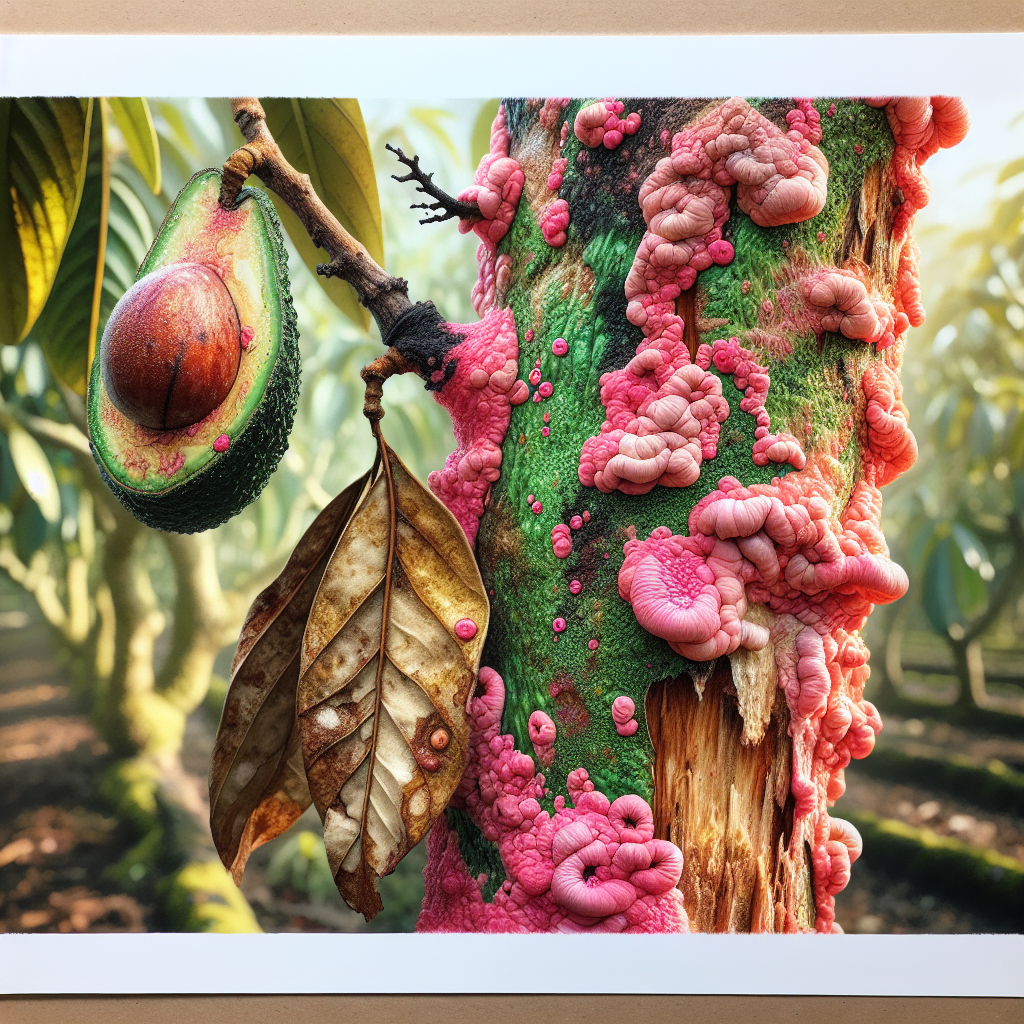
Definitive Diagnostic and Management Guide for Pink Disease
Introduction to Pink Disease
Pink Disease, scientifically known as Erythricium salmonicolor infection, is a fungal pathology that strikes fear into the hearts of tropical and subtropical growers. First identified in the early 20th century in Queensland, Australia, on citrus trees, this disease has since spread globally, devastating orchards of avocado, mango, and other high-value perennials. The fungus colonizes the bark, producing distinctive pinkish spore masses that give the disease its name, leading to girdling, dieback, and ultimately tree mortality if unchecked.
What makes Pink Disease particularly insidious is its ability to infect healthy trees silently before overt symptoms appear. Spores germinate in moist cracks and wounds, spreading through humid air currents and rain splash. In commercial settings, losses can exceed 30-50% in unmanaged groves, especially during prolonged rainy seasons. This guide equips farmers, orchardists, and agronomists with professional-grade diagnostics, organic management strategies, and prevention tactics to safeguard yields. Early detection is key—scout regularly for pink crusts on branches, particularly in shaded, humid microclimates. For small farms struggling with disease identification, tools like AI-powered plant diagnostics can accelerate accurate spotting (Why Misidentifying Plants Costs Small Farms Thousands - And How AI Camera Diagnosis Fixes It Fast).
Understanding Pink Disease's biology empowers proactive defense. The pathogen overwinters in dead wood, releasing billions of basidiospores during wet weather. Unlike many foliar diseases, it targets woody tissues, making recovery challenging. Integrated approaches combining sanitation, biological controls, and resistant rootstocks offer the best long-term control. This comprehensive resource draws from decades of field research across Asia, Australia, and the Americas, providing actionable steps tailored for organic and conventional systems alike.
Identifying Symptoms & Damage
Diagnosing Pink Disease requires keen observation of its hallmark signs, starting with small, pinkish-white mycelial crusts on bark surfaces. These crusts, often 1-5 mm thick, appear on twigs, branches, and trunks, particularly in fork crotches or pruning wounds. As the fungus advances, the infected bark develops a characteristic salmon-pink hue from dense spore production, accompanied by a faint mushroomy odor. Dead bark peels away in strips, revealing girdled, blackened cambium underneath— a classic diagnostic marker.
Early symptoms mimic other issues: yellowing leaves, sparse canopy, and twig dieback. Distinguish Pink Disease from Phytophthora root rot by the absence of root symptoms and presence of pink crusts; unlike anthracnose, it doesn't produce fruiting bodies on leaves. Advanced infection causes branch cankers, epicormic shoots, and profuse gumming in some species like citrus. Yield impacts are severe—up to 70% fruit drop in heavily infested Hass Avocado trees due to vascular blockage.
Damage assessment involves scoring branches: 1 (minor pink spots), 2 (crusts <10% girdle), 3 (partial girdle with dieback), 4 (full girdle, branch death). Use a pocket knife to scrape bark; healthy tissue is firm and green, infected is soft and pink-threaded. In mango orchards, look for weeping lesions on limbs. Photos under magnification reveal basidia—club-shaped spore producers. Misdiagnosis with sooty mold is common; Pink Disease lacks the black, honeydew association. Regular scouting post-rainfall, especially at dawn when crusts glisten, ensures timely intervention. Economic thresholds: prune if >20% branch coverage.
Lifecycle and Progression of Pink Disease
Erythricium salmonicolor follows a polycyclic lifecycle optimized for humid tropics. The fungus persists as mycelium in dead wood, reactivating during wet seasons (temp 20-30°C, RH >90%). Basidiospores (5-8 μm, hyaline) eject from pink crusts, dispersing via wind up to 50m or rain splash. Germination occurs within 6-12 hours on moist bark wounds, penetrating via lenticels or cracks.
Colonization phase (1-4 weeks): Mycelium ramifies inter- and intra-cellularly, killing cambium. Crust formation follows (2-6 weeks), signaling sporulation. Progression accelerates in shaded crowns; a single branch lesion can girdle a 5cm limb in 3 months. Secondary cycles repeat 4-6 times per rainy season, amplifying spread. Overwinter survival relies on stromata in bark fissures.
Tree response varies: susceptible Fuerte Avocado shows rapid dieback, while tolerant varieties compartmentalize via tyloses. Full tree decline spans 1-3 years untreated, with mortality rates 10-40%. Lifecycle interruption targets spore germination—dry pruning in dry seasons disrupts cycles. Understanding this progression underscores sanitation's primacy: remove infected wood before crust maturation.
Environmental Triggers & Risk Factors
Pink Disease epidemics hinge on high humidity (>85% RH), temperatures 22-28°C, and prolonged leaf wetness (>12 hours). Tropical lowlands (sea level-800m) suffer most, with peaks during monsoons or post-typhoon. Poor air circulation in dense canopies, overhead irrigation, and mechanical wounds (pruning, machinery) are prime triggers. Soil factors like waterlogging exacerbate via weakened roots, mimicking root rot synergy.
Risk factors include monoculture orchards, susceptible scions on vulnerable rootstocks, and excessive nitrogen favoring succulent growth. High planting density (>400 trees/ha) traps moisture, boosting spore deposition 3x. Recent transplants stress-prone, infection rates doubling first year. Climate change intensifies risks—erratic rains extend spore viability. In banana belts, overlap with Sigatoka heightens vulnerability. Mitigation: site selection on slopes, windbreaks for circulation, deficit irrigation during wet spells.
Organic Control & Treatment Plans
Organic management emphasizes prevention, but active outbreaks demand integrated tactics. Sanitation first: Prune infected branches 30cm below visible crusts during dry periods, removing >95% debris. Burn or deep-bury prunings; chipping spreads spores. Biologicals: Apply Trichoderma spp. (e.g., T. harzianum at 10^9 CFU/L) to wounds post-pruning—colonizes bark, outcompeting E. salmonicolor (80% efficacy in trials). Bacillus subtilis sprays (QST 713 strain) suppress sporulation via antibiosis.
Biopesticides: Neem oil (azadirachtin 0.03%) + potassium bicarbonate (2%) foliar sprays every 14 days during high risk—disrupts spore germination 70%. Copper octanoate (organic-approved, 10-20 ppm) for curative dips on cuttings. Cultural: Improve canopy airflow via selective thinning (20% reduction), avoid summer pruning. Wound dressings with lime sulfur seal entry points.
Treatment timeline: Week 1—scout/prune; Week 2—biofungicide drench; Weeks 3-8—biweekly sprays. Monitor with sticky traps for spore loads. In severe mango cases, trunk injections of phosphorous acid (organic-exempt) boost defenses. Rotate modes to avert resistance. Success metrics: <5% reinfection Year 2. Pair with companion planting like marigold for biodiversity.
Preventing Pink Disease in the Future
Long-term prevention builds resilient orchards. Select resistant varieties: Hass Avocado outperforms Fuerte; graft onto tolerant rootstocks like Mexican seedling. Establish new plantings at 6x6m spacing for airflow. Pre-plant soil solarization (6 weeks summer) reduces inoculum 90%. Annual dry-season sanitation removes 85% sources.
Routine practices: Copper pre-wet season sprays (3x at 2-week intervals), micronutrient foliairs (Zn, Mn) for vigor. Monitor via apps integrating weather data—spray at RH>90% forecasts. Quarantine new stock 6 months. Intercrop with thyme or yarrow—antifungal volatiles deter spores. For small farms, AI weather hyper-local forecasts prevent outbreaks (Why 80% of Small Farms Battle Weather Disasters - And How Hyper-Local AI Forecasts Can Save Your Harvest). Cover crops like clover stabilize soil moisture. Scout grids (1/tree/month wet season), threshold prune at 5% incidence. These yield 25-40% healthier trees.
Crops Most Affected by Pink Disease
Pink Disease ravages tropical perennials, topping the list with avocado (40% global reports), followed by mango (25%), citrus (15%), and lychee. Hass Avocado suffers most, with branch dieback slashing yields 50%. Kulfi Mango shows high susceptibility in India, lesions girdling flowering branches. Citrus like navel orange exhibit gummosis-like symptoms, while cacao faces pod and branch losses. Banana pseudostems occasionally infected, compounding black Sigatoka. Lesser hosts: guava, rambutan, longan. Temperate crops rarely affected. Regional hotspots: Queensland (avocado), Kerala (mango), Florida (citrus). Prioritize vigilance in these.